
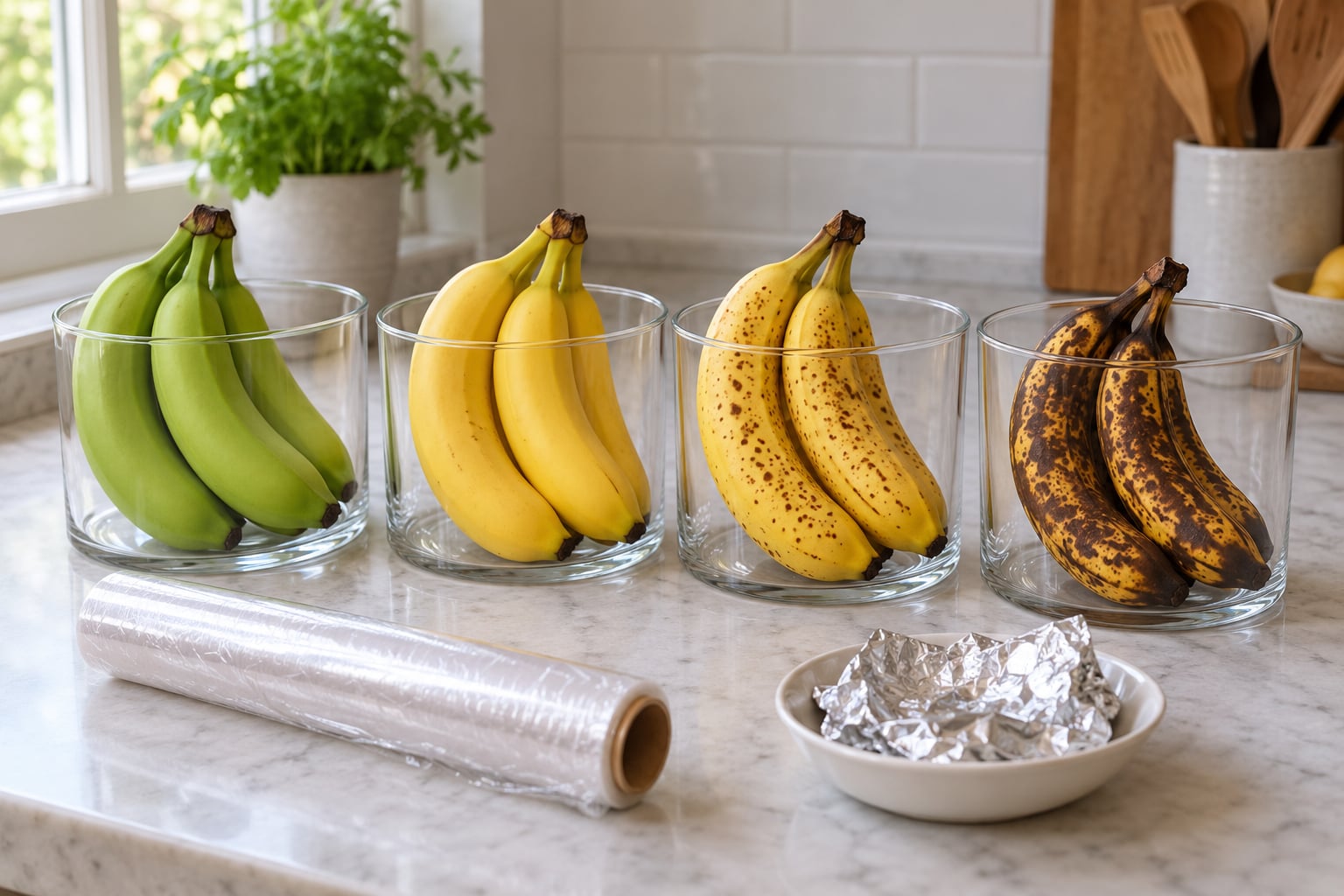
To store bananas to slow ripening, wrap the first 2-3 inches of each stem in plastic wrap or foil so the ethylene gas they release stays trapped, then keep the fruit cool, out of sunlight and separated from other ripe produce. Bananas stay firm roughly 3-7 days at a 20°C kitchen counter, and most households lose half a bunch to the compost bin before they notice this one habit.
That is the whole trick in two sentences, and everything below is the detail: what to use, the order to do it in, how to adjust for green versus ready-to-eat fruit, and which well-meaning habits actually backfire. Updated for 2026, this is the same routine I use on a weekly grocery run, where a bunch of six almost never gets finished before it turns to mush.
Table of Contents
- What You Need to Store Bananas to Slow Ripening
- Step-by-Step
- Common Mistakes That Make Bananas Ripen Faster
- Frequently Asked Questions
- How long do bananas last when stored at room temperature?
- Should bananas be kept in a sealed plastic bag?
- Do individual banana stem wraps really slow ripening?
- Why do banana peels turn black in the refrigerator?
- How can I tell whether a banana is still good to eat?
- What is the best use for bananas that ripen too quickly?
What You Need to Store Bananas to Slow Ripening
The good news is that none of this needs a gadget or a spend. You probably already own the one item that matters.
- A fruit bowl or a hanging basket for unripe bananas. A bowl on the counter is fine, and a hook under a cabinet is better because it stops the fruit pressing against itself.
- A loose paper bag when you want controlled ripening, either faster or slower, rather than the usual open-counter drift.
- Plastic wrap, aluminum foil or plain paper strips for wrapping individual stems. Plastic wrap is the most reliable, foil is nearly as good, and a strip of unprinted paper works when you want something reusable.
- An airtight container or a freezer bag for bananas that will not be eaten within a few days, plus a lemon or lime for the peeled-and-cut ones. The same airtight thinking applies to roots you keep in the fridge, so our guide to how to store fresh ginger so it lasts is worth a skim if you buy ginger alongside your fruit.
You also want a little counter space that is away from the stove, the dish rack and any window. Heat and humidity speed everything up, and a bowl parked next to the toaster oven is the banana equivalent of leaving a car in the sun.
Step-by-Step
Step 1: Separate Green Bananas by Ripeness
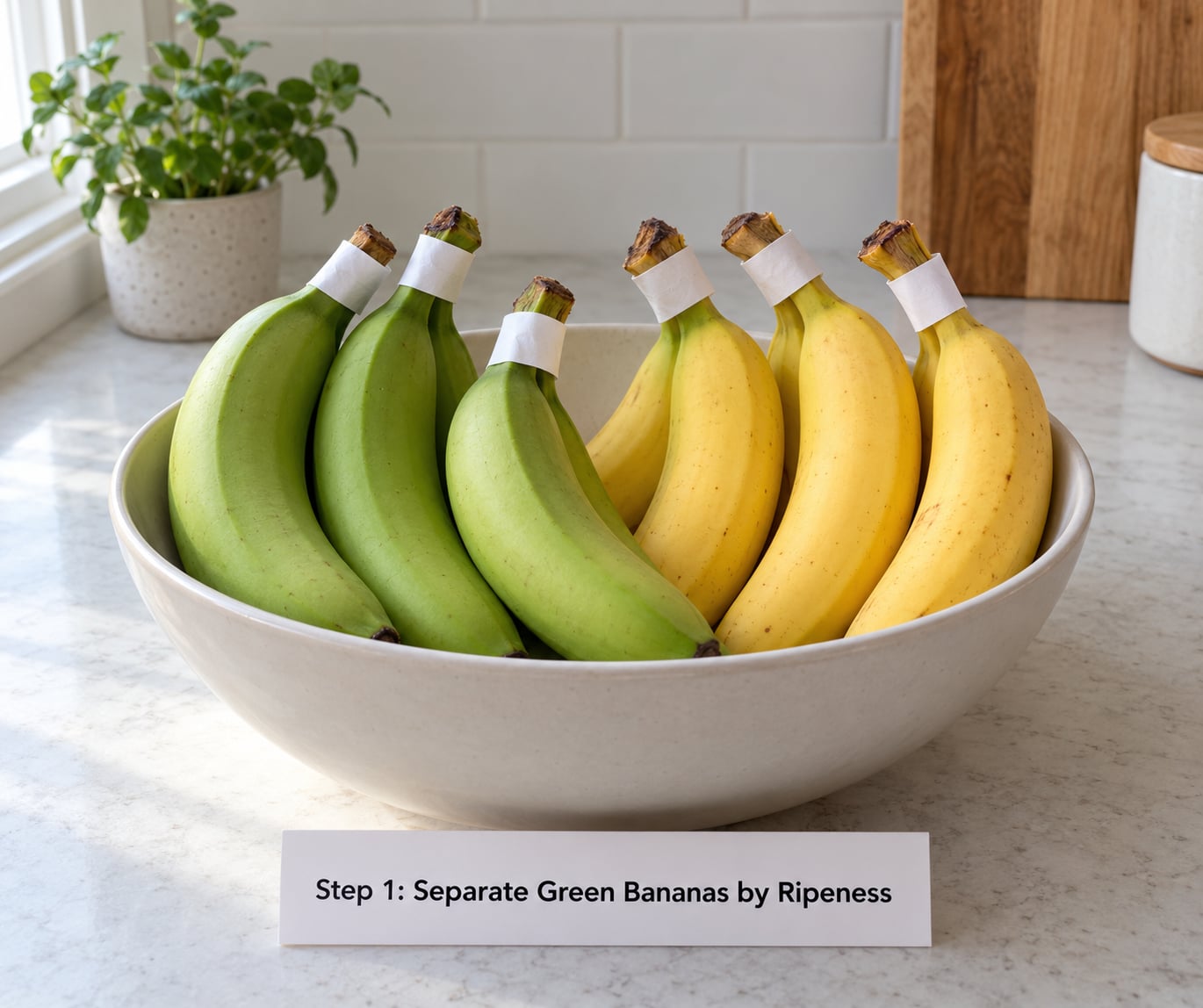
The first thing to do when you get bananas home is break the bunch apart and sort it. Anything already yellow goes on one side, anything still green goes on the other, and you leave the two groups in separate spots until the green ones catch up.
Splitting the bunch is the single most useful habit here. Fruit that touches other fruit develops pressure points and bruises, and a bruise turns brown days early and pulls the neighbours along with it. Households that eat about one banana a day can skip a bowl entirely and stand the fruit upright in a jar or cup, stems down, which also keeps the tops from touching the counter.
How you know it worked: the two groups stay visibly different for several days instead of the whole bunch turning yellow in a single afternoon. If you have almost no counter space, an open paper bag on a high shelf beats a crowded bowl in a hot kitchen every time.
Step 2: Wrap the First 2-3 Inches of Each Stem
This is the part that makes people skeptical, and the mechanism explains why. Bananas are climacteric fruit, which means they keep ripening after harvest, and they do it by releasing ethylene gas, a natural plant hormone. Most of that gas escapes upward through the stem, so sealing the crown slows the signal that tells the rest of the fruit to turn.
Wrap the top 2-3 inches of each individual stem rather than wrapping the whole crown as one lump. Individual wraps are better because a sealed bunch traps gas around every banana at once. Twist plastic wrap around the stem until it grips, or use a short strip of aluminum foil and fold it closed; both work about as well, and plastic wrap tends to win if you have some on hand.
You do not need to be surgical about it. Cut the whole stalk off the top of the bunch and most of that gas path is severed, which is why the de-stemmed bananas in a bag last noticeably longer than an intact crown.
How you know it worked: the bananas you were hoping to save are still green and firm when the unwrapped ones beside them have gone speckled. Expect a few extra days rather than extra weeks, and if somebody promises you a month, treat that as an anecdote.
Step 3: Keep Bananas Cool, Airy and Away from Other Fruit
Coolth is the second lever, and it is free too. Around 54°F is close to ideal for keeping bananas firm; a typical kitchen sitting near 20°C will give you 3-7 days from a green bunch, and a cooler cupboard or garage shelf stretches that. What you want to avoid is a spot that is warm, humid or in direct sun, because ripening chemistry speeds up with heat and moisture.
Air circulation matters just as much as temperature. That is the case for hanging the fruit on a hook or a banana hanger, not the traditional fruit bowl where the bunch rests on its own weight. Airflow carries ethylene away instead of letting it pool around the peel, and hanging removes the pressure points that cause the familiar green-top, brown-bottom banana.
Next, think about the neighbours. Apples, avocados, ripe pears, peaches, kiwis, tomatoes and melons all produce ethylene generously, and a bowl where bananas sit shoulder to shoulder with them will ripen in half the time. Keep about 2-3 feet of distance, or use a second bowl somewhere else on the counter.
The same gas works in both directions, which is the part most articles skip. Bananas are heavy ethylene producers, so keeping them next to sensitive produce shortens the life of nectarines, plums, peaches, cabbage, carrots, cucumbers and potatoes. If your kale or lettuce wilts within a day of a banana appearing in the crisper, that is the likely reason, and moving the fruit to the counter fixes it. Our piece on how to store leafy greens so they stay crisp covers the other half of that problem.
How you know it worked: the peel stays an even yellow-green with no brown shoulder on the bottom, and the fruit near the middle of the bowl is not days ahead of the fruit at the edge.
Step 4: How to Store Bananas to Slow Ripening by Stage
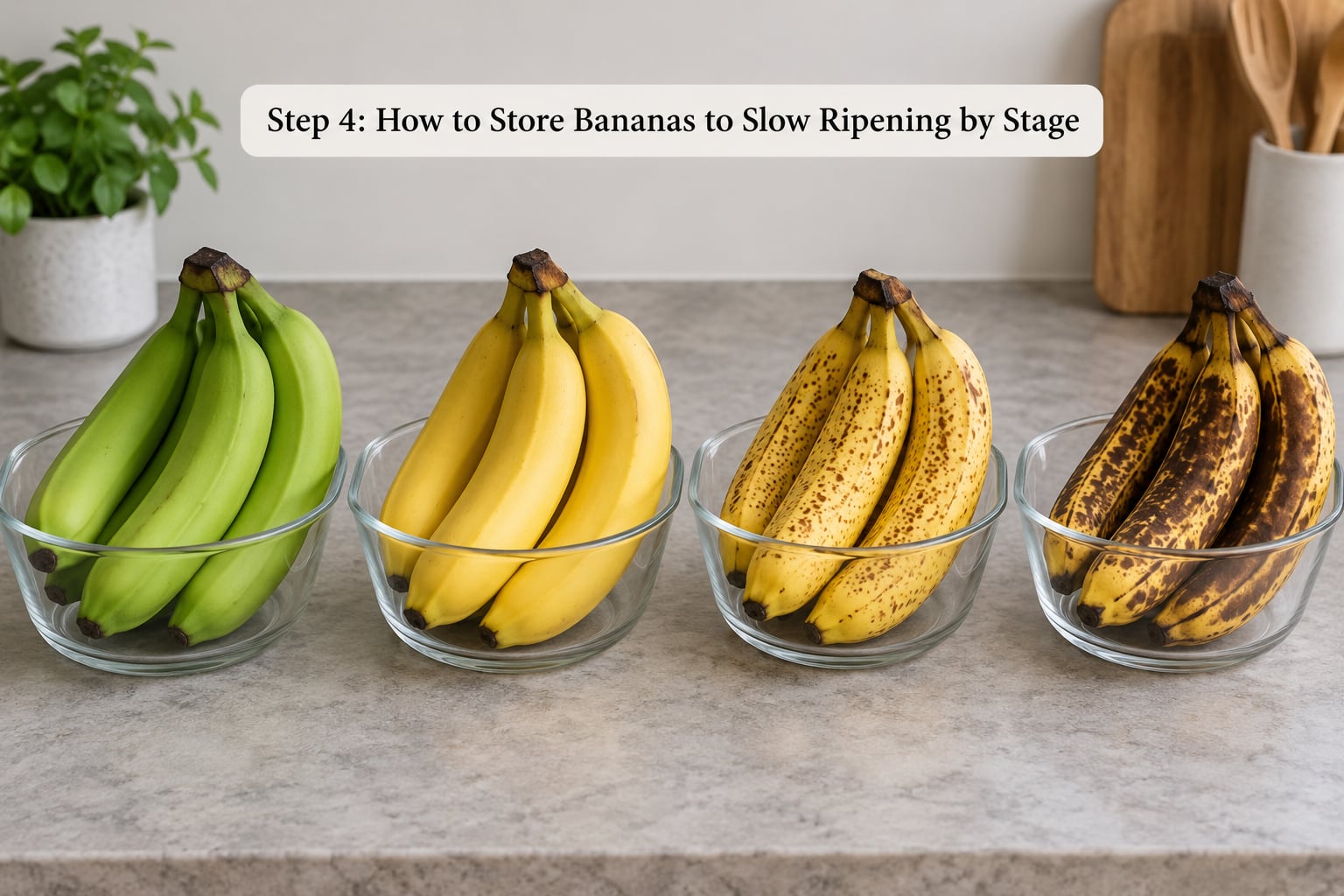
Once ripening is underway, the storage method changes. Here is what to do with each stage, and the reason behind each choice.
Green and firm. Leave them unpeeled on the counter or hanging, wrapped stems down, at room temperature. Do not refrigerate green bananas: chilling injury stops ripening, the fruit may never turn yellow properly, and you can end up with a green banana that stays green for a week. Keeping green fruit cold to slow it down is the most common mistake in this whole routine.
Yellowing with a few flecks. These are days from ready. Move them away from the green group, or move the green group away, so the fast fruit does not drag the slow fruit across the line with its ethylene.
Fully yellow and ready to eat. This is the moment to refrigerate. Chilled fruit releases far less ethylene, so ripening slows sharply, and a bunch refrigerated today often keeps another 4-6 days in good eating condition. The peel will turn dull grey and then black within a day or two, which looks alarming but says nothing about the flesh inside. Cold slows the peel chemistry far more than it slows the fruit.
Speckled and soft. Eat these first, and rotate them to the front of the bowl. If you are not going to get to them, peel and freeze them now: slice, spread on a tray, freeze until solid, then bag airtight. Frozen banana keeps around 8-12 months and is the best possible base for smoothies, oatmeal and banana bread.
Black peel, brown mush inside. Overripe fruit is not a food safety problem. The smell and texture are the real test, not the color, and if it smells fine and the flesh is not slimy it is good for baking, blending or a banana-peel tea.
When you want the opposite effect, a paper bag with an apple or a ripe pear inside speeds ripening noticeably, because the bag holds the gas around the fruit. A covered container is a bad idea when you are slowing things down and a good one when you are speeding them up, which is why sealed plastic confuses so many readers.
If you are dealing with peeled or cut banana, a thin brush of lemon or lime juice slows the browning caused by oxidation, and a short dip in one part vinegar to four parts water or a crushed vitamin C tablet dissolved in water works on the same principle. Neither lasts more than a few hours, so freezing is the reliable option for anything more than a day ahead.
One more note on freezing for later: thaw frozen banana in a bowl in the fridge, not on the counter, and expect the texture to be soft and slightly sticky. That texture is fine blended and fine in a loaf, which is why frozen fruit is reserved for baking rather than for eating straight out of the bag. The same single-layer freezing trick is the core of how to store summer berries so they last longer.
Common Mistakes That Make Bananas Ripen Faster
Crowding them in a mixed fruit bowl. Contact bruises the peel, and damaged tissue ripens and browns ahead of its neighbours. Give every banana its own space, or hang the bunch.
Sealing them in a plastic bag. A closed Ziploc traps ethylene and moisture in the smallest possible volume, so bananas stored that way ripen faster than bananas left in the open. A bag is only useful for the opposite job, speeding ripening alongside an apple.
Leaving them next to ethylene-producing fruit. Bananas spoil the sensitive produce as well, so this is a two-way problem, not a one-way one.
Refrigerating green bananas. You will get firmness and dull color instead of usable fruit. Chill them only once the peel is fully yellow.
Washing them before storage. Moisture on the skin encourages mold, and the bloom on an unwashed peel is part of what protects it. Wash just before eating, not before storing.
Treating a black peel as spoilage. Black skin after refrigeration is a cosmetic reaction, and a dark peel on a countertop banana usually means the flesh is sweeter and softer, not bad. Press it, smell it, and only discard if the texture is slimy or the smell is fermented.
Three habits fix most waste. Check the fruit every couple of days and move ripe bananas back into the refrigerator, which turns storage into a rotation system instead of a single decision. Buy slightly greener fruit than you think you need, since a bunch with a little green at the top will still be yellow when you get home. And keep soft bananas front and center, because fruit you actually eat is the only kind that was not wasted.
Frequently Asked Questions
How long do bananas last when stored at room temperature?
An unripe bunch usually lasts 3-7 days on a kitchen counter near 20 degrees Celsius, and a fully yellow bunch gives you about 2-4 days before it gets soft and speckled. Wrapping the stems and keeping the fruit away from other ripe produce adds a few days, not weeks. Cooler, darker spots stretch the window further, and a hot spot next to the stove shortens it noticeably.
Should bananas be kept in a sealed plastic bag?
No, not if your goal is to slow ripening. A sealed bag traps the ethylene gas the fruit releases and keeps moisture against the peel, so bananas ripen faster and the skins wrinkle. A paper bag left open at the top is the better option because air moves through it. A closed bag is useful only when you deliberately want ripening to speed up, ideally with an apple or ripe pear inside.
Do individual banana stem wraps really slow ripening?
They do, and the reason is mechanical. A ripe banana pushes most of its ethylene gas out through the stem, so sealing the top 2-3 inches of each stem slows the signal reaching the flesh. Wrapping each stem separately works better than wrapping one sealed bunch, and a few days of extra life is a realistic expectation. The viral claims about lasting a month are individual anecdotes, not a general result.
Why do banana peels turn black in the refrigerator?
Banana peels are damaged by cold, so chill injury darkens the skin within a day or two of refrigeration. The flesh underneath is unaffected and often stays firm for several more days, which is why refrigerating a fully yellow bunch is the single best way to buy time. If the peel is black but the inside smells normal and feels firm, the fruit is still good to eat.
How can I tell whether a banana is still good to eat?
Look at the flesh, not the peel. Open it and check that the inside is pale, firm and free of slimy texture, and smell it: fresh banana is mild and sweet, while spoiled fruit smells fermented or musty. Dark specks on a yellow peel usually mean peak eating quality. Greyish skin from the freezer is frost damage, and a mushy interior with a strong odor is genuine spoilage worth discarding.
What is the best use for bananas that ripen too quickly?
Peel them and freeze them. Slice or mash, spread on a tray, freeze until solid, then move the pieces into an airtight container or freezer bag, where they keep for 8-12 months. Frozen banana works best blended into smoothies, stirred into oatmeal, or baked into banana bread, muffins and pancakes, where extra sweetness is an advantage. Save the peels for compost or a cup of banana-peel tea.
Do one thing first: when you get the bunch home, split it and put the green bananas in a separate spot with their stems wrapped, the yellow ones in the fridge, and leave the two groups alone. Check back in two or three days and repeat the rotation, and the pile of brown bananas on your counter turns into two or three that you actually eat.