

A food and symptom journal is a dated record of everything you eat and drink, kept next to every symptom you notice and the time it started. To keep one well, you need three things: honest entries, accurate times, and a weekly hour spent reading them back. Ten minutes a day is usually enough, and most people have their first usable pattern after two to three weeks.
That last part is where beginners get discouraged. They log for four days, find nothing, and quit. A journal is not a diagnosis, and it is not a way to diagnose a food intolerance on your own; it is organized evidence you can bring to a doctor or registered dietitian. This guide is about keeping the record well enough that the evidence is worth reading.
Table of Contents
What You Need

You need four things, and none of them are expensive or complicated. Anything more elaborate than this tends to collapse in week two.
- One notebook or a dedicated notes file used for nothing else. Mixing it into a general notebook means half your entries go missing.
- A pen, or a notes app that works with one hand. Speed matters more than neatness. If logging takes more than thirty seconds, you will stop.
- A reliable clock or phone for timestamps. This is the single field people skip and then wish they had.
- Short labels for symptoms, so you use the same word every time. Bloating, cramping, nausea, urgency, heartburn, hives.
Optional extras earn their place only after a week of steady entries: a small calendar for spotting patterns across months, a photo habit for meals you cook from scratch, and a second notebook for sleep, stress and medications. That second notebook is the idea that came up repeatedly in the r/dysautonomia community, where people found it easier to keep a symptom-only log alongside a separate food, medication and activity log. Two smaller books are easier to maintain than one crowded one.
On format, paper beats apps for speed and privacy, and apps beat paper for sorting. Most people do fine with whatever they will actually fill in.
| Format | Best for | Strengths | Tradeoffs |
|---|---|---|---|
| Paper notebook | People who eat irregularly or log on the go | Fast, private, no battery, works with a pen in fifteen seconds | Slow to review later; no automatic sorting |
| Phone notes app | One person, one phone, quick lookback | Searchable, timestamped automatically, always in your pocket | Scrolling a wall of text after three weeks is unpleasant |
| Spreadsheet | People who plan to share data or print reports | Sortable, filterable, easy to summarize a week | Setup takes an afternoon; harder to update mid-meal |
| Dedicated food and symptom app | Longer tracking runs and report export | Pre-set symptom categories, reminders, PDF or CSV reports for an appointment | Most store your health data on someone else’s server |
Whichever you pick, the tools share a limitation worth knowing early. Every app stores the data well. None of them interpret it for you. The connection between a Tuesday dinner and Thursday morning discomfort still gets made by you, in the review.
How to Keep a Food and Symptom Journal: Step-by-Step
Here is the process that works. It takes about two to six weeks, and each step feeds the next.
1. Define What You Want to Track
Start with one question, written down, before you open the notebook. Most people pick something like: does a recurring bloating episode follow meals containing a certain ingredient, or does the same food leave me fine one day and unwell the next?
That second question is the honest one. People on r/ibs describe exactly that problem: eating a food and feeling fine, then eating the same food on another occasion and having a flare-up. If that is your situation, your goal is not to name a forbidden food. It is to gather enough repeated observations that a professional can work out whether a pattern exists at all.
Keep the goal observational. If you write down a conclusion in advance, you will bend the data to match it.
2. Create a Simple Daily Template
Copy this structure and use it the same way every day. Consistency is worth more than detail, because a field you fill in on day one and skip on day nine tells you nothing.
| Field | What to write | Example |
|---|---|---|
| Date and time | Clock time, not just morning or evening | Tuesday 12:40 pm |
| Food and drink | Ingredient list, not just the dish name; brand where it varies | Chicken, rice, olive oil, broccoli; water |
| Preparation | Raw, cooked, fried, reheated, and roughly how much | Cooked, one cup cooked rice |
| Symptom | Your fixed label words | Bloating, cramping |
| Severity | Zero to ten, or a four-point scale | 5 of 10 |
| Duration | When it started and when it eased | Started 6:15 pm, eased by 9 pm |
| Context | Sleep, stress, activity, meds, illness, cycle | Slept 5 hours, high stress day |
Print it, or build it once in your notes app and duplicate the block daily. If you want to get better at reading labels while you are at it, our guide to how to read an ingredient list on a food package is worth a read before you start logging packaged items.
3. Record Foods, Drinks, and Timing
Log everything, including the small things. The butter in the toast, the three cookies at 4 pm, the milk in the coffee, the sugar in the sauce. Triggers hide in exactly those entries, and people who omit them end up with a page that is technically accurate and practically useless.
Include beverages, snacks, condiments and supplements. Alcohol and caffeine count, and the timing of your last coffee can matter as much as a meal.
Write the time next to every item, not just at the top of the day. Symptoms often surface hours later, and a page with a single morning timestamp cannot tell you what actually preceded the problem. It also helps to note how a meal was prepared, since the same food cooked versus fried, or fresh versus reheated, can behave differently for some people.
When the same food appears five times in a week, the detail that saves you later is usually a brand or a preparation method. If you are also trying to eat more plants without much fuss, how to add greens to food without tasting them keeps the ingredient list short enough to log honestly.
Do not skip a meal because it seems obvious. Boring Tuesday toast is often the answer to why Thursday felt bad.
4. Describe Symptoms Clearly
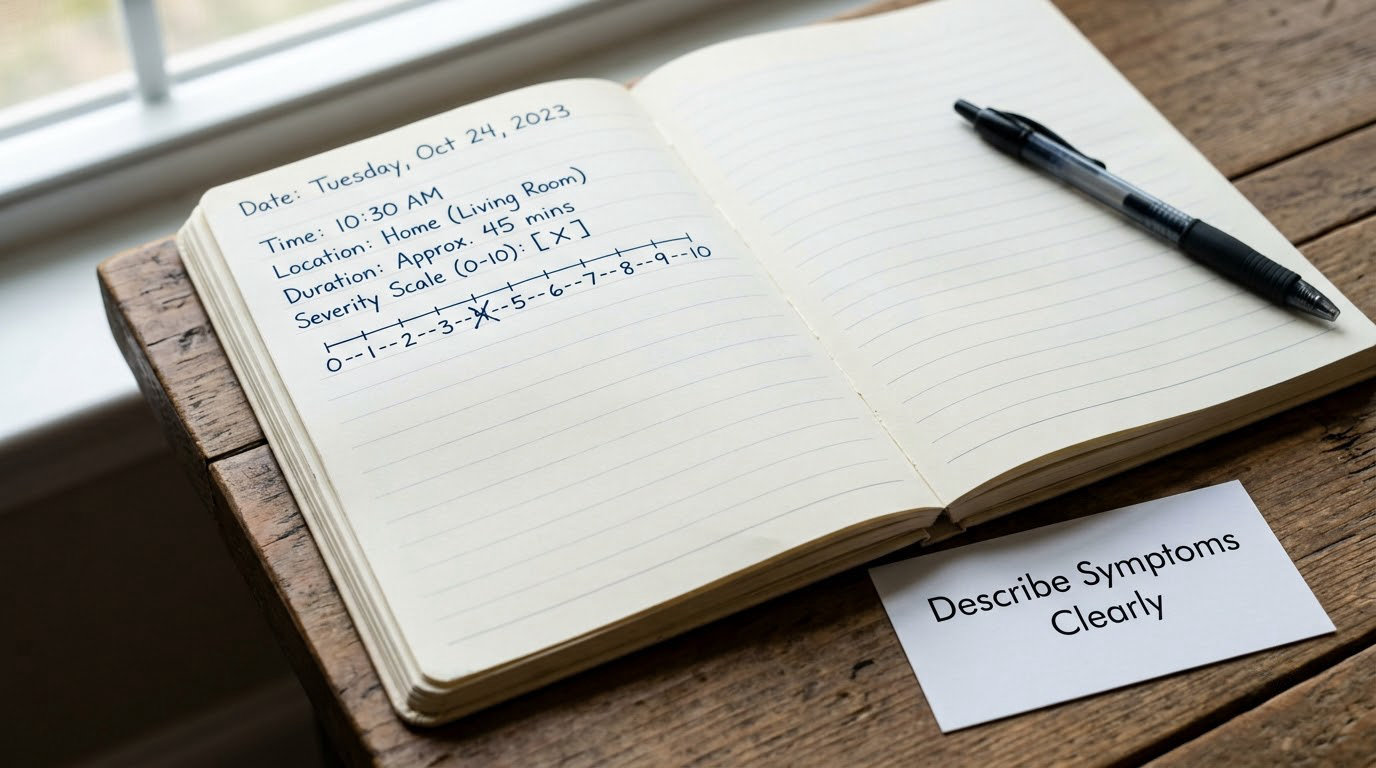
Write what you felt, where you felt it, when it started, how long it lasted, and what changed it. One sentence does it: mid-abdominal cramping, started 6:15 pm about three hours after lunch, five out of ten, eased after a walk and a glass of water.
A simple zero to ten scale is enough. Zero means nothing noticeable, ten means the worst you have had it. If numbers annoy you, use four words instead: none, mild, annoying, stopped-what-I-was-doing. Whichever you use, keep the same scale for the whole run, because a jump from a three-point scale to a ten-point scale in week three makes old entries unreadable.
Neutral words beat dramatic ones. “Bloating 4 out of 10” can be compared across weeks. “Felt like a balloon” cannot. If you dislike numbers, the Bristol Stool Scale is a well-known reference clinicians use for describing bowel movement consistency in a consistent way.
Write symptoms down when they start, not at bedtime. Memory of intensity is the first thing to go, and a batched evening entry turns into a vague summary of the day, which is the opposite of the point.
Seek medical care rather than logging if a symptom is severe, sudden, or persistent. Difficulty breathing, facial or throat swelling, vomiting that will not stop, blood in stool, chest pain, or a symptom that is getting worse over days are all reasons to contact a doctor or urgent care instead of opening the notebook. Nothing you write in a journal should delay care.
5. Add Context Without Overtracking
Food rarely acts alone. Poor sleep, a stressful day, a long run, a bout of illness, a new medication, an alcohol-heavy evening and the menstrual cycle all change how the body responds to the same meal. That is why context fields exist.
Track the context that answers your question and nothing more. If you are chasing bloating after lunch, sleep and stress matter more than step count. If your question is about blood sugar or energy, a rough stress rating and a note about caffeine usually suffice.
A hard rule from anyone with a chronic condition: log a change in medication or supplement, and log when it started. r/dysautonomia members emphasize that a new medication or supplement can change symptoms within days, and a journal that does not note the start date leaves you unable to explain a shift. Before you make any change to how you eat because of a symptom, check how to get more collagen from food and similar guides for what a food change actually involves, and talk to a professional first.
Do not turn context tracking into surveillance of yourself. If a field feels like fuel for self-criticism, cut it. A journal that makes you feel worse will not survive contact with a busy week.
6. Review Patterns Instead of Single Entries
Once a week, spend 30 to 60 minutes reading back. This is the step that separates a journal that works from a list of meals that does not.
First, mark every day where you recorded a symptom of four or higher. Then, for each marked day, look back at the previous 24 hours, and if nothing lines up, at 48 hours. This lookback window is the part almost every guide gets wrong. People blame the food from the meal that happened right before the symptom, but many reactions are delayed: an hour, a day, sometimes two. A registered dietitian writing about food intolerances described the classic version, where morning cereal gets blamed for symptoms that actually trace back to a peanut butter cookie eaten the night before.
Next, line up the foods that appear in the lookback windows of marked days against the foods that appear in the windows of unmarked days. The trigger candidate is the food that shows up before symptoms repeatedly and rarely before symptom-free days. One bad day is not a pattern. A food that precedes three or more separate episodes with a similar time gap is worth discussing with a clinician. The r/ibs reproducibility problem is exactly why: same food, different day, different outcome.
Also check the days with no symptoms at all. They are your control days, and skipping them is the most common way people convince themselves of something that is not there.
Note the gaps too. Entries missing times, missing portions, or missing symptom ratings are the reason a review comes up empty. Write down what was missing so week four is easier than week one.
A pattern is a clue, not a proof. Think of it as the question you bring to an appointment, not the answer.
7. Review and Share Selectively
Once a real pattern shows up, write a one-page summary: the suspected trigger, how many times symptoms followed it, the typical time gap, the severity range, and what else changed during those periods. One page is what a doctor or registered dietitian can actually use. A stack of twenty loose pages usually gets skimmed.
Bring it to an appointment and ask two questions: does this pattern mean anything clinically, and what should I do about it? If you are following an elimination or reintroduction protocol, note that the elimination phase typically runs two to four weeks before foods are reintroduced, with people on r/FODMAPS often reporting noticeable change within the first two to three weeks. Keeping the journal through both phases is what makes the result interpretable.
Two boundaries. Do not stop prescribed medication or treatment because a journal entry looks convincing, and do not cut out multiple food groups at once based on your own reading. Removing one food at a time, with a washout period and a planned reintroduction, is what makes a result meaningful and is the safer way to run it. If you are not sure where to start, a registered dietitian can build that structure for you.
Common Mistakes
Almost every failed journal fails the same way. Here are the seven I see most, and the fix for each.
Overcomplicating the system. Twelve columns, colour coding, a spreadsheet formula to track macros. Fix: cut back to the seven fields above and add only when a question demands it. A plain page gets filled; a beautiful system gets abandoned.
Writing too late. Entries reconstructed at bedtime have flattened times and softened severities, which destroys the analysis. Fix: log within fifteen minutes of eating, and log symptoms the moment they start.
Vague descriptions. “Felt bad today” cannot be compared with anything. Fix: symptom label, location, time, duration, severity. Two minutes of detail is the difference between data and noise.
Changing many habits at once. Starting a journal in the same week you quit dairy, gluten and caffeine means you will never know which change did what. Fix: change one variable at a time.
Treating correlation as proof. This is the big one. Fix: require repetition before you write a word about a trigger. Three or more episodes with a consistent time gap is a conversation starter, not a conclusion.
Forgetting drinks, snacks and portions. Fix: use the “anything that went in my mouth” rule, and write an approximate portion even when you are guessing. “About a cup” is fine.
Logging only the dramatic days. A journal of nothing but flare-ups creates a picture with no baseline. Fix: log every day, including the boring ones. Baseline days are what prove the pattern is real.
Three habits keep it going. Keep it to one page per week. Use checkboxes for routine items so writing stays light. And leave a sample filled-in row somewhere visible, because a blank form invites blank days while a filled example tells you exactly how little is enough.
If tracking food makes you anxious, fixates on numbers, or brings up difficult feelings about eating, pause the journal and talk to a professional. Logging should reduce uncertainty, not add it.
Frequently Asked Questions
What should I record in a food and symptom journal?
Record six things: the date and clock time, everything you ate and drank with approximate portions, how it was prepared, the symptom using the same label words each time, its severity and duration, and context such as sleep, stress, activity, illness, or medication changes. Timestamps and preparation details matter most, because a delayed reaction means the meal you suspect may not be the meal that caused it. Consistency in the same fields beats exhaustive detail.
How long should I keep a food and symptom journal?
Plan on two to six weeks, depending on how often symptoms appear. Most people notice obvious patterns after a week or two of steady logging, and community elimination protocols typically run two to four weeks before foods are reintroduced. Keep going past the first quiet stretch, because a single good week proves little without the baseline days recorded alongside it. Stop when a repeated pattern shows up or when you reach a professional for a structured plan.
Can a food and symptom journal diagnose a food intolerance?
No. A journal records observations; it does not diagnose food intolerance, food sensitivity or food allergy, which is a clinical distinction based on immune response and needs proper testing. What a journal does is show repetition: a food that precedes the same symptom three or more times with a consistent time gap. Take that pattern to a doctor or registered dietitian. It is a focused question, not a conclusion, and it is exactly the evidence they need to work from.
What should I do if a symptom feels severe or persistent?
Stop logging and get care. Seek urgent help for difficulty breathing, swelling of the face, lips or throat, chest pain, vomiting that will not stop, blood in stool, or any sudden severe pain. For symptoms that are persistent or worsening over days, contact your doctor rather than waiting for a pattern to appear. A journal is a record-keeping tool and never a substitute for evaluation, and no entry in it should delay care you need now.
Is a phone app better than a paper food journal?
Neither is better for everyone. Paper is faster to fill in mid-meal, stays private, and never runs out of battery. An app timestamps entries automatically, offers pre-set symptom categories, and can export a PDF or CSV report that is much easier to hand to a doctor. A spreadsheet sits in between and sorts well. The deciding factor is which one you will still be using in week four, since an incomplete diary that gets reviewed is worth more than a perfect system you abandon.
If you want one thing to do today, set up the seven fields above, write down the single question you are trying to answer, and log your next three meals with clock times. Give it two weeks of honest entries and one weekly review, and when the repeated pattern appears, take a one-page summary to an appointment instead of guessing on your own. That is how to keep a food and symptom journal in a way that actually answers something.