
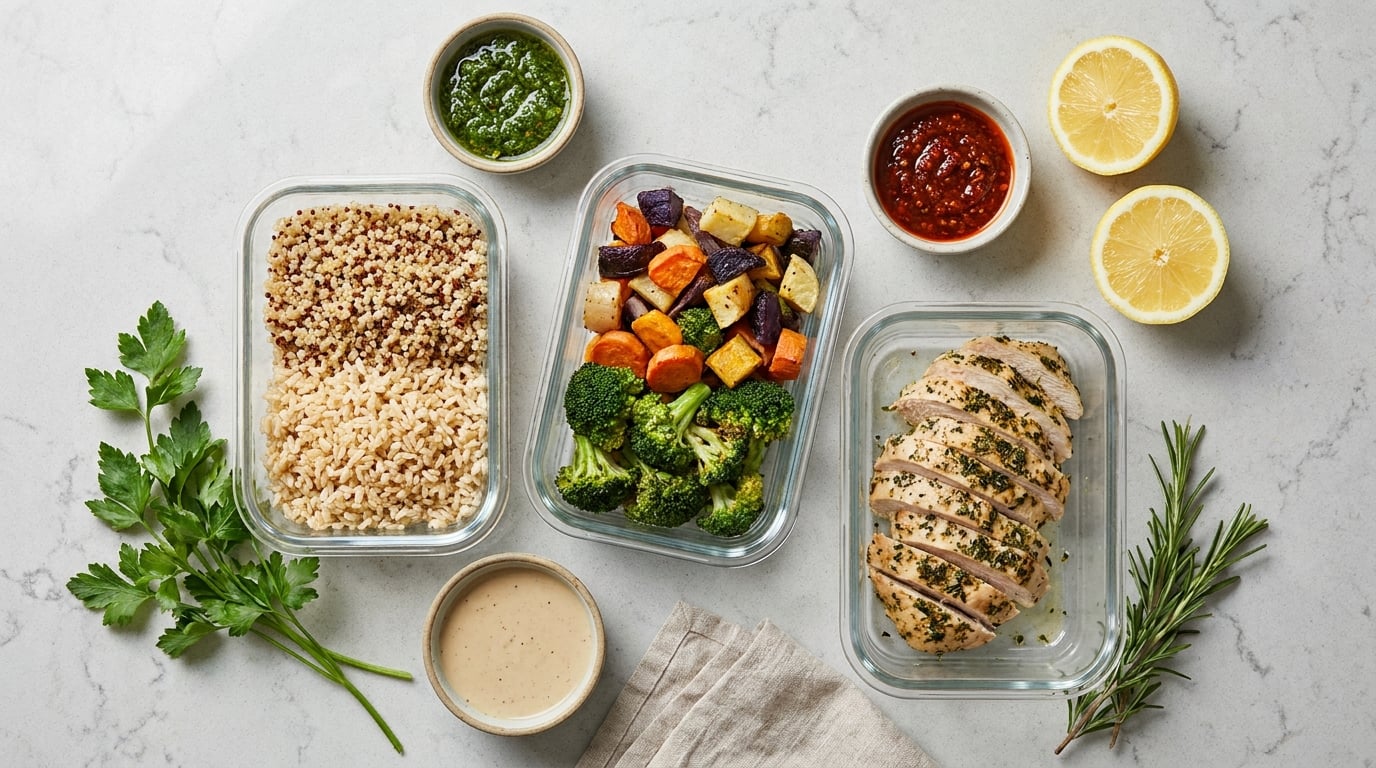
Batch cooking without getting bored comes down to one rule: cook the base in bulk, then change the paint. Instead of seven identical containers of the same finished meal, you cook a protein, a grain and vegetables once, store them separately, and combine them with a different sauce, seasoning or fresh add-in each night. If you follow that approach, learning how to batch cook for the week without getting bored takes about 60 to 90 minutes on a Sunday, works for beginners, and turns into five to seven meals that never taste quite the same.
The reason most meal prep collapses by Wednesday is rarely the cooking. It’s the packaging. When seven finished meals go into seven identical boxes, you have made one meal seven times, and your brain treats that as repetition even though the ingredients are new. Keeping components separate is the small structural change that fixes it.
Table of Contents
- What You Need
- Step-by-Step: How to Batch Cook for the Week Without Getting Bored
- Common Mistakes
- Frequently Asked Questions
- How long should batch-cooked meals last in the refrigerator?
- Can I freeze batch-cooked meals for the week?
- How many meals should I batch cook for one person?
- What foods should I avoid freezing?
- How can I stop batch-cooked meals from tasting boring?
- Should I cook every ingredient from scratch before meal prepping?
- Conclusion
What You Need
You don’t need much equipment, and buying a shelf full of single-purpose gadgets rarely fixes the boredom problem. What helps is storage that keeps components separate and a plan that gives you more than one thing to eat on any given night.
- Two sheet pans for roasting vegetables and protein at the same time, which turns a lot of oven time into one session.
- One large pot plus a rice cooker if you have one, for grains and legumes cooking while the oven runs.
- Airtight containers in two or three sizes, so you can keep a single grain portion and a two-serving portion without improvising.
- Masking tape or a label maker plus a pen, to mark each container with the contents and the date it was cooked.
- A food thermometer, which is the cheapest way to stop guessing when chicken, ground meat or leftovers are done.
- Measuring spoons and a set of small jars for sauces, so a scoop of dressing does not end up as a quarter of a jar.
For ingredients, aim for two proteins, two grains, three or four vegetables, and enough sauces and toppings for four different flavour profiles. Good batch-cook staples include chicken thighs or breast, ground meat, tofu, tempeh, lentils, chickpeas, rice, quinoa, sweet potato, broccoli, peppers and green beans. Frozen vegetables and microwave rice are legitimate shortcuts when your Sunday is already full.
Match the scope to your week. One person cooking alone needs far less volume than a family of four, and a small freezer means fewer containers and more repeated ingredients. Pick a level you can cook without rushing, because rushed batch food is usually the batch food people abandon.
Step-by-Step: How to Batch Cook for the Week Without Getting Bored
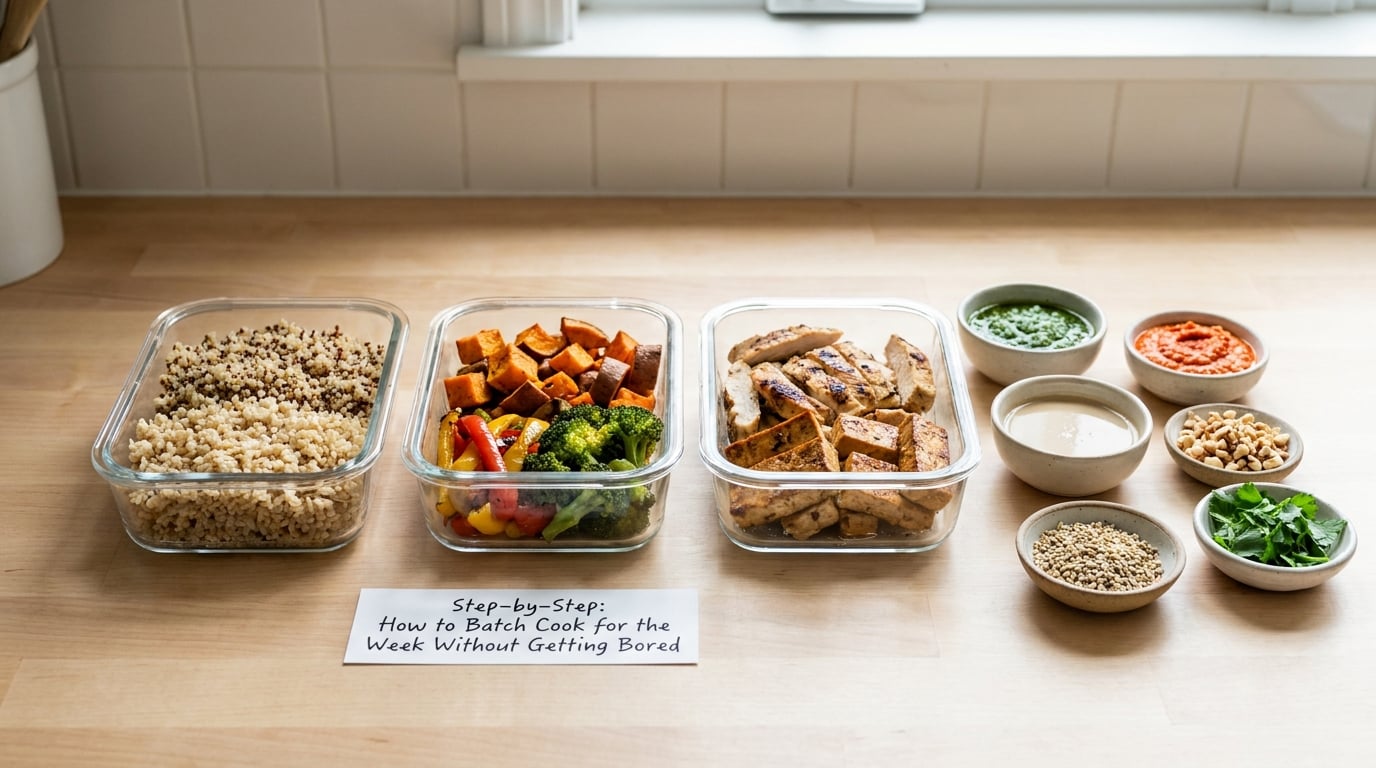
Follow these seven steps in order on one prep day. The active work runs about 60 to 90 minutes once the oven and stove are going, and each step has a simple sign that it worked.
Step 1: Plan a Flexible Batch-Cooking Menu
Plan two dependable bases rather than five finished meals. A base is a protein, a grain or starchy vegetable, and a vegetable, all cooked and stored on their own. Once those are ready, any night becomes a choice instead of a leftover.
Write your components on paper before you shop, then check what you already have. The easiest weekly plan looks like this:
| Day | Base components | Flavour added at eating time |
|---|---|---|
| Monday | Chicken, rice, roasted broccoli | Bright herb sauce, lemon, toasted seeds |
| Tuesday | Chickpeas, quinoa, roasted peppers | Salsa verde, avocado, pickled onion |
| Wednesday | Chicken, sweet potato, green beans | Sesame-ginger dressing, chilli, cucumber |
| Thursday | Lentils, quinoa, roasted broccoli | Roasted garlic tahini, crisp garlic, herbs |
| Friday | Tofu, rice, roasted peppers | Peanut or chilli-lime dressing, fresh herbs |
You’ll notice every day uses the same handful of components. Only the sauce and the serving style change, which is the whole trick. If a plan needs fifteen unfamiliar ingredients, it isn’t a batch plan, it’s a cooking project.
Step 2: Cook the Base Components
Start the oven and the grain pot first, since they run while you chop. Roast vegetables on one sheet pan and the protein on another with different seasoning, so nothing bleeds into anything else. You’ll know a component is done when the vegetables have browned edges and the protein has hit its safe internal temperature.
Those temperatures are the part worth memorising: poultry to 165°F, ground meat to 160°F, and whole cuts or fish to 145°F. Check the thickest part with your thermometer, not the edge.
Cook grains in a slightly larger water ratio than usual and stop them a couple of minutes early. They’ll finish on residual heat and stay separate instead of turning to mush in the container. Same with pasta, if you use it: pull it a minute early and rinse briefly so it holds its texture.
For the protein, roast at a higher temperature and slice or cube it after it cools a few minutes. Cutting too early juices it out and the pieces dry out faster in the fridge. This step is where most prep day results are won or lost, so don’t rush the thermometer.
Step 3: Make Three or Four Flavour Builders
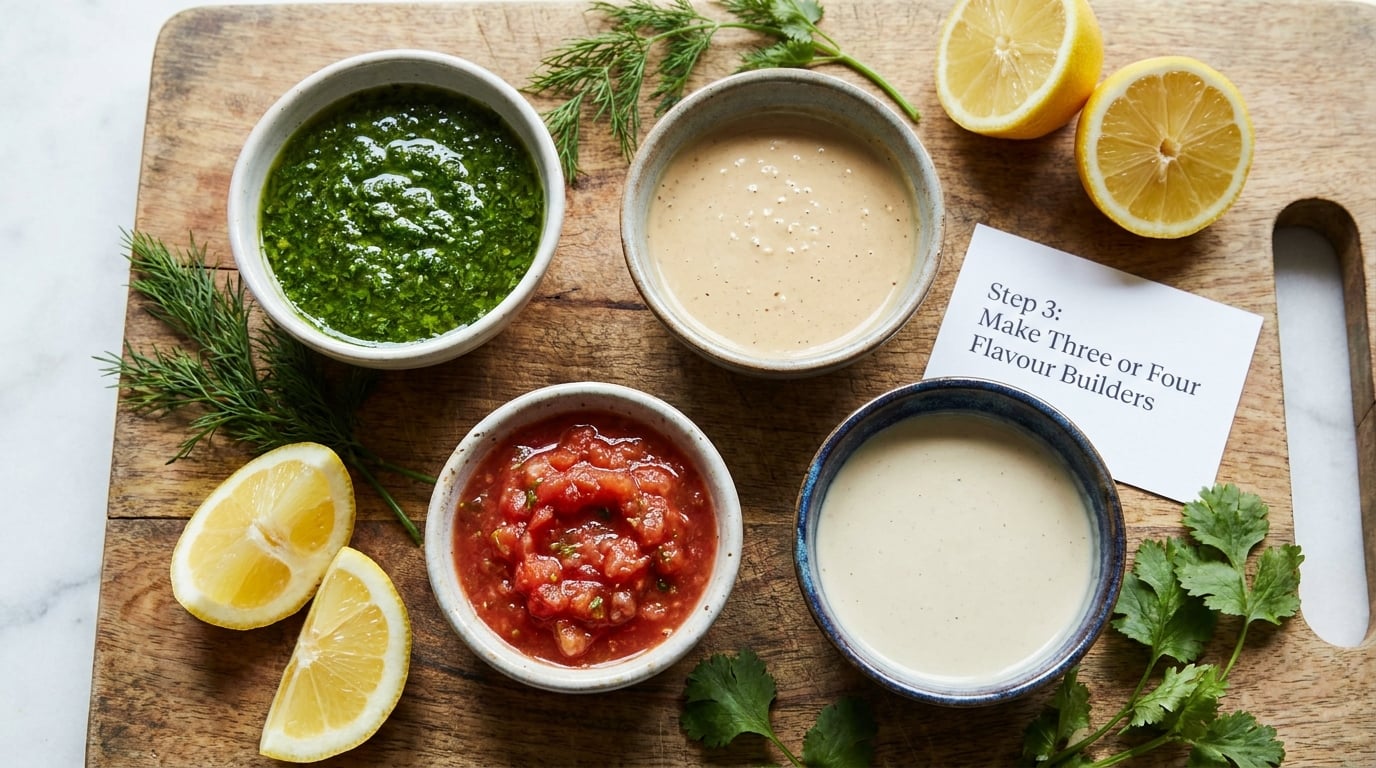
This is the step that answers how to stop batch-cooked meals from tasting boring. Sauces, dressings and toppings do the work that recipes can’t, because they change how the same base ingredients taste without adding cooking time.
Cover at least three of these categories on prep day:
- Bright — a herb sauce with parsley, yogurt or vinegar and lemon, or a simple salsa verde.
- Savory and deep — roasted garlic tahini, a soy-ginger marinade, or a warm salsa with cumin.
- Spicy — a chilli-lime relish, harissa-yogurt, or a sesame-chilli dressing.
- Smoky — chipotle in adobo, smoked paprika mixed into yogurt, or a barbecue-style glaze.
- Cooling and creamy — a cucumber-yogurt dip or a peanut dressing to balance heat.
Write each one on masking tape and stick it to the jar, then put two or three in the fridge for the first half of the week. Freezing small sauce portions in a silicone tray or an ice-cube tray means a week-two sauce costs you nothing but thirty seconds in the microwave.
Step 4: Change the Texture and Serving Style
Serving format changes your perception more than any ingredient swap. The same rice, chicken and broccoli becomes a different meal depending on how they’re served.
- Warm grain bowl — warm base, sauce poured over, fresh herbs and something crunchy on top.
- Cold chopped salad — cold components, a creamy dressing, and a crunchy element like toasted nuts or seeds.
- Wrap — warm grain and protein in a whole-grain tortilla with raw crunchy vegetables and a thin sauce.
- Skillet finish — cold components into a hot skillet with a splash of oil and the lid on for five minutes, which crisps everything slightly.
- Soup or curry — components into a pot with broth and seasonings, then simmer for fifteen minutes into something that doesn’t resemble Tuesday’s bowl.
Two of these are enough to double the perceived variety of a single prep session. Pick the skillet finish on days you want something warm and fast, and the wrap on days you eat straight from the container at a desk.
Step 5: Portion, Label, and Store Safely
Storage is where a good prep day gets ruined. Cool food in shallow containers, two to three inches deep, and get it into the fridge promptly rather than leaving it on the counter to cool for an hour.
Keep your refrigerator at or below 40°F and use the two-hour rule: cooked food that sits at room temperature for more than two hours goes into the fridge or the bin. Reheat leftovers until the centre reaches 165°F, and freeze anything meant for later in the week rather than the end of it.
| Food | Refrigerator at 40°F or below | Freezer at 0°F | Reheat quality after freezing |
|---|---|---|---|
| Cooked rice and grains | 3 to 4 days | 3 months or so | Good with a splash of water |
| Cooked chicken, turkey, mince | 3 to 4 days | 2 to 3 months | Good |
| Fish and seafood | 2 to 3 days | 1 to 2 months | Fair, dries out quickly |
| Beans, lentils, chickpeas | 3 to 4 days | 3 months or so | Good |
| Roasted vegetables | 3 to 4 days | 2 to 3 months | Fair to poor, goes soft |
| Salad greens and cucumber | 2 to 3 days | Do not freeze, turns limp | Not applicable |
| Creamy sauces and soups with dairy | 3 to 4 days | 1 to 2 months | Good, stir while heating |
| Mayonnaise and egg-based dressings | 3 to 4 days | Do not freeze | Not applicable |
Label each container with the contents and the date it went in, and keep the oldest in front. Most cooks underestimate how quickly cooked rice spoils: three to four days is the realistic window, so the days four and five of your week need frozen portions or a mid-week cook, not refrigerator storage.
Freezing well is mostly about moisture. Leave a little space in the container for expansion, press air out of the bag before sealing, and cool the food first. Food that goes straight from a hot pan to a freezer gets an ice layer that ruins the texture.
Step 6: Assemble Meals Without Repetition
Use one formula every night and change the ingredients inside it. One protein or plant protein, one grain or starchy vegetable, one or two vegetables, one sauce, and one crunchy or fresh topping. Under a minute of work per meal.
Five combinations from the same Sunday cook:
- Taco bowl — chicken, rice, roasted peppers and corn, salsa verde, crumbled cheese, shredded lettuce and lime.
- Mediterranean plate — chickpeas, quinoa, roasted broccoli, roasted garlic tahini, cucumber, tomato, olive oil and lemon.
- Sesame slaw bowl — tofu, sweet potato, green beans, sesame-ginger dressing, shredded cabbage, peanuts and a soft-boiled egg.
- Crispy skillet bowl — chicken, quinoa, roasted broccoli, a splash of soy and vinegar in a hot pan, sesame seeds and spring onion.
- Cold chopped salad — lentils, rice, roasted peppers, yogurt-herb sauce, toasted seeds, fresh parsley and a little feta.
Each of these reads as a different meal to someone opening the fridge, even though the cooking happened once. That is the entire answer to weekly batch-cook boredom.
Step 7: Use a Mix-and-Match Reset Plan
Two reviews keep a system alive. The first happens on prep day, the second on whichever night you planned dinner and then didn’t want it.
On prep day, look at the previous five meals and change at least one element: a different protein, a different sauce, a different serving style, or a different base grain. Changing one thing is enough. Changing all four at once means you don’t actually get to judge any of them.
On the night you reject dinner, apply a simple decision rule. If it failed because it looked dull, add crunch and something fresh. If it failed because it was bland, add acid and salt before adding more sauce. If it failed because you were tired of eating the same shape of food, switch the format to a wrap or a hot skillet rather than assembling the same bowl. Reheating the same container twice in a week is the most common reason people quit prep entirely, so giving yourself one no-reheat night also protects the whole habit.
Finally, keep one relaxed meal in the week that you actually want to cook. If Sunday planning feels like a job you resent by week two, most of that week’s cooking stops happening at all.
Common Mistakes
Cooking identical finished meals. Seven boxes of the same chicken and rice is one meal prepared seven times. Store components separately and combine them later.
Using one bold sauce as the only option. A strong sauce covers up the ingredients but makes every other night taste the same. Aim for contrast, so a rich, sharp, spicy and creamy option all sit in the fridge at once.
Storing food incorrectly. Deep containers, cooling on the counter for hours, and a refrigerator above 40°F are the three usual mistakes. Cool food shallow and fast, and freeze anything past day four.
Reheating everything the same way. Rice dried out next to broccoli or roasted peppers turn soft next to chicken. Reheat grains with a splash of water, and give vegetables a few dry minutes in a hot skillet instead of a wet microwave.
Leaving texture out. Soft, moist, warm food for five days in a row is a big part of the boredom. Add something crunchy at eating time: toasted seeds, nuts, fried onion, or a quick pickle made in the middle of the week.
Planning meals you don’t like. A rotation of ten to fifteen dishes you genuinely enjoy beats a new experimental recipe every Sunday. Save experiments for when you have free time, not the week you need reliability most.
Assuming everything freezes equally well. Raw greens, cucumber, dairy-heavy dressings and anything with a crisp coating turn limp or watery. Freeze grains, proteins, beans, cooked root vegetables and cooked sauces; buy fresh for the rest.
A few habits prevent most of the above. Freeze half of every batch on a double-batch so week three is already handled, keep two or three different bases in rotation rather than one, and add the fresh element at eating time rather than on prep day. Most prep failures are timing problems, not cooking problems.
Frequently Asked Questions
How long should batch-cooked meals last in the refrigerator?
Most cooked foods keep three to four days in the refrigerator at 40°F or below, and that includes rice, grains, cooked chicken, cooked vegetables and reheated leftovers. Fish and seafood are shorter at two to three days. Food should go into the fridge within two hours of cooking, cooled in shallow containers rather than a deep pot.
Can I freeze batch-cooked meals for the week?
Yes, and it’s the simplest way to cover days four through seven. Freeze grains, proteins, beans and cooked sauces in airtight containers or freezer bags, leaving a little room for expansion. Cool the food fully first, label it with the date, and reheat from frozen until the centre hits 165°F. Raw greens and dairy-heavy dressings do not freeze well.
How many meals should I batch cook for one person?
For one person, cook two base meals’ worth of components and three or four sauces, then assemble eight or more dinners over the week. A popular community rhythm known as the 3-3-3 rule runs smaller: cook three meals, eat them over roughly three days, then cook again. Smaller batches use less freezer space and keep quality high.
What foods should I avoid freezing?
Skip lettuce, spinach, cucumber, raw tomatoes and other vegetables that go limp, plus anything with mayonnaise or raw egg in the sauce. Also skip crispy elements such as fried onion, tortilla chips and crumb toppings, since steam softens them. Grains, cooked proteins, beans, lentils, cooked root vegetables and most cooked sauces freeze and reheat well.
How can I stop batch-cooked meals from tasting boring?
Batch cooking gets boring when finished meals repeat. Cook a protein, grain and vegetables in bulk but store them separately, then add a different sauce, seasoning or fresh topping each night. Three or four flavour profiles across one prep session, plus a change in serving style like a wrap, cold salad or hot skillet, makes one cooking session produce meals that taste distinct.
Should I cook every ingredient from scratch before meal prepping?
No. Store-bought cooked grains, canned beans, frozen vegetables and jarred sauces are perfectly good base components and cut prep day down to an hour or less. The components that genuinely benefit from starting from scratch are proteins and grains, where texture and seasoning matter most. Buying two or three shortcuts buys you room to make more sauces, which is where the variety actually comes from.
Conclusion
Batch cooking that doesn’t get boring comes down to keeping the base consistent and rotating the flavour. Cook one protein, one grain and vegetables in bulk, store them apart, and spend the time you saved on three or four sauces and a couple of fresh toppings.
Start smaller than feels realistic. Pick two bases, cook three sauces, and assemble a different combination each night rather than eating one finished meal all week. Keep one no-reheat night on the schedule, and review the week before you shop so the next prep day begins with a change rather than a repeat. That’s the whole system, and it’s the one you’ll still be running in 2026.