
A grain bowl is a one-dish meal built from five things: a cooked grain, a protein, vegetables, a fat-and-acid dressing, and something crunchy on top. If you know how to build a grain bowl from pantry staples, you can put a complete dinner on the table with rice, a can of beans, frozen vegetables and a spoon of sauce, and nothing perishable in the shopping list. Most bowls take 20 minutes if the grain is already cooked, or about 40 if you start from dry.
The reason this works is that the bowl is a formula, not a recipe. Every component is added separately, so any one of them can be swapped for whatever else is in the cupboard without the whole thing falling apart. That also makes it the cheapest way I know to eat well during a week when the fridge is bare.
Table of Contents
- What You Need
- Step-by-Step: How to Build a Grain Bowl From Pantry Staples
- Frequently Asked Questions
- What pantry staples can I use for a grain bowl?
- Can I make a grain bowl ahead of time?
- How long does a homemade grain bowl last in the refrigerator?
- How should I reheat a grain bowl without making it dry?
- What can I use instead of rice or quinoa?
- How can I keep pantry-based grain bowls from tasting boring?
- Conclusion
What You Need
Every grain bowl has the same five slots, and once you know them you can build one from almost any leftovers. Think of it as a checklist: something grainy, something protein, something vegetable, something sauce, something crisp.
- Grain base. About 1 cup cooked. Brown rice, white rice, quinoa, couscous, farro, barley, bulgur wheat, millet, buckwheat and old-fashioned oats all work.
- Protein. About 3/4 cup. Canned chickpeas, black beans, cannellini beans, lentils, tofu, tempeh, canned tuna, sardines or hard-boiled eggs.
- Vegetables. About 1 cup. Canned corn, jarred roasted peppers, frozen peas or mixed vegetables, dehydrated onions, and anything raw you have such as cucumber, carrot, cabbage or a soft tomato.
- Dressing or sauce. 1 to 2 tablespoons. Olive oil, tahini, peanut or almond butter, soy sauce, rice vinegar, apple cider vinegar, Dijon mustard, honey, maple syrup.
- Finishing crunch. A tablespoon or two. Pumpkin seeds, sunflower seeds, sesame seeds, chopped walnuts, roasted chickpeas, toasted breadcrumbs or crushed peanuts.
That per-bowl ratio is the spec most worth memorizing: 1 cup cooked grain, 3/4 cup protein, 1 cup vegetable, 1 to 2 tablespoons dressing. Weighing the grain first is the habit that makes the rest automatic. Once the base is portioned, the rest is just filling in slots.
Keep one distinction in mind. The bones of the bowl are shelf-stable: dry grains, canned beans, jarred sauces, dried spices, seeds and nuts. Cucumber, fresh herbs and avocado are additions, not requirements. If you have no fridge produce at all, the bowl is still finished and still balanced. Frozen vegetables count too, and they thaw in about three minutes in a microwave or in a sieve under hot tap water.
Pantry grains at a glance
| Grain | Water ratio | Cook time | Texture | Best paired with |
|---|---|---|---|---|
| Brown rice | 1 cup grain to 2 cups water | 25 to 30 minutes | Firm, holds shape | Black beans, corn, salsa-style sauce |
| Long-grain white rice | 1 to 1.5 cups water | 15 to 18 minutes | Soft, neutral | Tuna, quick-pickled vegetables |
| Quinoa | 1 to 2 cups water | 15 minutes | Light, separates well | Chickpeas, cucumber, tahini |
| Couscous | 1 cup grain to 1 cup boiling water | 5 minutes plus resting | Tender, small | Chickpeas, canned tomatoes, olive oil and lemon |
| Farro or barley | 1 to 3 cups water | 25 to 30 minutes | Chewy, nutty | Roasted vegetables, tahini dressing |
| Bulgur wheat | 1 to 2 cups water | 12 to 15 minutes | Soft, quick | Lentils, chopped cucumber and mint |
| Millet | 1 to 2 cups water | 15 minutes | Fluffy, mild | Chickpeas, cabbage, curry powder |
| Old-fashioned oats | 1 cup oats to 1 cup liquid | Overnight or 5 minutes | Creamy, sticky | Chia, seeds, dried fruit, soy sauce |
The grains people forget are the ones sitting at the back of the shelf. If you have never cooked farro or bulgur, they are cheaper per pound than most things in the aisle and they cook in less time than the package suggests once the water boils.
Step-by-Step: How to Build a Grain Bowl From Pantry Staples
Here is the whole method in five lines: cook or open 1 cup of grain, add 3/4 cup protein, pile on 1 cup vegetables, drizzle 1 to 2 tablespoons of dressing, then finish with a crunchy topping. Salt each component as you go, and build warm grain first so the bowl steams itself evenly.
Step 1: Choose and Season Your Grain Base
Start with about 2 cups of cooked grain for one large bowl, which is a comfortable serving if you are also adding protein and vegetables. Two cups dry grain makes roughly four cups cooked, so one cup of rice or half a cup of quinoa feeds two bowls.
Cook the grain in salted water, then season again after draining. This second seasoning is the step most people skip and it matters, because grains absorb liquid after they are cooked and will dilute whatever you added earlier.
For warm grains, drizzle a little oil over them and let them sit two or three minutes so the grains turn glossy rather than dry. A pinch of salt, a squeeze of lemon, or a spoonful of the dressing you plan to use all work here. A teaspoon of soy sauce mixed into warm rice is the fastest upgrade in this entire article.
You can tell the base is ready by look and touch. Rice grains should be separate and you should be able to roll one between your fingers without it clumping. Quinoa is done when the little spirals have opened and the grains fall apart freely. Couscous is done when it has absorbed all the water and fluffs up with a fork. Farro and barley are done when they have a slight chew and yield to a spoon without feeling soft.
Cold grains need less work. Leftover rice straight from the refrigerator just needs breaking apart with a fork and a drizzle of oil so it does not clump in the bowl.
Step 2: Add a Pantry-Friendly Protein
Protein is what turns a pile of rice into a meal, and it is the component most often left out of cheap bowls. A quarter to a third of a cup of cooked beans or lentils per serving does the job, and a half cup if you want the bowl to carry you through a long afternoon.
There are three quick ways to season pantry protein, and they take different amounts of effort. Straight from the can: drain, rinse, and add salt, pepper and a squeeze of lemon or a splash of vinegar. Warmed: put the drained beans in a pan with a spoon of oil and cook for five to eight minutes, tossing in garlic powder, smoked paprika, cumin or chili powder. Glazed: warm the beans in a spoonful of any jarred sauce, barbecue sauce, salsa or teriyaki-style sauce until it coats them and gets tacky, about 5 minutes.
Canned fish works the same way. Drain a can of tuna or mackerel, break it up with a fork, and mix in a spoonful of mayonnaise or yogurt, a squeeze of lemon and a chopped pickle if you have one. Salt cod or sardines straight from the can with oil, pepper and lemon is the no-cook version of the same idea.
Tofu and tempeh want heat. Press a block of tofu for 10 minutes under something heavy, cube it, and pan-fry or bake it until the edges brown, which is 20 to 25 minutes in a hot oven. Dusting it with cornstarch before it hits the pan gives a crust instead of a soft exterior.
If eggs are part of your routine, six hard-boiled eggs cover a week of bowls. Bring water to a boil, lower the eggs in for exactly 7 minutes, then move them straight to ice water. They peel cleanly that way and keep in the refrigerator for about a week.
Vegetarian or not, the same portion guidance holds. Half a cup of beans, lentils or tofu roughly matches one egg or a small serving of fish, and it is plenty next to a full cup of grain and a full cup of vegetables.
Step 3: Layer Vegetables and Crunchy Texture
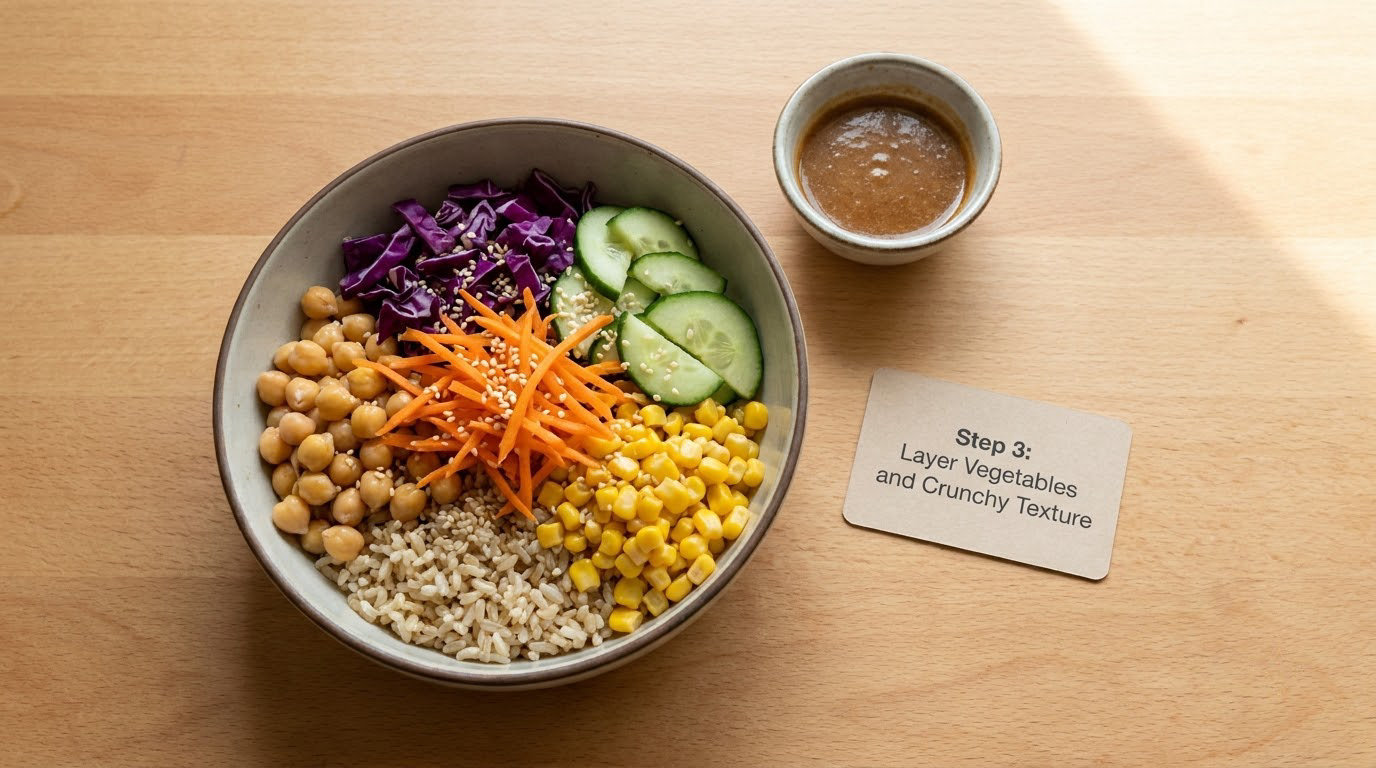
Vegetables break into two groups: the ones you can eat straight from the pantry, and the ones that need a thaw or a cook. Knowing which is which saves the most time.
No cooking required: canned corn drained of its liquid, jarred roasted peppers, olives, dehydrated onions reconstituted in warm water, and any raw vegetable that holds its crunch. Cabbage and carrot shredded raw are better for a bowl than most people expect, and cucumber, bell pepper and scallion work sliced straight in.
Needs thawing: frozen peas, frozen corn, frozen chopped spinach and frozen mixed vegetables. A small handful of frozen spinach stirred into a warm grain cooks in under a minute. Frozen chopped vegetables for a bowl are best used slightly frozen, because they hold their shape better than when they go soft in a pan.
Needs cooking: sweet potato and squash, which take 25 to 30 minutes in a hot oven; whole frozen kernels of corn, which can also be seared in a dry pan for a few minutes; and any root vegetable, which can be microwaved in three-minute intervals or simmered until a knife slides in without resistance.
Crumble something on top last so it stays crisp. Toasted nuts and seeds, roasted chickpeas, crushed peanuts or a spoon of toasted breadcrumbs all sit well on a warm bowl. The trick is to add them after the sauce, never before.
Step 4: Make a Simple Pantry Sauce
You do not need a bottled dressing. Every good pantry sauce has the same four parts: a fat, an acid, salt, and something aromatic or sweet. A useful default is 2 parts oil to 1 part acid, plus salt and a spoon of mustard or honey to hold it together. Three tablespoons of oil to a tablespoon and a half of vinegar, with a pinch of salt, is a complete vinaigrette in ten seconds.
Three formulas cover most weeks. Sesame-style: 2 tablespoons sesame oil, 1 tablespoon soy sauce, 1 tablespoon rice vinegar, 1 teaspoon honey or maple syrup, a grated clove of garlic if you have one. Whisk or shake in a jar. Mustard vinaigrette: 3 tablespoons olive oil, 1 tablespoon lemon juice or red wine vinegar, 1 teaspoon Dijon, a little salt and pepper. Tahini or nut butter: 2 tablespoons tahini, 1 tablespoon lemon juice, 1 to 2 teaspoons soy sauce, and water a spoonful at a time until it is pourable.
Sesame oil, tahini and nut butters seize when they first hit liquid. They go thick and pasty, then loosen as you add more liquid. Add the water or vinegar a little at a time and keep whisking, and it will turn into a smooth cream.
Salt changes what the bowl tastes like more than any other ingredient, and the grain needs it more than most people expect. A pinch of salt in warm rice and a separate pinch in the dressing will do more than doubling either amount of oil or vinegar.
Step 5: Finish and Balance the Bowl
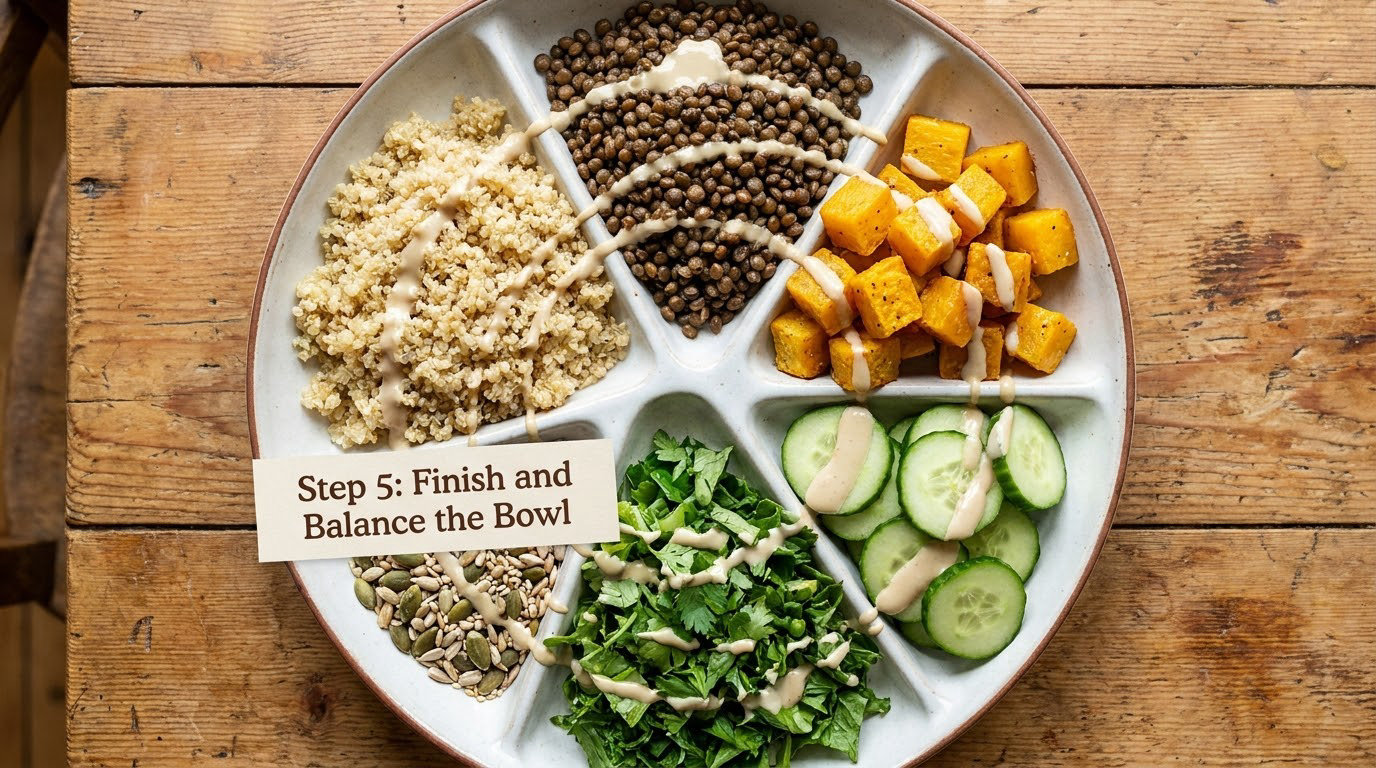
Build in a fixed order and the bowl is finished without any fuss: warm grain first, then room-temperature protein, then vegetables, then the sauce, then the crunch. Putting the warm grain down first means the heat softens the beans and greens just slightly, which is what makes cold toppings taste like they belong.
Taste before you eat. If it tastes flat, add salt. If it tastes heavy or dull, add acid. If it is good but boring, add heat or an aromatic such as garlic, ginger, smoked paprika or chili crisp. If the whole bowl feels dry, the answer is more sauce, not more oil on its own.
Boosters are optional and mostly shelf-stable: dried herbs, curry powder, zaatar, a spoonful of grated parmesan, pickled red onion made ahead, quick-pickled sliced vegetables in vinegar, seeds, or a spoonful of chopped pickles. Fresh herbs and avocado are the two things worth buying, and only if the day calls for them.
A finished bowl has visible sections. You should be able to see the grain, the protein, the produce, the sauce and the crunch as distinct parts, not a uniform beige mixture. If everything has blended together, the fix is usually a small handful of something raw and crisp added at the last second.
Common Mistakes
The bowl tastes bland. It is almost always under-salted, and often under-seasoned in two places at once. Season the grain while it is warm, season the dressing, then taste the assembled bowl before adding more of anything.
The grain is clumpy. Rice and quinoa stick when they cool as a single mass. Spread them on a tray or toss with a spoon of oil as soon as they drain. The same clumping is the reason cold grains need breaking up with a fork before they hit the bowl.
Everything is soggy by lunch. Pack the dressing in a separate small container and add it when you eat, or dress only the top layer. Airtight containers trap steam, so let the grain cool uncovered before the lid goes on and store vegetables separately from the base when you can.
The bowl is dry and chewy. Reheating dries the grain out. A damp spoon of water or broth in the pan, covered, over low heat for 3 to 4 minutes brings it back, and a microwave needs a damp paper towel on top rather than a splash after.
It feels unbalanced. A bowl that is all grain needs protein and something raw. A bowl that is all vegetables needs the grain and a fat. A bowl with no crunch needs seeds, nuts or roasted chickpeas, and that one addition does more for the way it feels than any extra dressing.
For prep ahead, cook grains in a batch, roast one tray of vegetables, mix one jar of dressing and keep them separate in the refrigerator. Build each bowl in the morning, which takes about two minutes, and keep the dressing out of the grain container until you are ready to eat. Cooked grains and other cooked leftovers belong in the refrigerator within two hours and are safe for about 3 to 4 days, so a Sunday batch comfortably covers a work week if the bowls are built daily rather than all at once.
Frequently Asked Questions
What pantry staples can I use for a grain bowl?
The core five are a grain such as rice, quinoa, couscous, farro, barley, bulgur or millet; a protein such as canned chickpeas, black beans, lentils, tofu or canned fish; a vegetable such as canned corn, jarred peppers, frozen peas or raw cabbage; a dressing built from oil, vinegar or lemon, soy sauce, tahini or nut butter; and a crunchy finish such as seeds, nuts or roasted chickpeas. Garlic powder, smoked paprika, cumin, dried herbs and pickled vegetables turn the same five slots into a different meal each time.
Can I make a grain bowl ahead of time?
Yes, and it is the best use of this formula. Cook a batch of grain, roast a tray of vegetables and mix a jar of dressing, then store all three separately in airtight containers in the refrigerator. They keep 3 to 4 days, so Sunday prep covers a workweek. Build each bowl the morning you eat it and carry the dressing in a separate container so nothing goes soggy, then add the crunch right before eating.
How long does a homemade grain bowl last in the refrigerator?
An assembled bowl keeps about 2 days, and components kept separately last longer. Cooked grains and other cooked leftovers should be refrigerated within 2 hours and used within 3 to 4 days. Cooked beans and lentils last the same 3 to 4 days once opened. Hard-boiled eggs keep about 1 week. A homemade oil-based dressing in a jar stays good for roughly 5 to 7 days refrigerated, and any bowl with fish or cooked egg is best eaten within a day or two.
How should I reheat a grain bowl without making it dry?
Reheat the grain separately and add a little moisture. Put it in a pan with a tablespoon of water or broth, cover, and let it steam over low heat for 3 to 4 minutes, stirring once. In a microwave, cover the grain with a damp paper towel rather than adding water after, which steams the starch instead of soaking it. Keep the vegetables and any raw toppings out of the pan so they stay crisp, and add the dressing after reheating.
What can I use instead of rice or quinoa?
Almost any whole grain works, and the swap is direct: use the same 1 cup cooked per bowl. Couscous cooks in 5 minutes from boiling water, farro and barley take about 25 to 30 minutes and add chew, bulgur and millet are ready in 12 to 15 minutes, and buckwheat cooks like a grain even though it is a seed. Old-fashioned oats, made in a jar with a splash of milk, make a savory breakfast bowl with soy sauce, seeds and grated cabbage.
How can I keep pantry-based grain bowls from tasting boring?
Season in two places and finish with contrast. Salt the warm grain and salt the dressing, because salt added only to the top is always less even. Then add an acid such as lemon juice, rice vinegar or pickle brine to brighten whatever is heavy. For variety, keep four flavor directions on the shelf: a sesame and soy sauce, a mustard vinaigrette, a tahini or nut butter sauce, and a jar of salsa or barbecue glaze. Beans tossed in any of those change character, and a tablespoon of seeds or nuts at the end fixes any bowl that feels flat.
Conclusion
Start with one cooked grain, one protein, two vegetables, one sauce and one crunchy topping, and use the ratio of 1 cup grain to 3/4 cup protein to 1 cup vegetable to get the proportions right. Season the warm grain and the dressing separately, then taste the bowl before you serve it and correct for salt, acid or crunch. Repeat it tomorrow with a different grain and the same formula, and you have a week of lunches that never relies on fresh produce.