
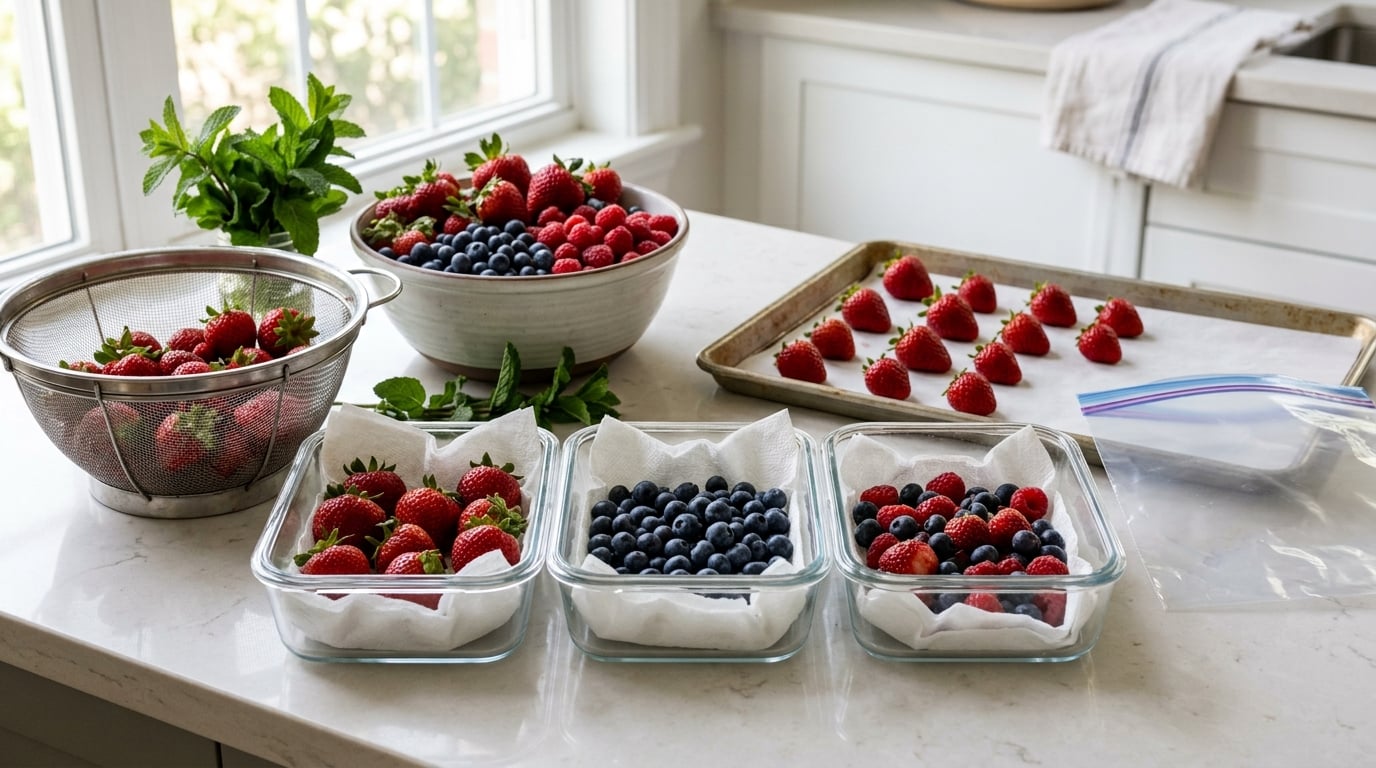
Berries go bad because of moisture, not age. To learn how to store summer berries so they last longer, keep them unwashed and bone dry until you need them, then refrigerate them in a single layer in a shallow container lined with paper towel. Whole firm berries like blueberries can stretch from three or four days to closer to two weeks that way, and the rest can be frozen.
That is the whole trick, and it costs nothing. No gadgets, no special wraps, no chemistry experiments.
I wasted more raspberries than anyone I know before I stopped doing the obvious wrong things: rinsing them in the store car, sealing them wet into a plastic tub, then shoving that tub into the crisper drawer where nothing dries out. Peak-season berries are the cheapest and best-tasting ones you will buy all year, and they are also the ones most likely to end up in the bin four days later. The gap between good storage and careless storage is the difference between eating the strawberries and finding them furry on Friday.
Here is what actually works, from picking through to freezing.
Table of Contents
- What You Need
- Step-by-Step: How to Store Summer Berries So They Last Longer
- Common Mistakes
- Frequently Asked Questions
- How long should summer berries be stored in the refrigerator?
- Should summer berries be washed before storing?
- What is the best container for keeping berries fresh longer?
- Can I freeze berries that are already slightly soft?
- How can I tell whether stored berries have gone bad?
- Why do berries get moldy so quickly after rinsing?
What You Need
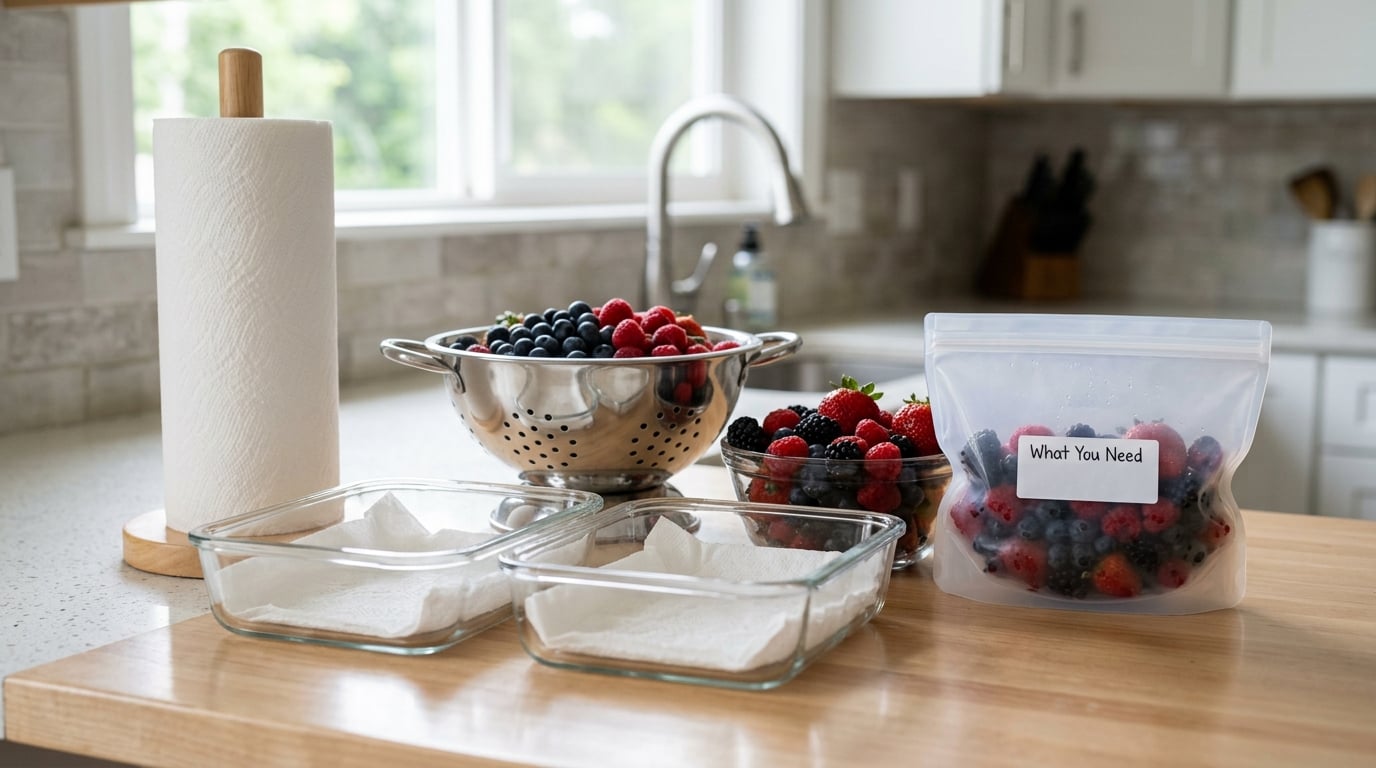
You need less than you think. A shallow container wider than it is deep, a roll of plain paper towel, a colander, and a baking sheet for freezing are the core four. A salad spinner or a clean kitchen towel takes the place of the spinner if you would rather not own one.
- A shallow container. Glass or plastic, but shallow and wide so the fruit sits one or two layers deep. A flat-lid storage container or even a plate covered loosely with foil does the job.
- Paper towel. Ordinary roll toilet paper would work. This is the piece most people skip and the piece that does the most.
- A colander or fine strainer for rinsing, plus a towel or salad spinner for drying.
- A baking sheet and a silicone mat or parchment for pre-freezing, so berries do not freeze into one solid brick.
- Freezer bags or rigid freezer containers, and a marker to label them with the berry type and the date.
What you do not need: an airtight container for fresh berries, a crisper drawer, a silicone berry keeper sold as a solution, or any kind of wash before they go in the fridge.
Step-by-Step: How to Store Summer Berries So They Last Longer
Keep them dry, keep them cold, keep them ventilated, keep them in a single layer, and keep them unwashed until you are ready to eat them. Do those five things and firm summer berries go from three to four days in the fridge to a week or more, with blueberries and cherries stretching longest.
Choose Berries Without Bruising Them
Storage cannot rescue fruit that was already damaged, so pick carefully. Look for berries that are dry to the touch, evenly colored, and firm enough that a berry does not dent when you press it lightly.
Skip any container where the fruit is sitting in juice, where the bottom is damp and translucent, or where one berry is fuzzy grey rather than white. That grey patch is mold that has already spread to its neighbours, and the rest of the clamshell is a shared countdown.
Reach to the top and back of the display rather than the mound at the front. The front berries are the ones everybody has already squeezed and dropped back, and bruised spots are exactly where mold starts. Pick through from the top down and leave the bruised pile alone.
Buy smaller clamshells more often rather than one large one. Twice as many trips to the market is a lot cheaper than losing half of a big box. And whatever you bring home, do not rinse yet. Washing at the store is the single most common reason berries turn to mush within a day or two.
Wash Berries Only When You Are Ready to Use Them
The online advice on this splits into two camps and both are half right, so here is how to settle it. Washing removes the mold spores that were sitting on the skin, and it also wets the fruit. Left wet and sealed, those berries mold faster than unwashed ones. Washed, dried properly, and stored with airflow, they often outlast unwashed fruit.
So the answer to whether you should wash berries before storing is: usually no, except before freezing.
| Method | What it does | When to use it |
|---|---|---|
| Store dry, no wash | Leaves surface spores intact but no water to feed them | Default for fridge storage, up to about a week for firm berries |
| Cold water rinse | Removes visible debris and some spores | Right before eating, or the night before, if you dry well |
| Vinegar, 1 part to 4 parts water, 10 to 15 minutes | Weak acid bath that knocks down surface spores | Worth it for a clamshell you suspect; rinse again in plain water after |
| Baking soda, 1 teaspoon in 2 cups water, brief dip | Gentler alkaline wash some home cooks prefer | Alternative if you dislike vinegar. Rinse after |
| Salt water, 1 tablespoon in 4 cups | Brine that firms the skins slightly | Also fine. Expect a slightly softened texture |
| Hot water | Cooks the fruit on contact | Never. Warm or cold water only |
Whichever method you pick, the drying step is the part that decides whether it worked. Rinse in cold water, tip the berries into a colander, and either spin them in a salad spinner or roll them around in a dry towel for a minute with the towel gathered at the ends. Let them sit on a fresh dry towel afterwards until there is no visible sheen.
Then check them. Any berry that feels soft, splits open, or shows a translucent spot goes straight in the compost, not back in the container. One squashed berry sitting under a hundred good ones will take the whole lot within a day.
Refrigerate Berries in the Right Conditions
Once they are dry and clean, storage is simple. Put a folded sheet of paper towel on the bottom of a shallow container, arrange the berries in a single layer, put a second sheet loosely over the top, and put the container in the fridge.
That top towel is optional but useful. It lifts condensation off the fruit so the skins stay dry, and you can swap it out every couple of days if it is damp. Some people leave the lid slightly ajar instead. Either approach works because both let moisture escape.
Place the container on a fridge shelf rather than in the crisper drawer. The crisper holds a higher humidity than the rest of the fridge, which is right for leafy greens and wrong for berries, since it traps the exact damp conditions mold wants. The upper shelves tend to run a little cooler and have better airflow around the door.
Keep the fridge at 40F or below. Colder is better for slowing respiration, which is why a berry from the back of the fridge tastes blander than one straight from the market, but the door is the warmest and most humid spot in the whole appliance, so never park the container there.
And keep berries away from ripe bananas, apples, avocados, and tomatoes. Those produce ethylene gas, which berries are sensitive to, and it speeds up ripening and softening in everything nearby.
Refrigeration slows things down, but it does not stop it. Berries are still alive after harvest and still respiring, and a hard green strawberry will not turn red on your counter. That is why fridge storage buys you time and not ripening, and why unripe berries are the one case where leaving them out helps.
Freeze Berries for Longer Storage
Freezing is where the summer surplus goes. Unlike refrigeration, washing is the right call here, because you are not going back into the fridge with wet fruit. Wash, dry completely, and only then freeze.
- Wash and dry thoroughly. Any water that freezes onto the fruit becomes ice crystals that dull the texture later.
- Hull and halve large strawberries. Whole frozen strawberries are disappointingly tough when they thaw, which matters for baking but not for smoothies.
- Spread in a single layer on a baking sheet lined with parchment or a silicone mat, and freeze until solid, usually about an hour.
- Transfer to bags or rigid containers and squeeze out as much air as you can, then seal.
- Label with the berry type and the date, plus the quantity if you care about portioning later.
The pre-freeze step is the one people skip, and it is the difference between a bag of loose berries and a brick you have to thaw to break apart. Fruit that freezes separately keeps more of its shape and is less prone to freezer burn, the dry greyish patches that show up when air gets to the surface.
Frozen berries hold their nutrition well, including most of the anthocyanins that make blueberries and blackberries valuable, though vitamin C drops noticeably over the first few months. Most sources put good quality at eight to twelve months for a well-sealed bag and up to three years in a deep, consistently cold freezer.
Thaw in the fridge the night before rather than on the counter, and never refreeze berries that have been thawed. Plan to move them from freezer to fridge to bowl, skipping the counter step entirely.
Adjust Storage Methods by Berry Type
Different berries have genuinely different clocks, and setting your expectations by type saves a lot of disappointment. Raspberries will never last like blueberries, no matter what you do to them.
| Berry | Fridge, dry and ventilated | Counter | Frozen | Best container |
|---|---|---|---|---|
| Strawberries | 3 to 5 days, up to 7 with a very dry fridge | 1 day max, and only to use immediately | 6 to 9 months | Shallow container, single layer, hulls still attached |
| Blueberries | 7 to 14 days | 2 to 3 days if fully ripe and dry | 9 to 12 months | Shallow container; they hold up to stacking |
| Raspberries | 1 to 3 days, no longer | 1 day | 6 to 9 months | Single layer on paper towel, never piled |
| Blackberries | 2 to 4 days | 1 to 2 days | 9 to 12 months | Single layer, dry, loosely covered |
| Cherries | 5 to 10 days with the stems on | 2 to 3 days once ripe | 6 to 9 months, pitted first | Shallow container; bag and stem with the rest |
Strawberries are the most temperamental. Their seeds sit on the outside and hold water against the flesh, which is why molded strawberries spread so fast, and their aroma is already partly gone by the time the fruit ripens on the plant. Blueberries are the opposite, with a waxy natural bloom that resists moisture and lets them hold for two weeks. Raspberries and blackberries are hollow-cored, so they dry out and trap mold spores in their centers at the same time. Cherries keep longest of the soft fruits as long as the stems are on, which slows the moisture leaving the fruit.
Store varieties separately. When one soft berry in a mixed container goes, it takes its neighbours with it, and strawberries will soften long before blueberries are affected.
Common Mistakes
Almost everyone makes at least one of these, and they explain most of the moldy berry stories I hear.
- Washing berries at the store. Wet fruit in a closed clamshell is a mold incubator. Fix: rinse only when you need them, and dry them first if you must.
- Sealing wet berries into an airtight container. A tight lid traps the water you just added and turns the interior into a greenhouse. Fix: dry berries go in, lid goes on loosely, paper towel goes underneath.
- Using the crisper drawer. Its higher humidity helps kale and hurts berries. Fix: an upper fridge shelf instead.
- Piling everything into one deep tub. The weight of the fruit on top bruises the bottom layer, and bruised spots are where mold starts. Fix: single layer, more trips to the fridge if necessary.
- Storing mixed varieties together. Fix: one shallow container per type, each with its own paper towel.
- Parking the fruit next to ripe bananas or apples. Ethylene from those fruits speeds up softening in everything nearby. Fix: give berries their own shelf.
- Thawing and refreezing repeatedly. Each cycle costs texture and can push the fruit past the point where I would eat it. Fix: freeze in single-use portions so you only take out what you need.
One more that is not on most lists: not checking on them. Mold in a clamshell is visible from above but invisible under the layer of fruit beneath. A quick look every other day lets you pull the container early, while the good berries are still worth saving.
The counter-versus-fridge question comes up constantly, so here is the short version. Strawberries, raspberries, and blackberries are usually picked ripe or close to it, and they do not improve at room temperature, so the fridge is where they go. If you found firm, pale, under-ripe berries, one day on the counter in a cool, airy spot can finish them, and then they go in the fridge. Blueberries picked with visible red or green shoulders will soften and color in a day or two out of the fridge. Nothing ripens faster than sitting on a warm windowsill, though, so keep that brief.
One community consensus is worth mentioning because it comes up in almost every discussion: the simple airflow fix is usually better than the chemistry. The popular advice on kitchen forums splits between vinegar baths and a firm no-washing-until-needed rule, and the part almost everyone agrees on is moving berries out of the clamshell into a shallow container lined with paper towel and letting air move around them. That is the step that does the real work.
On nutrition, since this is the part I actually care about. Berries are high in vitamin C, and vitamin C is one of the first things to go. Storage temperature and duration both drive the loss, so a berry eaten on day two is nutritionally stronger than the same berry eaten on day twelve, even though the day-twelve berry may look perfectly fine. Anthocyanin content holds up better, and freezing generally preserves it better than a long refrigerator stay does, though vitamin C takes a hit in the first few months. If the nutrient profile is the point, eat fresh and early, freeze the rest, and do not expect a week-old fridge berry to deliver the same thing as one you ate the same afternoon.
Frequently Asked Questions
How long should summer berries be stored in the refrigerator?
Dry, unwashed berries in a shallow paper-towel-lined container last about 3 to 5 days for strawberries, 7 to 14 days for blueberries, 1 to 3 days for raspberries, 2 to 4 days for blackberries, and 5 to 10 days for cherries. If you have already washed them, dry them thoroughly first or expect the lower end of those ranges.
Should summer berries be washed before storing?
Usually not. Washing wets the skin, and sealed wet berries mold faster. Store them unwashed and rinse just before eating. The exception is freezing, where you should wash and dry them completely first, since water that freezes on the fruit becomes ice crystals that ruin the texture. A vinegar rinse at 1 part vinegar to 4 parts water is worthwhile for a suspect clamshell.
What is the best container for keeping berries fresh longer?
A shallow, wide container lined with a paper towel and covered loosely, kept on an upper fridge shelf rather than in the crisper drawer. Airflow matters more than material, so glass and plastic work about equally well. The original clamshell is the worst option because it traps condensation and has no way to draw moisture off the fruit.
Can I freeze berries that are already slightly soft?
Yes, especially for smoothies, baking, and sauces, where texture matters far less than flavor. Wash them, remove any bruised or molding berries, dry completely, then tray-freeze in a single layer before bagging. Very soft berries break down more in the freezer, so plan to use them within a few months rather than a year.
How can I tell whether stored berries have gone bad?
Discard berries that are fuzzy rather than dusty white, leaking, slimy, fermented-smelling, or sitting in pooled juice. One moldy berry means checking the whole container and pulling any that touch it. Strawberries that are uniformly soft and darker may just be ripe, but if they collapse under a fingertip, they are past saving.
Why do berries get moldy so quickly after rinsing?
Rinsing leaves a film of water on the skin, and any container you close traps that moisture against the fruit. Mold spores are already present on every berry, and a damp surface at fridge temperature is exactly what they need. Either skip the rinse and store them dry, or rinse them and dry them thoroughly on a towel before they go anywhere near a closed container.
Start with the box you already have in the fridge. Move the berries out of the clamshell into something shallow, put a paper towel underneath, leave the lid loose, and skip the rinse until tomorrow. That change alone, made tonight, is worth more than any gadget.