
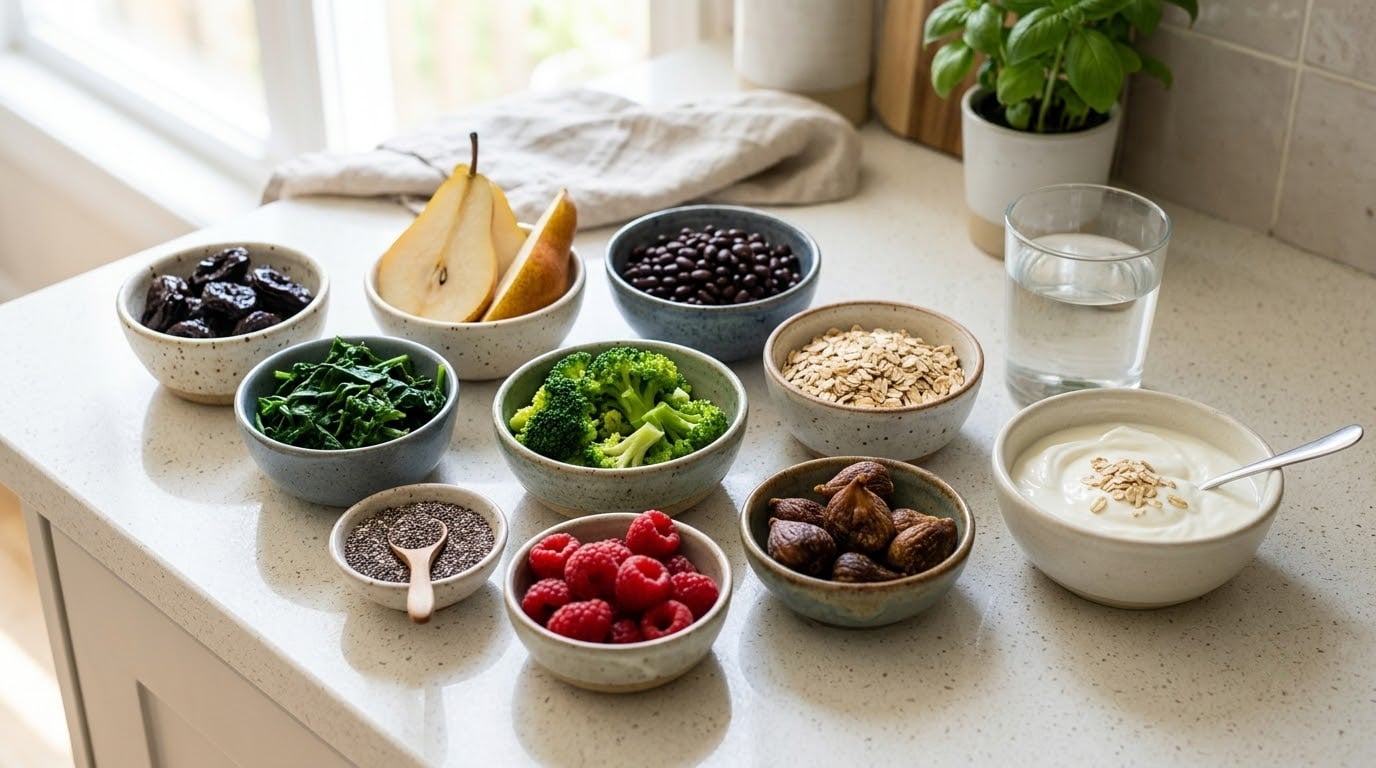
If constipation has you backed up, the foods that help with constipation naturally are mostly whole foods rich in fiber, plus a few that pull water into the bowel. Prunes, pears, oats, beans, chia seeds, kiwifruit, and leafy greens come up again and again because each one adds bulk, softens stool, or feeds the bacteria that keep your gut moving. Most people see a difference within one to three days of eating them consistently, alongside enough fluid.
Regular bowel movements mean passing soft, easy stools without straining, usually somewhere between three times a day and three times a week. When stools get hard and dry, passing them becomes both harder and more unpleasant. The fix is rarely one magic food. It is a pattern: fiber every day, fluid alongside it, and a little movement.
What follows is a practical list, not a strict diet. Each food comes with what it actually does, a realistic serving, and how quickly you might notice something. The table below has the short version if you are in a hurry, or skip straight to the section for the food already in your kitchen.
Table of Contents
- Foods That Help With Constipation Naturally at a Glance
- 1. Prunes and Prune Juice
- 2. Pears, Especially Peeled or Cooked Pears
- 3. Avocado
- 4. Black Beans and Other Beans
- 5. Oatmeal and Other Whole Oats
- 6. Chia Seeds and Flaxseeds
- 7. Kiwifruit
- 8. Leafy Greens and Broccoli
- 9. Berries, Especially Raspberries
- 10. Fermented Foods Such as Yogurt, Kefir, and Sauerkraut
- 11. Sweet Potatoes and White Potatoes with Skin
- 12. Figs, Dates, and Raisins
- How to Add More Fiber Without Disrupting Your Routine
- When Constipation Needs Medical Attention
- Frequently Asked Questions
- A Simple Starting Point
Foods That Help With Constipation Naturally at a Glance
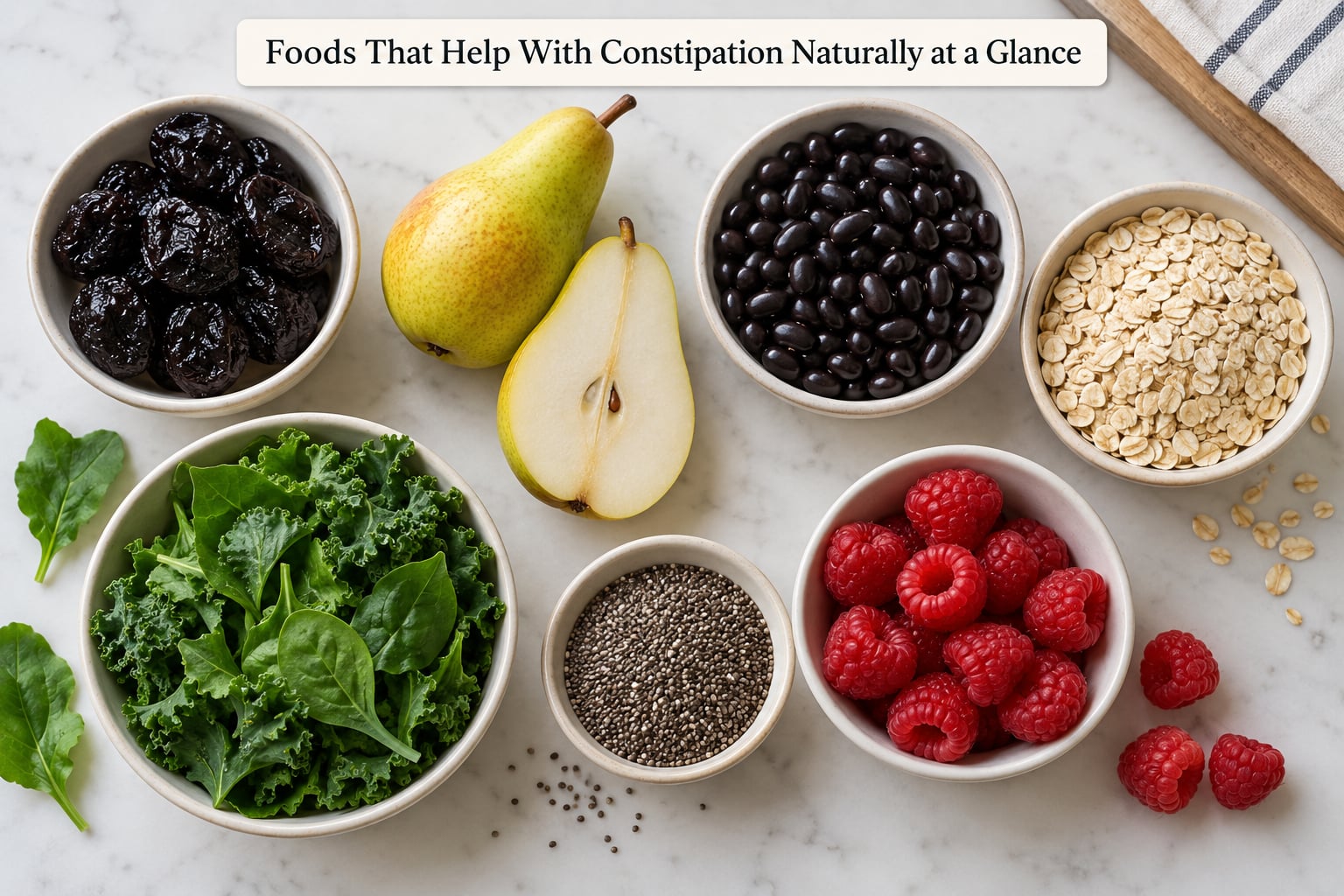
Here is the quick version before the detail. No food works reliably on its own, and the “fast” column below reflects what people commonly report rather than a guarantee.
| Food | Main strength | Most practical use | Typical timeline |
|---|---|---|---|
| Prunes and prune juice | Sorbitol plus fiber | 5 whole prunes or a small glass of juice with breakfast | Hours to one day |
| Pears | Pectin, sorbitol, water | A peeled or baked pear with breakfast | One day |
| Avocado | Fiber plus fat | Half on toast, or cubed into a salad | One to three days |
| Black beans and lentils | High fiber and resistant starch | Half a cup in soup, tacos or rice bowls | Two to four days |
| Oats | Beta-glucan, gel-forming fiber | Half a cup dry cooked with fruit and seeds | One to two days |
| Chia and ground flax | Gel-forming fiber and omega-3 fats | One tablespoon stirred into oatmeal or yogurt | One to two days |
| Kiwifruit | Actinidin enzyme plus fiber | Two fruit daily, eaten with the skin | One to two days |
| Leafy greens and broccoli | Volume, fiber, magnesium | Two cups cooked or a large raw portion each meal | Two to three days |
| Raspberries and berries | Very high fiber density | A cup with yogurt or on oatmeal | Two to three days |
| Yogurt, kefir, sauerkraut | Live cultures | A daily serving alongside fiber-rich meals | Weeks, not days |
| Potatoes with skin | Resistant starch and potassium | A medium baked potato with beans or salad | Two to three days |
| Figs, dates, raisins | Concentrated fiber | Three figs or a small handful with oatmeal | One to two days |
1. Prunes and Prune Juice

Prunes are the best-known food for constipation relief for a good reason. Alongside insoluble fiber, they contain sorbitol, a sugar alcohol that draws water into the large bowel, which softens stool and nudges the colon to contract.
People who use prunes as a regular habit tend to start small. Five whole prunes in the morning is the common starting point, and that is roughly 2 to 3 grams of fiber. Prune juice works faster because it skips the solids, but you get much less fiber, so it works best as a partner to whole fruit rather than a replacement.
One caution: prune juice is high in sugar compared with the fruit, and more is not always better. If you notice cramping or loose stools, step back to a couple of whole prunes instead.
2. Pears, Especially Peeled or Cooked Pears
Pears are one of the easiest swaps because most kitchens already have one. A medium pear delivers roughly 5 to 6 grams of fiber, and the peel holds a meaningful share of insoluble fiber plus most of the plant’s pectin.
That skin is also where a lot of the sorbitol sits, which is useful for regularity but not always comfortable if you are sensitive to fermentable carbohydrates. Peeling a pear, or baking it until soft, removes some of that load while keeping most of the fiber and water.
Try a baked pear with a spoonful of oats on top, or a peeled pear eaten with breakfast. Cooking softens the texture too, so it feels gentler on a stomach that is already unhappy.
3. Avocado
Avocado is a different kind of helper. It contributes fiber, but what makes it distinctive is the fat alongside that fiber. Fat in the diet tends to speed up transit through the digestive tract, and avocado makes it easy to eat fat without it feeling heavy.
That fat matters for another reason: very low-fat diets sometimes coincide with slow, hard stools. Avocado fits into a high-fiber pattern rather than replacing one.
Half a fruit on toast with seeds, or cubes tossed through a salad with beans, is plenty. Avocado is calorie-dense, so half is usually the right amount for everyday eating.
4. Black Beans and Other Beans
Beans are among the highest-fiber foods you can buy, and half a cup of cooked black beans gives you roughly 7 to 8 grams. They also carry resistant starch and fermentable fibers that feed gut bacteria, which produce short-chain fatty acids that support the lining of the colon.
The catch is that they can cause gas and bloating before regularity improves, especially if you jump from almost none to a large serving. Start with two or three tablespoons and build up over a couple of weeks. If you want the structure of beans without the gas, older canned varieties that have been rinsed well are often gentler than quick-cooked fresh beans.
Practical uses are endless: stirred into soups, spooned over rice bowls, folded into tacos, mixed with chopped vegetables for a salad. If you want to understand what these foods do for your gut bacteria, our guide to 14 foods high in prebiotic fiber breaks down the pattern further.
5. Oatmeal and Other Whole Oats
Oats contain beta-glucan, a soluble fiber that dissolves in water and forms a soft gel in the gut. That gel holds water against the stool, which is exactly what hard, dry stool needs. It also feeds beneficial bacteria rather than simply passing through.
Cook half a cup of dry rolled oats rather than using instant or heavily processed varieties, since processing strips some of the fiber. Toppings matter as much as the oats: a spoonful of chia or ground flax, a handful of raspberries, and a spoon of plain yogurt turn a plain bowl into something with enough fiber to matter.
Oatmeal also happens to be a natural morning routine food, and many people find that eating something within an hour of waking is what prompts a bowel movement later that day.
6. Chia Seeds and Flaxseeds
These tiny seeds swell with water and form a gel, which is why they are among the most commonly recommended fiber additions. An ounce of chia seeds contains around 10 grams of fiber, and ground flaxseed gives you roughly 2 grams per tablespoon along with omega-3 fats.
Whole flax seeds pass through you mostly intact, so buy them ground or grind them yourself in a coffee grinder. For chia, mixing one tablespoon into oatmeal, yogurt, or a smoothie and letting it sit for ten minutes gives you a smoother texture and easier swallowing.
Drink fluid with them. Seeds that absorb water in the gut need fluid available in the gut, and taking them on a dry stomach without a glass of water is a common way people end up more uncomfortable than they started.
7. Kiwifruit
Kiwifruit earns its place through two mechanisms rather than one. It has around 2 to 3 grams of fiber per medium fruit, and it contains actinidin, a proteolytic enzyme that has been studied for its effect on how quickly food moves through the digestive system.
The common practical routine is two fruit a day, eaten with the skin, which is where much of the fiber sits. Many people who have not had success with bulk-forming fiber report that kiwi helped where heavier fibers caused more bloating.
Individual responses vary quite a bit here. Some people find kiwi gentle, others notice more gas for a day or two before settling. Give any single food two to three weeks before you decide it does not work for you.
8. Leafy Greens and Broccoli
Vegetables contribute fiber and, just as importantly, volume. A large portion of leafy greens or a cup of cooked broccoli adds bulk to a meal, and that physical bulk is part of what stimulates the colon to move.
Broccoli is easy to underestimate: one cup of cooked florets gives you around 5 grams of fiber. Spinach, kale, and chard each land in the 3 to 4 gram range per cooked cup, with magnesium playing a supporting role.
Preparation is where most people fall short. Sautéing or steaming with a little fat works better than boiling, since much of the fiber is water-soluble and partly leaches away. If a big pile of greens sounds punishing, start with a side salad you actually look forward to rather than a plate of vegetables you avoid.
9. Berries, Especially Raspberries
Berries are among the highest-fiber-per-calorie fruits available, and raspberries lead the group at roughly 8 grams of fiber per cup. Blackberries and blueberries trail slightly behind but still deliver well.
One important distinction: whole berries are not the same as berry juice. Juice has most of the fiber and volume removed, which is one reason many people find fruit juice unsatisfying for constipation even though they drink it daily.
Use them where they naturally fit: over oatmeal, folded through plain yogurt, added to salads at the end of cooking, or eaten straight from the fridge as an afternoon snack. Frozen berries count and cost less, and they thaw nicely in overnight oats.
10. Fermented Foods Such as Yogurt, Kefir, and Sauerkraut
Fermented foods supply live cultures and, in some cases, a small amount of fiber of their own. They belong in a varied eating pattern rather than standing alone as a constipation cure, and the honest timeline is weeks, not hours.
Kefir tends to be the strongest starting point on this list because it is fermented more thoroughly and typically carries a higher count of live cultures than most yogurt. Plain kefir mixed into oatmeal with berries covers two bases at once. Sauerkraut and kimchi add cultures too, but newcomers often report a flare of gas in the first week.
If you are new to all of this, our step-by-step on how to add fermented foods to your diet lays out a slower ramp that avoids the worst of it. Choose products with live cultures listed on the label, and watch added sugar in flavored varieties.
11. Sweet Potatoes and White Potatoes with Skin
A medium baked sweet potato with the skin on delivers around 4 grams of fiber and a good amount of potassium. Cooking and cooling potatoes increases their resistant starch, which is a slowly digested carbohydrate that gives gut bacteria something to work with.
Preparation and portion are what trip people up. A large baked potato with butter and salt is mostly starch, while a medium one alongside beans and a salad becomes a genuinely high-fiber meal. Keep the skin on, since a good share of the fiber sits there.
Sweet potatoes and white potatoes both work. White potatoes are not the enemy some posts suggest; what matters is that you are eating the skin and pairing it with fiber-rich foods.
12. Figs, Dates, and Raisins
Dried fruit concentrates everything: three medium figs give you roughly 8 grams of fiber, while a small box of raisins is closer to 1.5 grams. That concentration is the strength and the risk at the same time.
Sugar adds up quickly in dried form, so portions need to be deliberate. Three figs or a small handful is a sensible serving, eaten alongside something with protein and fiber rather than on their own in front of the TV.
They work well folded into overnight oats, stirred into plain yogurt, added to oatmeal with cinnamon, or baked into a dish with nuts. If dried fruit leaves you thirsty, drink water with it. Fresh fruit and dried fruit are not interchangeable in a day, so pick one.
How to Add More Fiber Without Disrupting Your Routine
The most reliable fiber habits are boring ones. Most guidelines for adults land somewhere between 25 and 34 grams of fiber a day, and many people eat well under half of that. Getting there gradually matters more than hitting a number on day one.
- Add one fiber to something you already eat. Oats with fruit at breakfast, beans in your usual soup, a pear alongside lunch. One addition that you never have to think about again beats a full overhaul.
- Increase existing portions gradually. Going from very little fiber to a lot is what causes the bloating, gas, and cramping people associate with fiber. Add roughly 5 grams every few days and give your gut time.
- Pair fiber with fluid. Fiber works by holding water. If your intake jumps but your water intake does not, constipation can actually get worse rather than better.
- Swap refined grains for whole ones. White bread and white rice are among the lowest-fiber staples in most kitchens. Whole-grain bread, oats, brown rice, and quinoa change the fiber total without changing the meal.
- Keep some texture. Whole grains, nuts, seeds, and raw vegetables contain more fiber than their processed equivalents.
- Watch juice. Juicing keeps vitamins and strips fiber, so juice is not a fiber strategy. Our carrot juice recipe with a blender is a good drink, but eat the pulp or pair it with something solid if regularity is the goal.
- Move a little. A short walk after a meal often does more for morning regularity than any single food.
If bloating is the sticking point, start with the low-gas options: oats, pears, kiwi, rice, potatoes, and citrus. Add beans, cruciferous vegetables, and wheat later, once your gut has settled.
When Constipation Needs Medical Attention
Diet changes help with occasional constipation. They are not the right answer for every case, and some patterns need a clinician rather than a fruit bowl. Talk to a doctor or a registered dietitian if constipation comes with any of the following.
- Severe abdominal pain, or pain that wakes you at night
- Vomiting, or a swollen or tender abdomen
- An inability to pass gas or stool, which can signal a blockage
- Blood in the stool, black tarry stools, or rectal bleeding
- Unexplained weight loss, or a change in bowel habits that persists
- Constipation that begins suddenly after the age of 50, or that alternates with diarrhea
- Ongoing constipation despite consistent fiber and fluid changes
Constipation is sometimes a symptom of another condition, including hypothyroidism, diabetes, irritable bowel syndrome, or a medication side effect. Opioids, some antidepressants, iron supplements, calcium channel blockers, and GLP-1 medications are all known to slow things down. If you take one of these regularly, a doctor can adjust the plan or the medication rather than leaving you to guess at food.
During pregnancy, and for children, talk to a doctor or a pediatric or prenatal dietitian before making significant changes to fiber or using supplements. Higher fiber without enough fluid can make things worse, not better.
Frequently Asked Questions
Which fiber is best for constipation?
Most adults do best with a mix of both types. Insoluble fiber, found in wheat bran, vegetables, nuts, and beans, adds bulk and speeds transit through the colon. Soluble fiber, found in oats, chia, flax, apples, and pears, dissolves into a gel that holds water against the stool and keeps it soft. Neither type alone is usually the full answer, which is why mixing sources across the day works better than doubling up on one.
Are probiotics good for constipation?
They may help some people, though the evidence is modest and varies by strain. Fermented foods like kefir, plain yogurt, sauerkraut, and kimchi supply live cultures, and kefir generally carries the highest count. Probiotics work on the gut microbiome over weeks rather than hours, so they are a supporting habit, not a quick fix. Choose products listing live cultures and start with a small serving if you are prone to gas.
Can dehydration cause hard stools?
Yes. When your body is short on fluid, it pulls water from the bowel, which leaves stools dry and hard and much harder to pass. This matters most when you are increasing fiber, because fiber relies on water to form its gel and move things along. Drinking more when you are already constipated helps, but dehydration on its own is rarely the whole cause, and water alone will not fix constipation from other causes.
How long does it take for fiber to relieve constipation?
It depends on the food. Sorbitol-rich choices such as prunes, prune juice, and pears can work within hours to about a day. Bulk-forming fiber from oats, chia, flax, and beans usually shows up in one to three days, as the colon adjusts. Fermented foods take weeks because they work through the gut microbiome rather than the bowel directly. Give any new food two to three weeks before judging it.
Is constipation a symptom of something else?
Sometimes. Constipation can show up alongside hypothyroidism, diabetes, irritable bowel syndrome, and some neurological conditions, and it is a common side effect of medications such as opioids, certain antidepressants, iron, and GLP-1 drugs. A sudden change in bowel habits in an adult over 50, or any constipation with blood, severe pain, vomiting, or unexplained weight loss, deserves a medical appointment rather than a dietary guess.
Can I eat these foods if I have IBS or IBS-C?
Some of these foods are high in FODMAPs, the fermentable carbohydrates that trigger symptoms in many people with IBS. Safer staples are oats, potatoes, rice, quinoa, oranges, kiwi, firm tofu, and most fish. Beans, garlic, onions, apples, pears, and large portions of broccoli are usually limited on a low-FODMAP plan. If you have IBS-C, a registered dietitian can help you build a fiber target you can actually tolerate.
A Simple Starting Point
Pick one food from this list you will genuinely eat and keep it up daily. Five prunes at breakfast, half a cup of oats with berries, or two kiwifruit is enough to start, and it works better with water alongside and a short walk later in the day. Add the next food after a week or two rather than changing everything at once.
Give it two to three weeks, and expect some adjustment in the middle. If constipation continues past that, or if it comes with pain, bleeding, vomiting, or unexplained weight loss, stop experimenting and talk to a doctor or registered dietitian. Foods that help with constipation naturally are genuinely useful, and they are not a substitute for a diagnosis when something more serious is going on.