

To start intermittent fasting safely, begin with a 12-hour overnight fast, hold it there for a week, then lengthen the fasting period by about an hour every few days until you reach 14 or 16 hours. Keep your meals just as nourishing as they were before, drink water through the fasting hours, and back off or stop the moment you feel dizzy, shaky or anxious rather than pushing through it.
Most people who quit fasting in week one didn’t fail at the method. They picked a protocol meant for someone three months in. This guide walks through a gentler ramp, what to eat inside your eating window, and the signs that mean it’s time to talk to a doctor instead of pushing harder.
A note before anything else: this is general information, not medical advice. If you’re pregnant or breastfeeding, under 18, managing diabetes, taking medication, or have a history of disordered eating, speak with your doctor or a registered dietitian before changing how you eat.
This is one of those topics where the loudest advice is the least useful. You’ll see 20:4 and 36-hour fasts described as the real starting point, and almost nobody mentions that the fastest route to giving up is also the fastest route to feeling terrible. Updated for 2026, here’s the slow version that tends to stick.
Table of Contents
- What You Need to Start Intermittent Fasting Safely
- Step-by-Step: A Gradual Beginner Plan
- 1. Get Medical Guidance When You Need It
- 2. Establish a Balanced Baseline
- 3. Notice Your Current Eating Pattern
- 4. Try a Small Overnight Change
- 5. Choose a Simple Schedule and Start Intermittent Fasting Safely
- 6. Keep Meals Hydrating and Nutrient-Dense
- 7. Adjust One Variable at a Time
- 8. Review Results and Know When to Stop
- Common Mistakes When Starting Intermittent Fasting
- Frequently Asked Questions
- Conclusion
What You Need to Start Intermittent Fasting Safely
The honest answer is that you need almost nothing. No special appliance, no brand of shaker cup, no expensive supplement stack. A kitchen timer, a water bottle and a notebook are genuinely enough. Everything that matters is behavioural rather than equipment-based.
That said, five practical preparations make the difference between a smooth start and a rough one:
- A consistent meal schedule. Three meals at roughly the same times each day gives you something to trim later. Chaos first, fasting second, works badly.
- Everyday nourishing foods. Protein, fibre-rich carbohydrates, vegetables or fruit, and some healthy fat at most meals. Fasting compresses your eating window; it does not reduce your nutrient needs.
- Water within reach. Most of the hunger people blame on fasting is really thirst or a boring routine. Keep a large bottle filled and sip through the day.
- A starting window you can actually keep. Pick something that survives a busy Wednesday, not your best hypothetical day.
- A way to track how you feel. A few notes a day on energy, hunger, sleep and digestion tell you far more early on than the scale does.
One definition to nail down before the steps. Fasting means no calories. Water, black coffee and unsweetened tea are the simplest choices because they contain essentially none. Anything with sugar, milk, cream or calories ends the fast, however innocent it feels at 9am. Herbal tea and sparkling water are fine too. If you enjoy a small square of dark chocolate or a calorie-free sweetener, that’s a personal call about how strict you want to be — nobody will come for you, but know that the fast is technically over.
One extra bit of kit genuinely helps: a pinch of salt in your water or an electrolyte drink without sugar, on longer fasting days. A little sloppiness in the first two weeks is often nothing more than sodium and water moving around.
Step-by-Step: A Gradual Beginner Plan
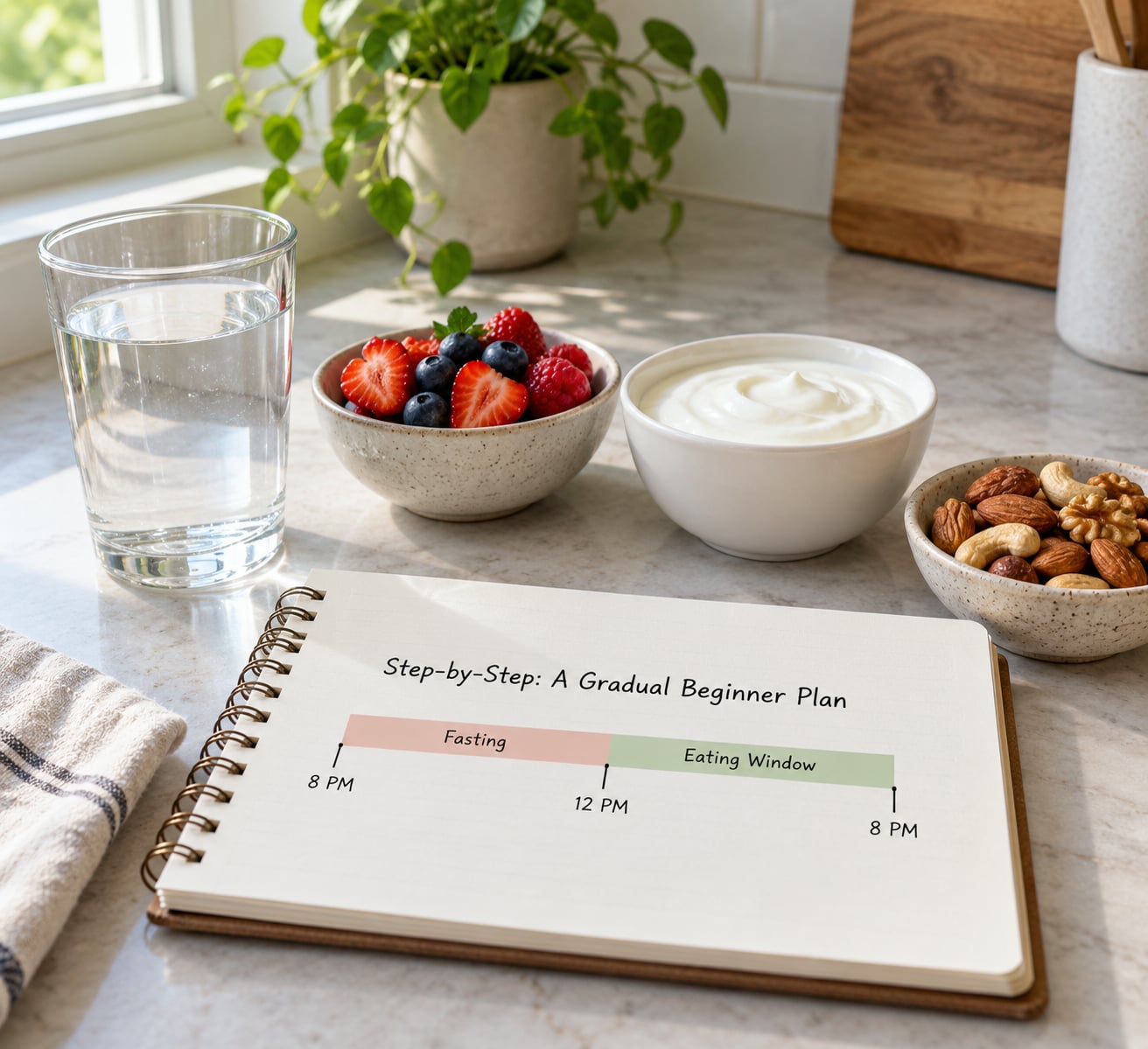
Eight steps, in order. Each one is small enough that you can do it badly and still carry on, which is the whole design.
1. Get Medical Guidance When You Need It
Talk to a doctor or registered dietitian before you change anything if you’re pregnant or breastfeeding, under 18, underweight, living with type 1 or type 2 diabetes, taking any medication that needs food, or have a current or past eating disorder. Add anyone recovering from illness, surgery or an injury to that list.
Why the caution on medication specifically? Several common drugs are prescribed on the assumption that you’ll eat something within a few hours. Diabetes medications are the obvious case, where skipping food can send blood sugar low quickly, but the same applies to a range of thyroid, blood pressure, anti-nausea and psychiatric medications. Your pharmacist can usually tell you which ones on your list fall into that group and how to adjust the timing — that’s a five-minute conversation worth having.
Example: someone with type 2 diabetes on a medication taken at breakfast and dinner shouldn’t just move dinner to noon and hope for the best. They call their prescriber, and the two of them work out a schedule that keeps meals and doses together.
A good response is a clear yes, a clear no, or a modified plan. A vague shrug is a reason to find another opinion.
2. Establish a Balanced Baseline
Before shortening anything, spend a week eating three regular meals that actually fill you up. This is the step people skip, and it’s the one that makes fasting tolerable later.
A practical plate for your baseline meals: a palm-sized portion of protein, a fist of fibre-rich carbohydrate such as oats, brown rice, quinoa, sweet potato or beans, two handfuls of vegetables or fruit, and a thumb-sized amount of fat such as olive oil, avocado, nuts or seeds. That’s not a diet plan. It’s a template you reuse so you don’t have to think about meals on top of everything else.
Example: scrambled tofu with spinach and black beans at 8am, a lentil and sweet potato bowl at 1pm, and a plate of salmon, roasted vegetables and brown rice at 7:30pm. Nothing extreme, nothing that feels like a diet.
Why this matters: fasting removes a convenience, not a requirement. If your meals were already thin on protein and fibre, shortening the hours between them just concentrates the problem. Some readers come to fasting while already restricting foods for other reasons — our guide to how to do an elimination diet safely, step by step covers that separately, and the two are better approached one at a time.
A positive response here feels boring, which is exactly right: steady energy, no afternoon crash, no constant grazing.
3. Notice Your Current Eating Pattern
For three to seven days, write down the clock time of your first and last calorie-containing food. Nothing else — no calorie counting, no weighing, no app demanding your data.
Example: Monday, first calorie 8:15am, last 9:40pm. That’s 13 hours and 25 minutes of overnight eating, which includes an evening top-up most people don’t count. Thursday: first calorie 6:30am, last 8:00pm, with a 4pm biscuit that flatters neither your record nor your energy.
That note is your honest starting point, and it beats the 16-hour schedule your colleague swears by. If your current window is 13 hours, your first target is 12 to 13 — barely a change. If it’s 15 hours, you’re already closer than you think and the jump to 14 is gentler than it sounds.
What a good response looks like: noticing that the evening top-up is habit rather than hunger, and that a 9:40pm finish is social rather than necessary. Both are true for most people.
4. Try a Small Overnight Change
Do nothing drastic. Eat a normal breakfast and a normal dinner, and make one small move — either delay breakfast by 45 to 60 minutes or bring dinner forward by the same amount. Pick one, not both.
Example: you usually finish dinner at 9pm. This week, aim for 8:15pm. Or you eat at 7am; move it to 8am and get comfortable with a lighter start.
Give it a full week. If those seven days felt unremarkable — which is the goal — you’ve just built your first habit without ever using the word fasting. A tolerable change that lasts is worth more than an impressive one that lasts three days.
5. Choose a Simple Schedule and Start Intermittent Fasting Safely
Most beginners do best with one of the first three options below. The longer schedules exist, and they’ll wait for you.
- 12:12 overnight. Eat between 8am and 8pm, fast for the 12 hours around sleep. Many people find they land here naturally once breakfast slips to 9am and dinner comes forward. Difficulty: easy. Beginner fit: excellent.
- 14:10. Eat between 10am and 8pm, or 8am and 10pm. Ten hours of eating and fourteen of fasting. This is where most comfortable beginners end up. Difficulty: manageable. Beginner fit: very good.
- 16:8. Eat for eight hours, fast for sixteen — noon to 8pm, or 6am to 2pm. Popular, well studied, and a fine third or fourth step rather than a first. Difficulty: moderate. Beginner fit: good after two to four weeks.
After that come 18:6, alternate-day fasting, 5:2 and one-meal-a-day. Alternate-day fasting and one-meal-a-day in particular are not beginner territory — both concentrate hunger into brutal pockets, and the guidance you’ll find elsewhere for them assumes a well established routine.
The other choice is timing. Morning eaters tend to do better with an earlier window because they feel ravenous by evening; night owls usually prefer noon to 8pm. There’s also a circadian argument for eating earlier in the day that research on meal timing supports, so if your schedule allows, the earlier window is the one to test first.
Two rules. Don’t escalate faster than about an hour per week, and don’t escalate at all in a week when sleep, training load or work is chaotic. Consistency at a gentle level beats ambition at a hard one.
6. Keep Meals Hydrating and Nutrient-Dense
A compressed eating window makes meal quality more important, not less. With two or three meals instead of five or six, each one has to carry protein, fibre, fat and micronutrients. Skipping a meal because it doesn’t fit the window is how the pattern stops being an eating pattern and starts being restriction.
Real examples that work well inside a 10-hour window:
- Overnight oats eaten late in the morning. Rolled oats with chia, milk or oat milk, berries and a spoon of nut butter at 10am. This is the workhorse for an 8am-to-6pm or 10am-to-8pm window.
- A tofu and vegetable grain bowl. Pressed tofu, roasted sweet potato, quinoa, kale, avocado and a tahini dressing at 1pm.
- Yogurt, fruit and nuts. Plain Greek yogurt with berries and a small handful of walnuts at 7:30pm — enough to carry you to breakfast without arriving famished.
- A filling soup. Lentil and vegetable soup with a side of whole-grain bread. Slower to eat than it looks, which helps.
On drinks during the fast: water, sparkling water, black coffee, unsweetened tea and herbal tea are all fine. Bone broth is a grey area — it’s low-calorie but it does contain protein, and some strict protocols treat it as breaking the fast, so decide once and stop thinking about it. Anything with sugar, milk, cream, artificial sweetener taken with a meal, or juice ends the fast.
Watch out for the fermented drinks. Kombucha and kefir are calorie-containing even when they don’t taste especially sweet — if you’re following a strict early-stage protocol, keep them for the eating window. Our step-by-step on how to brew kombucha safely at home is worth a read if you make your own, mostly for the safety side of it.
And break the fast gently. After fourteen to sixteen hours without food, blood sugar is lower and hunger is loud. Start with a modest portion of something easy to digest — yogurt and fruit, eggs and toast, soup — then wait ten or fifteen minutes before deciding whether you want more. Not a feast, not a graze through the cupboards.
7. Adjust One Variable at a Time
Something will feel off. The common ones: hunger around your usual mealtimes, irritability in the late afternoon, a headache, restless sleep, or bloating. Almost all of it resolves within one to two weeks and most of it is fixable.
The rule is to change one thing at a time, because otherwise you can’t tell what worked. When something’s up, review in this order:
- Sleep. Under-sleeping makes hunger louder and decision-making worse. Fix this before touching anything else.
- Hydration and sodium. A headache that arrives mid-afternoon is frequently a water or salt issue, not a fasting one.
- Portion size in the window. Under-eat and hunger builds all day. Most people need slightly more at breakfast than they think when they compress the window.
- Meal timing. If 16 hours is consistently fighting you, drop back to 14 or 12 for another fortnight.
- The window length itself. Last resort, and only after the other four.
Do not respond to a rough day by eating straight through the fasting hours, and do not respond to a good day by shortening the fast to celebrate. That compensation loop is what turns fasting into binge-restrict cycling for a lot of beginners.
Exercise is worth its own note. Keep training where it is. Fasted cardio is fine if it feels fine, but move heavy lifting to near your first meal and don’t add intensity while you’re adapting. If a session leaves you wrecked every time, the window is too long right now.
8. Review Results and Know When to Stop
Give the routine a fair two weeks before you judge it. Then ask three questions: can you keep this schedule most days without white-knuckling it, does your energy hold up through the afternoon, and is your sleep unchanged or better?
Weight is the least useful early signal, for a plain reason. When you cut carbs or change meal timing in the first week, some of what the scale shows is water and glycogen rather than fat. That drop is real on the scale and misleading as a measure of progress. Look at how you feel, how clothes fit, and a waist measurement taken the same time each month — not daily weight.
There’s also a social version of the review. Ask whether you’re skipping meals you actually enjoy, whether you’ve stopped eating with friends, and whether the fasting is starting any conversations about food that didn’t exist before. Any of those is useful information, and whatever trend cycle you started this alongside, it still needs to fit a life you want to keep living.
Normal, and usually short-lived: hunger pangs, irritability, mild headache, constipation in the first week, difficulty sleeping if you’re hungry at bedtime, and feeling colder than usual. Ease these by eating more in the window, drinking more water, and shifting your window earlier.
Stop and speak to a doctor if any of these appear: fainting, persistent severe dizziness, confusion, chest pain, repeated binge eating, a marked loss of strength, rapid heart rate, or a menstrual cycle that stops. Also stop if fasting has become the thing you think about all day. The pattern is meant to be background, not a project.
Common Mistakes When Starting Intermittent Fasting
1. Starting with the strictest schedule. 20:4 or a 24-hour fast on day one is the single most common beginner error, and it’s the most cited complaint in the r/intermittentfasting threads that surface on this topic — people asking for a guide that doesn’t jump straight to 16 hours or a full day of skipping. The fix is unglamorous: 12:12 first, and only move when the current version feels like nothing.
2. Skipping meals without adjusting portions. Compressing four meals into two isn’t automatically fewer calories; sometimes it’s the same calories plus a 9pm overeat. Fix: split your usual daily protein across the meals you keep, and add fibre to the first meal of the window so satiety arrives early.
3. Drinking your calories. A latte, a juice, a sweetened tea or a fizzy drink technically ends the fast, and it’s easy to do without noticing. Fix: pick your two or three acceptable fasting drinks in advance and stick to them. Once that habit is automatic it stops being a daily negotiation.
4. Counting the small stuff. A sugar-free gum, a splash of milk in coffee, a cherry tomato. Whether these matter is a rule you set for yourself, but a half-rules approach is worse than either consistent choice. Decide: strict for the first month, then relax, or relaxed throughout. Pick one and be honest about it.
5. Training hard while hungry. Fasting and demanding sessions don’t mix well for most beginners. Fix: keep intensity where it is, schedule harder work near your first meal, and back off during the adaptation period. If you’re a shift worker or training at odd hours, anchor your window to when you actually eat rather than to a clock.
6. Ignoring existing medical conditions. The most serious and the most avoidable. Fix: the medication conversation in step 1, before day one, not after a bad week.
One habit that makes all six easier: run the fast for four or five days a week, not seven. A rest day at your usual meal times costs you very little and protects you against the all-or-nothing thinking that ends most attempts.
Frequently Asked Questions
What is the best intermittent fasting method for beginners?
Start with 12:12, where you fast for the twelve hours around sleep, and hold it for a full week. Move to 14:10 once that feels unremarkable, then consider 16:8 after another two weeks. Beginner-friendly means the version you can repeat on a bad week, not the strictest one on paper. If you are managing a health condition or taking medication, your doctor may prefer a specific schedule or rule out fasting entirely.
How long does it take to see results from intermittent fasting?
Give any honest attempt two to three weeks before you judge it. Hunger and afternoon energy usually settle first, within one to two weeks. Visible weight change tends to show up from week three or four, and the first drop is partly water and glycogen rather than fat. Sustained, measurable change typically takes two to three months of consistent practice. If nothing has shifted by week four, the pattern is probably too strict to hold.
Does coffee break a fast?
Black coffee contains almost no calories and is the most widely accepted fasting drink, and most people tolerate it well. What breaks a fast is the add-ins: sugar, milk, cream, or most plant milks turn it into a snack. Bulletproof coffee with butter or MCT oil is a fasted drink by another name and will stop many beginners, especially in the first fortnight. Herbal and unsweetened tea are fine too.
What should I do if I feel hungry while fasting?
Try water first, then a black coffee or unsweetened tea, and wait fifteen minutes. Hunger comes in waves rather than rising smoothly, and most waves pass without you eating. If hunger is constant enough to interrupt your day, your window is too long or your meals in the window are too small. The fix is usually a bigger first meal with more protein and fibre, not more fasting.
Who should not do intermittent fasting?
Do not fast, and check with a doctor first, if you are pregnant or breastfeeding, under 18, underweight or have a low body mass index, living with type 1 diabetes, or taking medication that needs to be taken with food. A current or past eating disorder is also a reason to skip this approach entirely. People recovering from illness or surgery should get individual advice. In these groups, structured eating patterns are generally the safer recommendation.
Conclusion
If you take one thing from this guide, make it this: for the next seven days, simply delay breakfast an hour or bring dinner forward an hour, and change nothing else. That is the whole first step of how to start intermittent fasting safely, and most people who begin there are still going in 2026 while their friends have already quit 16:8.
Once that week feels ordinary, note your eating hours, choose 14:10 or 12:12, and keep your meals as good as they were before. If you’re pregnant, under 18, managing diabetes, on medication or working through an eating disorder, skip this article’s advice and book an appointment instead.