
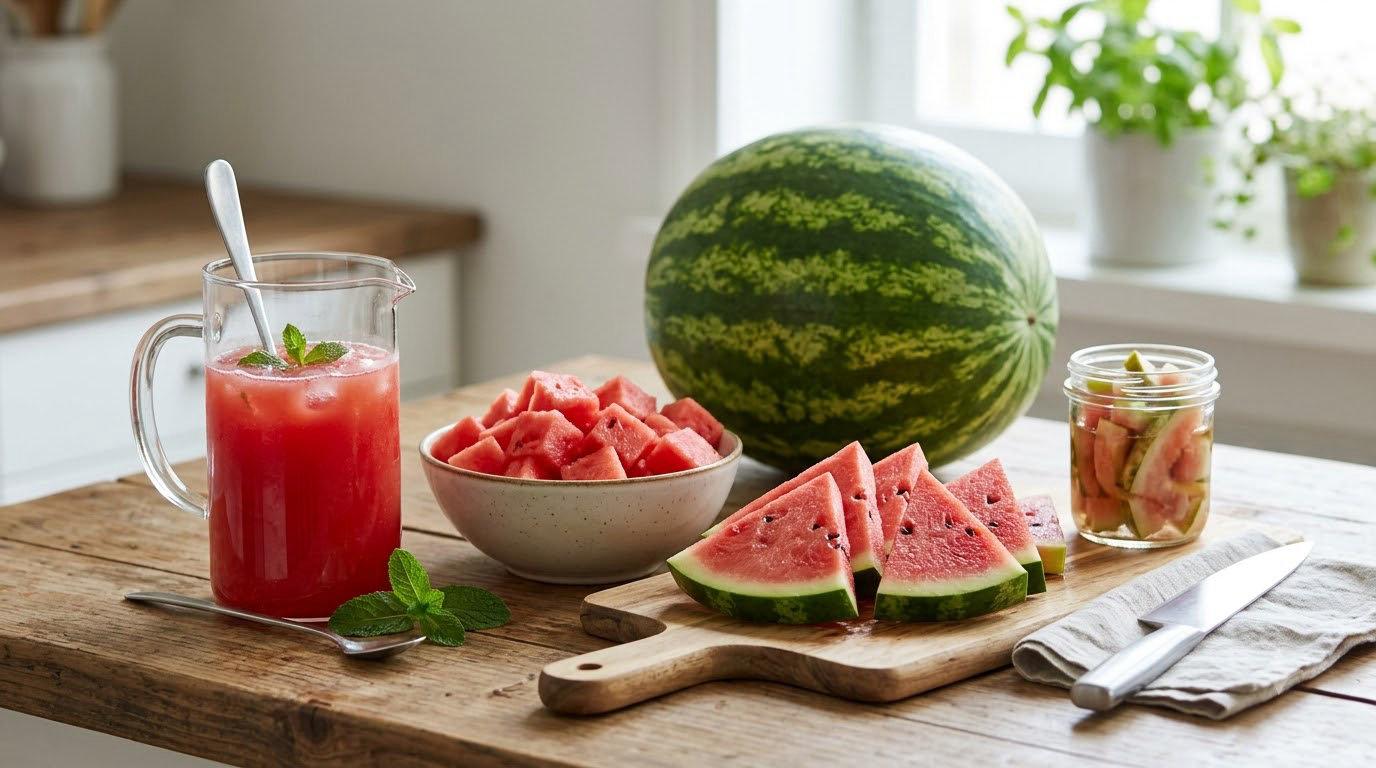
A whole, uncut watermelon keeps at room temperature for roughly 7 to 10 days, so slicing it does not start a countdown. Once it is cut, the flesh stays good in the fridge for 2 to 3 days sealed airtight, and cubes freeze for several months.
The catch is planning before you cut. A 15 to 20 lb melon is 6 to 10 servings, and a household of two or three can easily be looking at half a fridge shelf of wilting chunks by Wednesday. Here is the sequence I use: check the melon, decide whole or chilled, cut it into even pieces, store it properly, and turn it into meals and drinks on a schedule rather than saving it for a perfect moment that never comes.
Table of Contents
- What You Need
- Step-by-Step: How to Use a Whole Watermelon Before It Spoils
- Common Mistakes
- Frequently Asked Questions
- How long does a whole watermelon last at room temperature?
- How long does cut watermelon stay fresh in the refrigerator?
- Can you freeze watermelon if it is getting close to spoiling?
- How do you know when a whole watermelon is bad?
- Should you wash the outside of a watermelon before cutting it?
- What can I make with watermelon that is slightly soft?
- Conclusion
What You Need
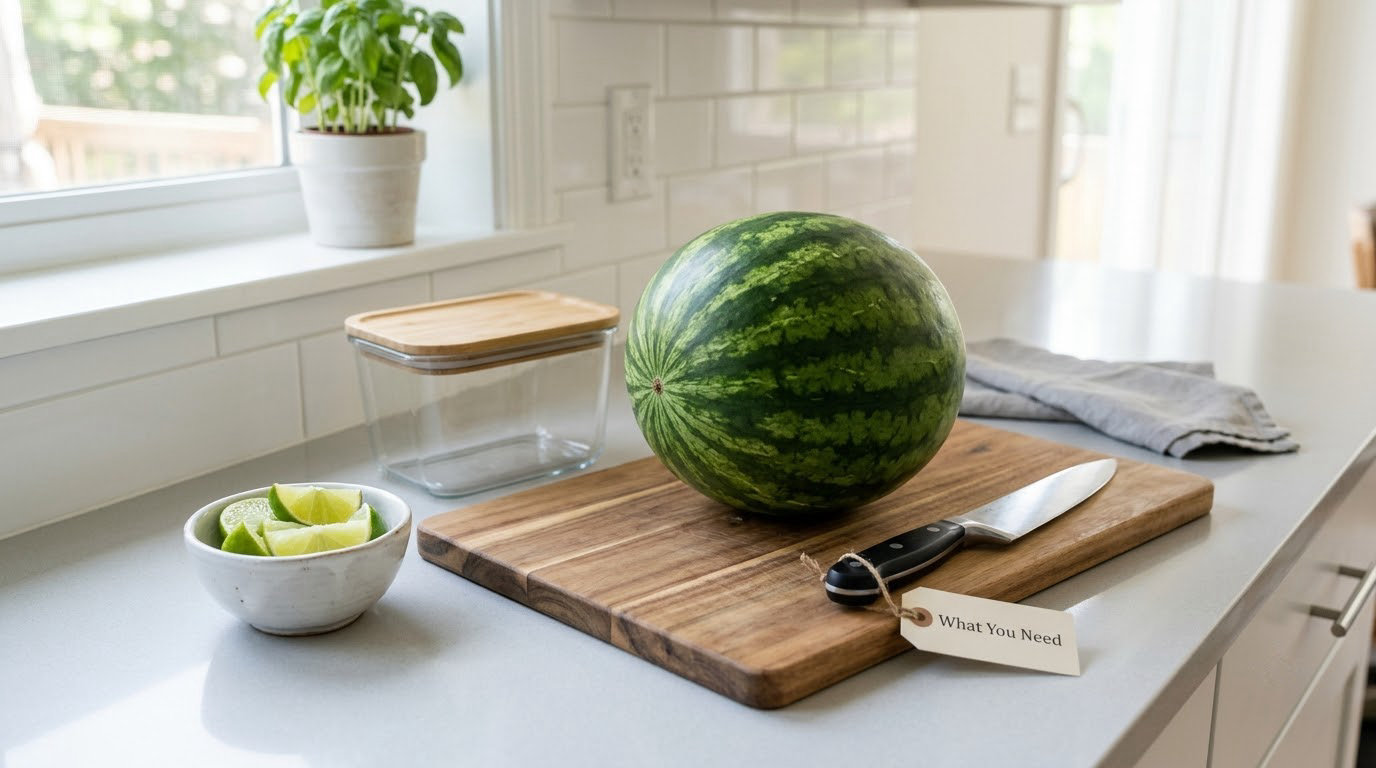
- A sharp chef’s knife or long serrated knife. A dull blade crushes flesh instead of cutting it, and the juice ends up on your counter rather than in a cube.
- A large cutting board with a damp cloth underneath. That cloth stops the board sliding while you press down, which is the difference between a clean cut and a wobble.
- An airtight glass or rigid container that leaves a little headroom. A resealable freezer bag works too, but a hard container protects the cubes from being crushed on a crowded shelf.
- A colander or steamer insert to lift cubes clear of the juice they release, or a container with a raised rack in the bottom.
- A bowl of lime or lemon wedges, a small jar of salt, and a few herbs if you plan to season anything.
Before you touch any of that, judge the fruit. Look for a rind with a dull matte finish and a creamy yellow patch where the melon rested on the ground, plus a dry, brownish stem rather than a green or wet one. Lift it if you can: for its size, a heavy melon is usually a water-dense one.
Step-by-Step: How to Use a Whole Watermelon Before It Spoils
Step 1: Check the Watermelon Before Cutting
Start outside. The rind is your first and best signal, and it is the only part of the fruit that never lies to you about spoilage. Wipe the whole melon with your palm and look for a dark, glossy, sunken patch or a soft spot that yields when you press. If the rind feels slimy, has a fermented or sour smell at the stem end, or the flesh leaks dark liquid, the fruit is finished and nothing you do in the kitchen will fix it.
Listen too. Tap the side with a knuckle: a deep hollow thud usually means a ripe, dense melon, while a higher, more elastic tap points to something that needs a day or two on the counter. A very round watermelon tends to be sweeter than an elongated one, though that is a rule of thumb, not a promise.
Here is the sign I care most about: an uncut melon with a dry, corky stem, a dark field rather than a pale grey one, and no soft patches is a melon to use now, not one to keep hoping for. Watermelon does not ripen much once picked, so delay buys you nothing but a softer rind.
Step 2: Decide Whether to Chill It Whole or Cut It
Here is the storage timeline that keeps everything honest. The interesting number is the first one, because an intact rind is a moisture seal and a microbial barrier, and that is why heat rather than cold is what damages an uncut melon.
- Whole, unripe to ripe: kitchen counter, out of sun, room temperature around 20-25C, usable for 7 to 10 days.
- Whole, cut halfway: refrigerator at 0 to 4C, usable for 3 to 4 days.
- Cut cubes, sticks or wedges: airtight container in the fridge at 0 to 4C, usable for 2 to 3 days.
- Frozen cubes: freezer bag or sealed tub, below -18C, several months and best within 3.
- Defrosted cubes: fridge, drained, 0 to 4C, 24 hours, blended straight away.
- Freshly pressed juice: sealed bottle in the fridge at 0 to 4C, 24 hours.
Refrigerating a whole melon is worthwhile only once you are two or three days from cutting it, because the fridge takes the chill out of the flesh slowly and a whole melon is a space hog. If you are going to eat it in the next day or two, the counter is fine and the flavour is better.
That timeline also answers the question people ask most: the 2 to 3 day cut window does not start when you buy the melon. It starts the moment the blade breaks the rind. A Ziploc bag is perfectly acceptable for cut pieces, provided you squeeze the air out and press the seal flat, but a rigid container is better if the fruit has already started weeping juice.
Step 3: Cut the Watermelon Safely
Wash the outside of the melon under cold running water and scrub it with a clean brush or your hands. You are not washing for cleanliness alone: the rind carries field soil and bacteria, and cutting through it with a knife puts whatever is on that surface straight into the flesh.
Dry it thoroughly, then park the melon on your damp-clothed board. Cut it in half crosswise through the stem end, not pole to pole, so you get two flat discs rather than a rolling cylinder. Stand each half cut-side down, which gives you a stable flat face, and cut each one into wedges with the skin on. Take the skin off a wedge at a time as you need it, or run the blade between flesh and rind to lift it away in one strip.
Keep your other hand flat on the rind and your fingertips curled, and keep that hand behind the blade’s travel rather than beside it. A melon wedge is slippery and wet, so cut slowly and change your grip before you feel any strain.
Now cut the flesh into even pieces rather than random chunks. Uniform cubes dry out at the same rate, which is what makes the 2 to 3 day window real instead of optimistic: in a bowl of irregular pieces, the small slivers go soft while the big wedges are still fine. A 1-inch cube is the workhorse size, and it gives you about 8 cups from a 15 lb melon.
Step 4: Store the Cut Pieces Correctly
Transfer the cubes to a clean, dry container, seal it, and refrigerate at 0 to 4C immediately. Do not rinse the cut flesh, because water speeds up both moisture loss and bacterial growth.
Lift the pieces clear of the juice. Cut watermelon keeps releasing water, and cubes sitting in a puddle lose flavour and pick up smells from the shelf above them. A container with a raised rack, or a colander set inside a deeper tub, drains the pieces and keeps the juice available for a drink later instead of wasting it.
Give the container a date. A piece of masking tape with today’s date and the word “eat” beats any memory test at the back of the fridge, and it is the single habit that stops people binning good fruit on day four.
Freeze the surplus on the same day you cut it. Scoop the cubes into a freezer bag or sealed tub in a single layer, press out the air, label the date, and freeze. They hold for several months and are best used within about three, and you can eat them straight from frozen for a cold snack. Do not plan on refreezing them after they have thawed, because the ice crystals shred the cell walls and the second freeze turns them to mush.
Step 5: Turn the Flesh into Meals and Drinks
Here is the part that actually solves the problem. Twelve ideas, each taking a few minutes, so you can spread a single melon across a week instead of forcing it into one afternoon.
- Snack cubes with lime and salt. One-inch cubes, a squeeze of lime, a pinch of flaky salt. The plainest option and the one that disappears fastest with kids.
- Sticks for lunchboxes. Cut 1 by 3 inch sticks, stand them in a flat container so they do not slide out, and skip the salt. These survive a commute better than cubes.
- Feta, mint and balsamic salad. 4 cups cubes, 100g crumbled feta, a small handful of torn mint, a tablespoon of balsamic and a squeeze of lime. This is the default answer on r/Cooking for someone trying to finish a melon alone, and it genuinely works as a meal rather than a side.
- Frozen slushie. Blend 3 cups frozen cubes with 1 cup water, the juice of one lime, a handful of mint and 2 tablespoons of sugar or honey, adding liquid a splash at a time until it moves. Serves two. This is the single best destination for a fridge that is about to give up.
- Breakfast smoothie. 2 cups cubes, 1 banana, 150g yoghurt, 1 tablespoon honey. Blend for 20 seconds and drink immediately, because a watermelon smoothie left standing turns watery fast.
- Watermelon and blueberry salsa. 3 cups finely diced flesh, half a cup blueberries, a small diced jalapeno, the juice of a lime, a pinch of salt. Spoon it over grilled fish or tortilla chips.
- Grilled watermelon with feta and chilli. Thick wedges, brushed with a little olive oil, 2 to 3 minutes a side on a hot grill until the faces caramelise. Top with feta, mint and a squeeze of lime. Heat does something odd but good to watermelon: the flesh softens and picks up a smoky sweetness it does not have cold.
- Chilled watermelon soup. 4 cups cubes blended with 1 cup cucumber, 1 cup water, 1 tablespoon lime juice, 1 tablespoon olive oil and a small basil leaf. Chill for an hour and season with salt. Serves four as a starter.
- Watermelon ceviche with shrimp. 3 cups small cubes tossed with the juice of two limes, 200g cooked shrimp, a diced red onion and a jalapeno. Let it sit 10 minutes in the fridge and serve with tortilla chips. The citrus does the curing work, so there is no raw fish involved.
- Popsicles. Blend 3 cups flesh with 1 cup coconut water and 2 tablespoons of honey, pour into small moulds, and freeze 4 to 6 hours. Keeps for weeks in the freezer.
- Infused water or tea. Drop 8 to 10 chunks into a 1.5 litre jug of water with a few mint leaves, or bruise 2 tablespoons of seeds and steep them in hot water for 10 minutes. Cheap, and it counts as using the fruit.
- Drink dispenser in the hollow shell. Scoop out most of the flesh, blend it with a litre of water, lime and sweetener, strain out the seeds, and pour it back into the emptied rind. Chill it and add spirits or sparkling water at the table.
Two parts of the fruit usually get binned and should not. The white inner rind, scraped clean of green, makes decent quick pickles: cut it into strips, salt it at a ratio of 50g rind to 10g salt, leave it 4 hours, drain, then cover it with vinegar, a spoon of sugar and the same pickling spices you use for dill. It is ready in about 24 hours. Black seeds toast on a dry pan in five minutes and salt well as a snack, and pale seeds can be steeped for a mild tea.
Step 6: Use Leftovers Before Quality Drops
This is the part I think about as the real answer to how to use a whole watermelon before it spoils, because a plan beats good intentions. A melon cut today, with the 2 to 3 day window in mind, can be worked through like this.
- Day 1, right after cutting: eat some fresh as cubes, make the feta and mint salad, and freeze the rest in single layers. Freezing on day 1 is the decision that decides whether the rest of the week goes well.
- Day 2: the fruit is at its best but softening. Blend the softer pieces into a slushie or smoothie, and cut fresh sticks from the firmer corners for lunchboxes.
- Day 3: the last safe day. Squeeze the pieces hard: if they spring back, juice them or dice them into salsa. If they are at the end of the window, freeze or cook them today, because tomorrow is a guessing game.
- Past day 3: anything that is fridge-soaked, slimy, cloudy or sour-smelling goes in the bin. If you froze early, this is where you reach for a bag of cubes instead.
One more preservation route worth knowing: thin slices on a dehydrator at about 135F turn into chewy fruit leathers in 6 to 8 hours, and they store for months. It is the one method that turns a melon into something that behaves more like a dried fruit than a refrigerated vegetable.
How to Tell Watermelon Has Gone Bad
Spoiled watermelon is easy to spot if you know which signals matter, and many of the signals people worry about are harmless. Flesh that looks pinkish-grey rather than bright red is usually just oxidation and dull flavour, not danger. Slightly soft flesh is normal on day two. A rind that is hard to cut through means a very good melon. None of those mean throw it away.
Real spoilage looks different: a sour, fermented or vinegary smell that hits you before you taste anything, a slimy or watery texture that leaves no resistance, flesh gone brown or pink-grey with dark edges, and fuzzy white or grey mould starting at the cut face. If you find mould, discard the whole container, not just the fuzzy piece. Watermelon is mostly water and a low-acid fruit, so it is not a food to trim around.
When in doubt, taste a small piece from the centre of a different cube than the one you are inspecting. Sweet and watery is fine. Sour, fizzy, or slimy is not.
Common Mistakes
Storing an unwashed melon
Not washing the rind before cutting pushes field bacteria straight into the flesh with the knife. Rinse and scrub the outside under cold water, dry it, then cut.
Leaving cut melon uncovered or in a thin bag
Exposed flesh loses water fast, takes on refrigerator smells, and dries out at the edges. Seal it airtight, or at minimum press all the air out of a freezer bag, and keep it on a lower shelf away from anything strongly scented.
Cutting on a board that slides
Wet rind on a dry board is how people hurt themselves. Put a damp towel under the board, park the melon cut-side down for stability, and keep your free hand behind the blade.
Confusing a dull rind with spoilage
A tough, deeply patterned rind and a dark matte field are signs of a good, ripe melon. Spoilage looks like a sunken slimy patch, a sour smell at the stem, or leaking liquid. Judge the whole fruit, not one spot.
Keeping too much exposed flesh in the fridge
A big bowl of loose chunks is the usual reason people give up on a melon. Store only two or three days’ worth, lift the pieces out of their juice, and freeze the surplus the day you cut it.
Refreezing thawed watermelon
The second freeze turns cubes to mush, and a watery slushie is worse than a dull piece of fruit. Blend thawed cubes within a day and do not refreeze them.
Two more things people get wrong. Cutting a whole melon and refrigerating the half you did not eat is the single most common cause of sad leftovers: if you are not eating half tomorrow, freeze it or cut it all into cubes. And skipping the date label means guessing at day three, when guessing always goes badly.
Frequently Asked Questions
How long does a whole watermelon last at room temperature?
An uncut watermelon keeps for roughly 7 to 10 days on a kitchen counter kept out of direct sun. The intact rind acts as both a moisture seal and a barrier, so room temperature damages the fruit far more than cold does. The 2 to 3 day limit applies only once the flesh is exposed. A melon already at peak ripeness will go sooner than a firmer one, so check the stem and rind before you decide.
How long does cut watermelon stay fresh in the refrigerator?
Cut watermelon, sticks or cubes last 2 to 3 days in the fridge at 0 to 4C in a sealed airtight container. Lift the pieces out of the juice they release, or set a colander inside a deeper tub, because fruit sitting in water loses flavour and picks up smells. Freshly pressed juice keeps about 24 hours. If you will not eat it within two days, freeze it the day you cut it.
Can you freeze watermelon if it is getting close to spoiling?
Yes, and that is exactly when to do it. Scoop the flesh into 1-inch cubes, spread them in a single layer in a freezer bag or sealed tub, press out the air, label the date and freeze. They hold for several months and are best used within about three. Blend them straight from frozen into a slushie or smoothie. Do not refreeze them after thawing, because the second freeze turns them to mush.
How do you know when a whole watermelon is bad?
Check the rind and the stem end. Spoiled watermelon feels slimy, has dark sunken or leaking patches, and gives off a sour or fermented smell. Cut into it and the flesh may be brown or pink-grey with dark edges, or show fuzzy white or grey mould at the cut face. If you find mould, discard the whole container rather than trimming around it, because watermelon is a high-moisture, low-acid fruit.
Should you wash the outside of a watermelon before cutting it?
Always. Rinse the outside thoroughly under cold water and scrub it before you cut, then dry it. The rind carries field soil and bacteria, and slicing through it carries that contamination into the flesh. You do not need to wash the cut flesh itself, since water speeds up moisture loss and bacterial growth. Dry the melon well after rinsing, and pat the rind with a towel so it does not slip on the cutting board.
What can I make with watermelon that is slightly soft?
Soft but not slimy is still perfectly usable, and blending is the fastest route. Toss it into a slushie with ice, lime and mint, blend it into a smoothie with banana and yoghurt, or juice it for a chilled drink. Soft flesh also works in watermelon soup and in salsa, where the texture disappears entirely. If the pieces are slimy, cloudy or sour-smelling, freeze what you can and bin the rest rather than tasting your way through it.
Conclusion
Start by checking the melon: a dry brown stem, a dark matte field, no soft patches and a heavy weight for its size mean it is ready to use now. Leave it whole on the counter for up to 7 to 10 days, refrigerate it if you are not cutting for a couple of days, and once the knife goes in you have 2 to 3 days in a sealed airtight container at 0 to 4C.
Then decide the same day how to use a whole watermelon before it spoils: cubes and sticks on day one, a feta and mint salad and a batch of slushie on day two, juice or salsa on day three, and everything beyond that already in the freezer. The rind, the seeds and the hollowed shell are all edible parts of that melon, and between them most of what people throw out ends up on a plate instead of in the bin.