
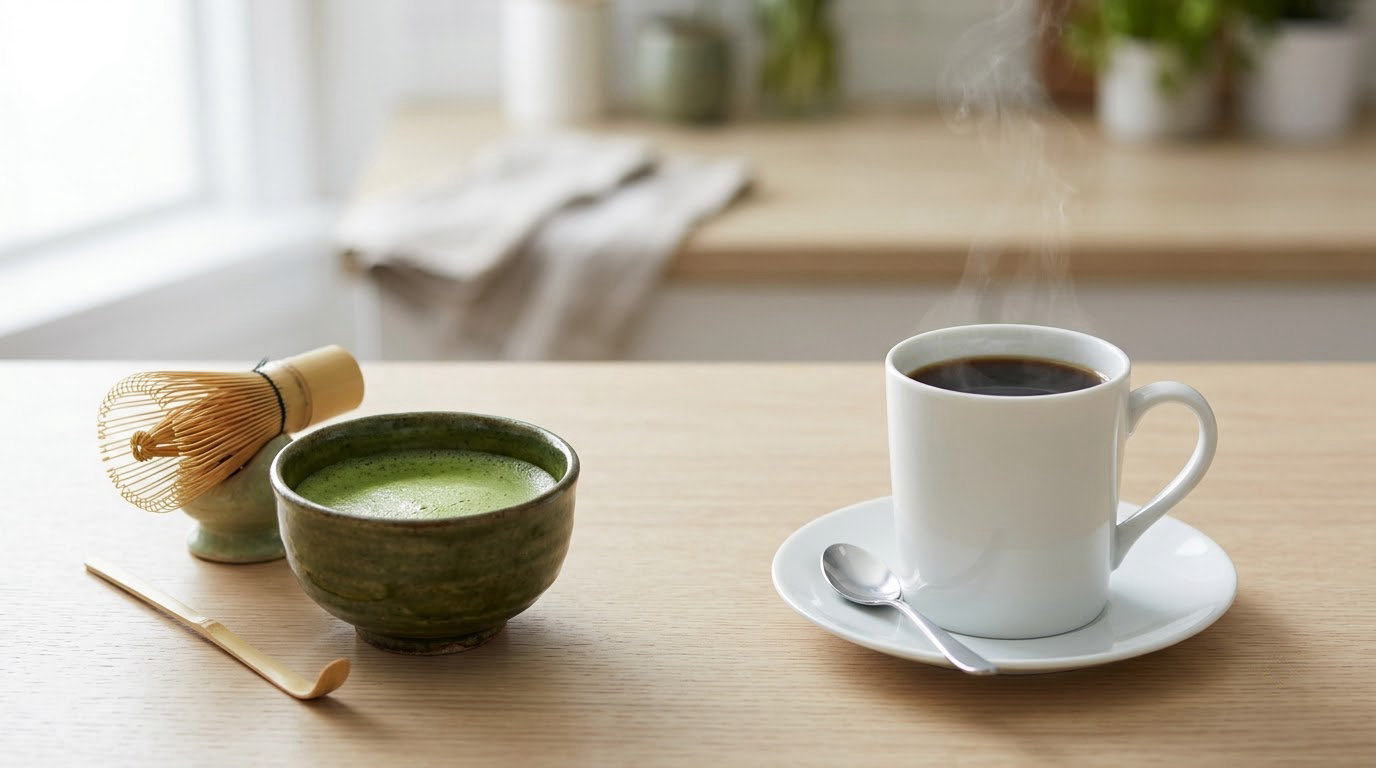
For steady energy across a few hours, matcha wins: roughly 70 mg of caffeine arriving alongside L-theanine, so alertness climbs gently and tapers instead of spiking. Coffee wins on one thing, immediate alertness — a larger dose hits faster, which is what you want on a genuinely sleep-deprived morning.
Both drinks contain caffeine, and neither is a substitute for sleep. The difference is in the delivery, not the ingredient. This comparison looks at the numbers, the shape of the energy curve each one produces, and the situations where coffee is genuinely the better tool.
This is general information, not medical advice. If caffeine affects you badly, or you take medication or have a health condition where caffeine matters, talk to your doctor or a registered dietitian before changing what you drink daily. It was last reviewed in 2026.
Table of Contents
Matcha vs Coffee for Steady Energy at a Glance
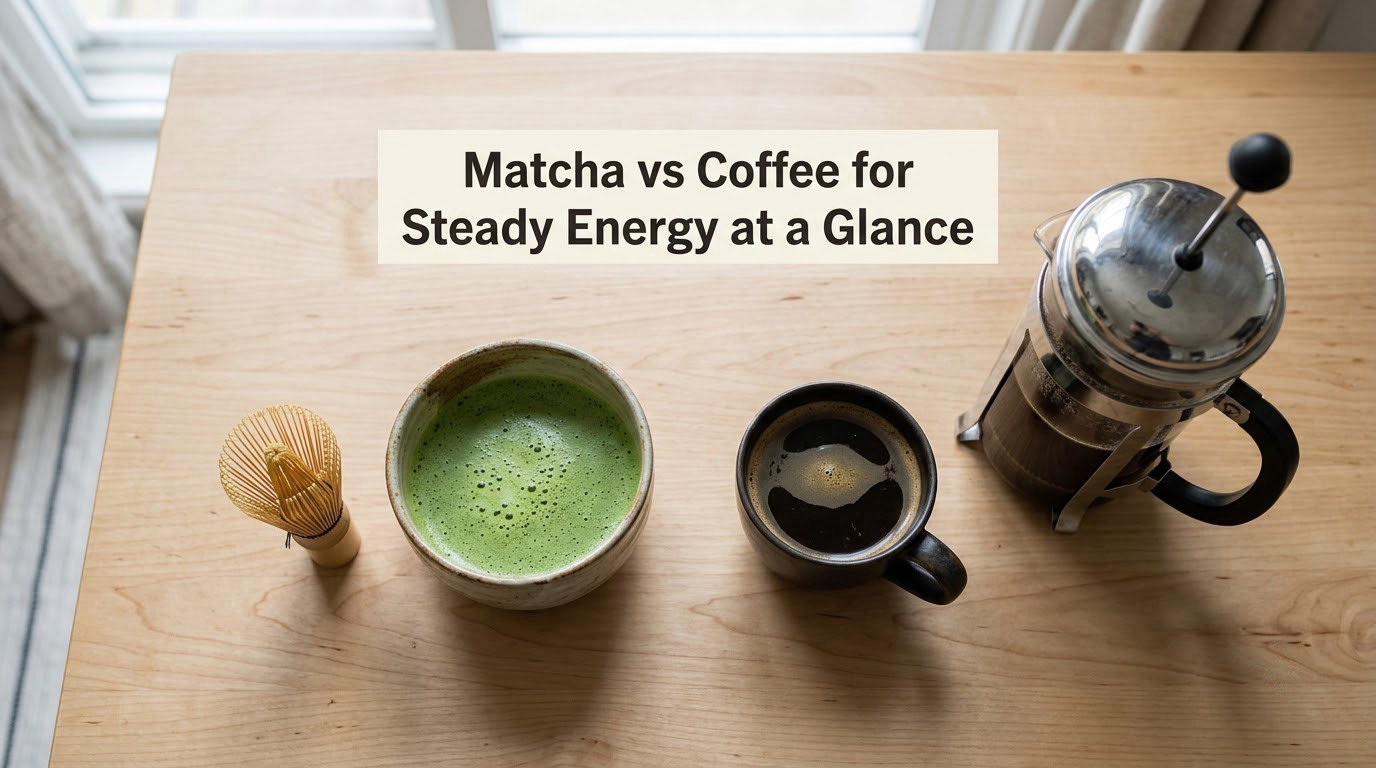
The table below is the short answer. Ranges are wide because brewing and serving sizes vary, and the figures come from USDA FoodData Central values plus published research rather than a single lab.
| Factor | Matcha | Coffee |
|---|---|---|
| Caffeine per typical serving | 38–88 mg per 1–2 g of powder, roughly 70 mg typical | 95–200 mg per 8 oz drip cup, about 63 mg per espresso shot |
| Caffeine by weight | About 2–3% of the powder | About 1% of the bean, but much of it stays in the grounds |
| Onset | 30–45 minutes, slower when taken with food | 15–45 minutes |
| Time to peak alertness | About 1–2 hours | About 30–60 minutes |
| Perceived duration | 3–5 hours of gradual taper | 1–3 hours, then a decline |
| L-theanine | Present, roughly 20–40 mg per serving | Essentially none |
| Crash likelihood | Low for most people | Moderate, especially on an empty stomach |
| Jitters or anxiety risk | Lower at typical doses | Higher, dose-dependent |
| Leading antioxidants | Catechins, including EGCG | Chlorogenic acids |
| pH | About 6–7 | About 4.5–5.5 |
| Best for | Deep work, the afternoon slump, caffeine-sensitive readers | Waking up fast, exercise, short bursts, sleep-deprived days |
If you take one row seriously, make it the duration line. “Steady” is a claim about the shape of the curve, not about how much caffeine is in the cup.
How Do Matcha and Coffee Affect Energy?
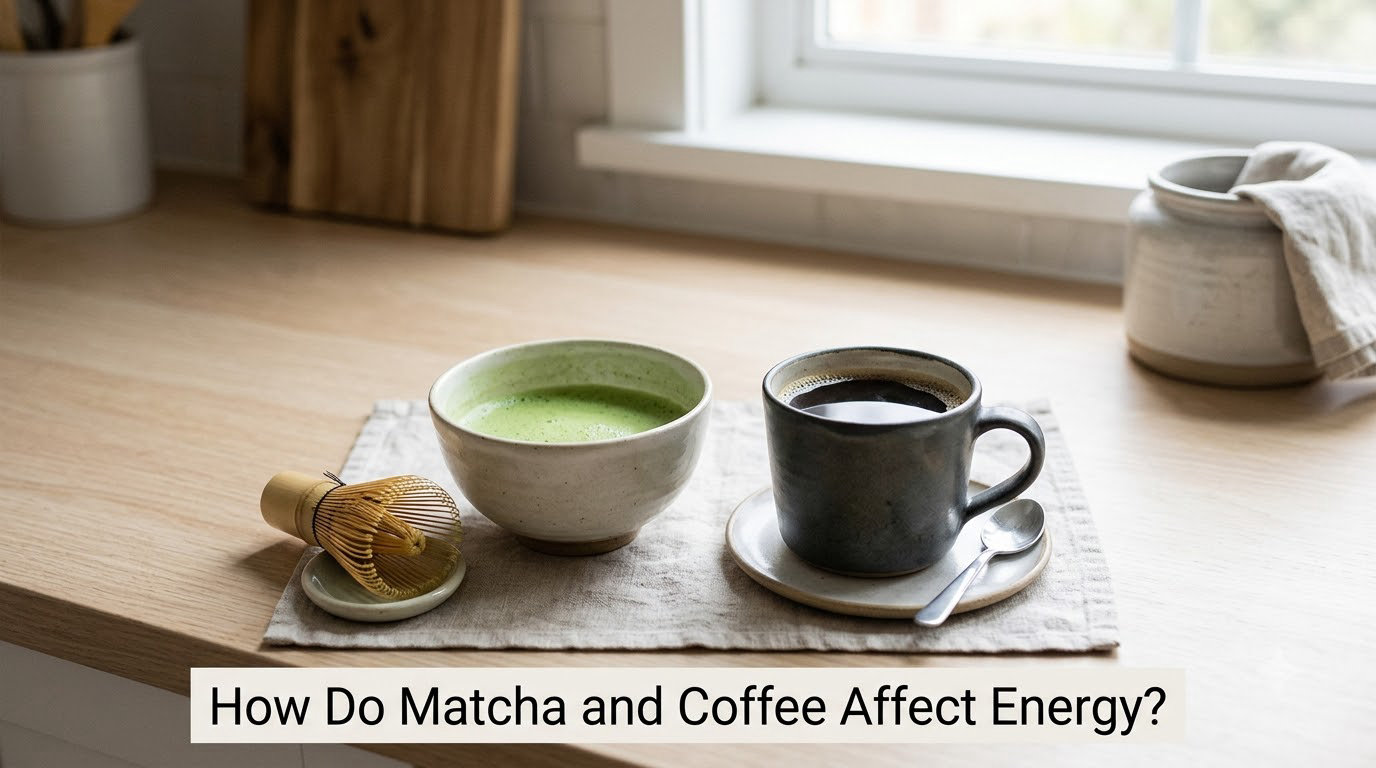
Both drinks work on the same target. Caffeine blocks adenosine receptors in the brain, and adenosine is the neurotransmitter that builds up overnight and makes you feel tired. Blocking the receptor doesn’t remove the tiredness, it hides it from you while the caffeine is present.
Everything that makes the two drinks feel different comes from how the caffeine gets there, and what arrives alongside it.
Why matcha feels calmer than coffee
Matcha is ground whole tea leaves from Camellia sinensis, so you swallow the leaf rather than drinking an infusion and discarding the grounds. Coffee extracts soluble compounds and about a third of the caffeine stays behind in the spent grounds. That is why matcha delivers more caffeine per gram than brewed coffee while still delivering less per cup.
The bigger difference is L-theanine, an amino acid found almost exclusively in tea leaves and absent from coffee. Research published in Biological Psychology in 2008 found that the combination of caffeine and L-theanine improved attention-switching accuracy and reduced mind-wandering compared with caffeine alone. People describe the effect as alpha-wave brain activity, the pattern associated with wakeful but unhurried concentration.
Does matcha spike your cortisol?
Caffeine reliably triggers a cortisol rise within about half an hour of drinking it. L-theanine appears to soften that response, which is the main reason matcha’s stimulant effect feels flatter. The practical upshot is that a matcha drinker is usually less likely to describe their morning as a jolt.
Softening a cortisol response is not the same as removing one, so anyone sensitive to stress hormones should start small and watch how they feel rather than assuming the difference is large.
Caffeine Content and Timing
Matcha typically delivers 38–88 mg of caffeine per 1–2 g serving, with about 70 mg as a reasonable midpoint. Coffee runs 95–200 mg per 8 oz cup, and a single espresso shot is roughly 63 mg. So the honest answer to “which has more caffeine” is: per cup, coffee usually does.
Why the caffeine numbers differ across sources
You will see matcha quoted anywhere from 38 mg to 88 mg and coffee from 80 mg to 200 mg across different articles. That is not sloppiness on anyone’s part — it is real variance, and four things drive it.
- Powder mass. A teaspoon of matcha weighs about half a gram to a gram. Doubling the spoon doubles the caffeine.
- Grade. Ceremonial grade is younger leaf, shade-grown and milled finer, and it generally carries more caffeine and L-theanine per gram than culinary grade, which is coarser and made from older leaf.
- Roast and brew ratio. Darker roasts and a higher grounds-to-water ratio push a cup toward the top of the coffee range. Espresso concentrates, brewed coffee dilutes.
- Infused versus consumed. In matcha you drink the whole leaf. In coffee you leave the grounds behind. Per gram of plant material, tea is the more caffeinated.
Timing follows the delivery. Coffee clears fast enough that most people feel the peak inside an hour. Matcha, taken with food and released from a solid matrix, ramps more slowly and stays in the middle range for several hours.
Caffeine itself has a half-life of roughly five hours in most adults, which is why an afternoon coffee can still be working at bedtime. That number does not change based on which drink delivered it.
Which Drink Provides More Steady Energy?
Matcha provides more steady energy. Coffee provides a faster and larger spike, then a decline that many people notice as a crash or an afternoon dip.
The matcha vs coffee for steady energy curve, hour by hour
Coffee: alertness climbs steeply, peaks between 30 and 60 minutes, holds near that peak for another hour or so, then falls. If you were running on poor sleep, that top end is exactly what you want. If you slept fine, it can overshoot into restlessness and then undershoot into fatigue around the two-to-three-hour mark.
Matcha: alertness climbs gradually, reaches a shallower peak around one to two hours, and tapers over three to five hours. Because the caffeine is bound up in leaf material and arrives with L-theanine, the rise and the fall are both flatter.
What steady actually depends on
None of this is guaranteed by the beverage itself. Perceived steadiness changes with dose, whether you ate, how much you slept, and your tolerance.
- Dose. The gap between a comfortable cup and a large cup matters more than the gap between matcha and coffee.
- Food. Matcha on an empty stomach hits faster than the 30–45 minute figure suggests. Coffee on an empty stomach is the classic setup for jitters and a sharper crash.
- Sleep. No drink converts four hours of sleep into eight hours of function.
- Tolerance. Daily drinkers get a smaller peak and a less obvious decline. That is tolerance, not a change in the curve.
Matcha vs Coffee: Antioxidants and Nutrients
Both drinks are genuinely rich in plant compounds, and the honest framing matters more than the ranking. Matcha leads on antioxidant density because you consume the whole leaf: EGCG, a catechin, is concentrated in fresh young leaves, and figures published in a 2003 chromatography paper put matcha well ahead of brewed green tea on a per-serving basis.
Coffee leads on volume and contributes a different class entirely, chlorogenic acids, which are associated in observational work with metabolic markers. “Bigger antioxidant effect” is not a meaningful conclusion from that comparison, because the compounds and the study designs differ.
Two practical notes. Matcha carries meaningfully less caffeine but also tannins that can interfere with iron absorption, so people managing low iron are usually advised to drink it away from meals and check with their clinician. And coffee is markedly more acidic, which is why it bothers some people’s reflux far more than matcha does.
Taste, Texture, and Daily Use
Matcha tastes grassy, sweet and sometimes marine, with a texture that comes from suspended leaf particles. Coffee is roasted and acidic, and it can be adjusted almost endlessly by grind, ratio and roast.
Preparation is the real trade-off. Brewed coffee takes a minute in a machine. Matcha takes a minute to whisk, but it asks for new equipment, a sieve to sift clumping powder, and water around 70–75°C — boiling water makes it bitter. That learning curve is the single most common reason people try matcha once and go back to coffee.
Grade is worth getting right for energy purposes. If you want the caffeine and L-theanine in the drink, ceremonial grade at one teaspoon is the sensible starting point, roughly 25–35 mg. Culinary grade is made for baking and smoothies, where the bitterness is covered.
Why matcha became the drink everyone is ordering
The shift is mostly cultural rather than nutritional, and it is worth being clear about that.
- The whisking ritual photographs well and reads as a deliberate, considered morning rather than a caffeine transaction.
- The lower caffeine per cup made it easy to market to people who felt coffee was too strong.
- Cafés turned it into a visual category of its own, distinct from a flat white or a cold brew.
- It sits naturally in a wellness conversation that coffee, with its jitters reputation, did not.
None of that changes the chemistry. It explains why you keep seeing it.
Which Should You Choose?
Choose coffee when you need alertness now, when you are exercising, when you slept badly, or when you simply prefer it. It is faster, more available, and cheaper per cup at home. Choose matcha when your work needs three hours of even attention rather than forty minutes of urgency, or when caffeine makes you anxious.
Some readers should stay with coffee. Anyone managing an anxiety condition, iron deficiency, arrhythmia, reflux, or caffeine-sensitive medication should talk to a clinician first, and pregnancy has its own widely published caffeine guidance that applies to matcha exactly as it does to coffee. Many people on the anxiety forums describe coffee as the one drink that makes them feel like they cannot breathe, which is not a mild complaint.
A workable middle path is stacking them: coffee at the start of the day for the fast onset, matcha mid-morning or early afternoon for the long tail. That pattern gives you both curve shapes and keeps total caffeine under the 400 mg daily ceiling the FDA cites for healthy adults.
What people report when they switch
Community discussions are more useful than marketing here, and the pattern is consistent. On r/Anxiety, users describe coffee as the worst of the two for panic symptoms, while several note that the sustained benefit they wanted came from ordinary black tea rather than matcha specifically. On r/decaf, one user drinks a morning matcha of around 50 mg before meditation and says it is enough to stop them nodding off.
On r/tea, people correct the common claim that matcha is simply weaker than coffee: per gram of plant it is more caffeinated, per cup it is less. On r/AskReddit and r/veganfitness, the usual summary is that coffee is instant and tea builds over time, and several users keep coffee anyway because they want more raw caffeine.
The recurring fear is worth naming directly. Swapping a strong coffee for one cup of matcha and expecting the same jolt leaves people disappointed and exhausted. That is a dosing mistake, not proof that the switch failed.
Frequently Asked Questions
Is matcha better for energy than coffee?
For sustained energy over several hours, yes. Matcha delivers roughly 70 mg of caffeine together with L-theanine, so alertness climbs gently and tapers over 3-5 hours with little crash. Coffee delivers a larger, faster dose with no L-theanine, peaking in 30-60 minutes and fading within a few. Coffee is still the better choice when you need to be sharp immediately or you are running on poor sleep.
Does matcha spike your cortisol?
Caffeine of any kind tends to raise cortisol within about 30 minutes, and matcha is not exempt. What differs is that L-theanine, the amino acid found in tea leaves and not in coffee, appears to soften that caffeine-triggered response, which is part of why matcha’s effect feels flatter. If you are sensitive to stress responses, start with a teaspoon and adjust from there rather than assuming the difference is large.
Is matcha better than coffee to keep you awake?
If you mean genuinely short on sleep, coffee is the better tool. Its larger, faster dose produces the sharpest possible rise in alertness, which matters when fatigue is the problem. Matcha is the better choice when you are adequately rested but need three to five hours of even focus. Note that caffeine has a half-life of around five hours regardless of source, so an afternoon cup of either can affect your night.
Will I feel exhausted if I switch from coffee to matcha?
Usually not, as long as you replace the dose rather than deleting it. A single teaspoon of ceremonial matcha is roughly 25-35 mg of caffeine, so if you were drinking two strong coffees, one cup of matcha is a large cut. People who report exhaustion after switching usually dropped from a high caffeine load to a small one overnight. Reduce gradually over a couple of weeks and keep the total near your previous level.
How much caffeine is in matcha compared with coffee?
USDA FoodData Central values put matcha at 38-88 mg per 1-2 g of powder, with about 70 mg typical. Brewed coffee runs 95-200 mg per 8 oz cup, and a single espresso shot is roughly 63 mg. Per cup, coffee usually contains more. Per gram of plant material, matcha contains more, because you swallow the whole leaf while most of the caffeine stays in the coffee grounds.
Why is Gen Z obsessed with matcha?
Mostly cultural rather than nutritional. The whisking ritual is visually distinctive and reads as a deliberate morning ritual, the lower caffeine per cup made it easy to position as a gentler option than coffee, and cafés built it into a distinct menu category. Social platforms amplified the visibility of that ritual. None of this changes the chemistry of the drink, but it explains why matcha appears on so many café counters.
Conclusion
Matcha is the better drink for steady energy because its caffeine arrives with L-theanine in a slower, flatter delivery, giving three to five hours of even alertness without a spike and a crash. Coffee is the better drink when you need alertness now, when you slept badly, or when you want something cheaper and faster to make.
Start with a modest serving, one teaspoon of ceremonial matcha or one cup of coffee, and adjust from there based on how you sleep and how your body responds. Keep the total under 400 mg a day and stay clear of both in the final six hours before bed. And if you are using either drink to get through chronic sleep debt, that is the problem worth fixing first.