
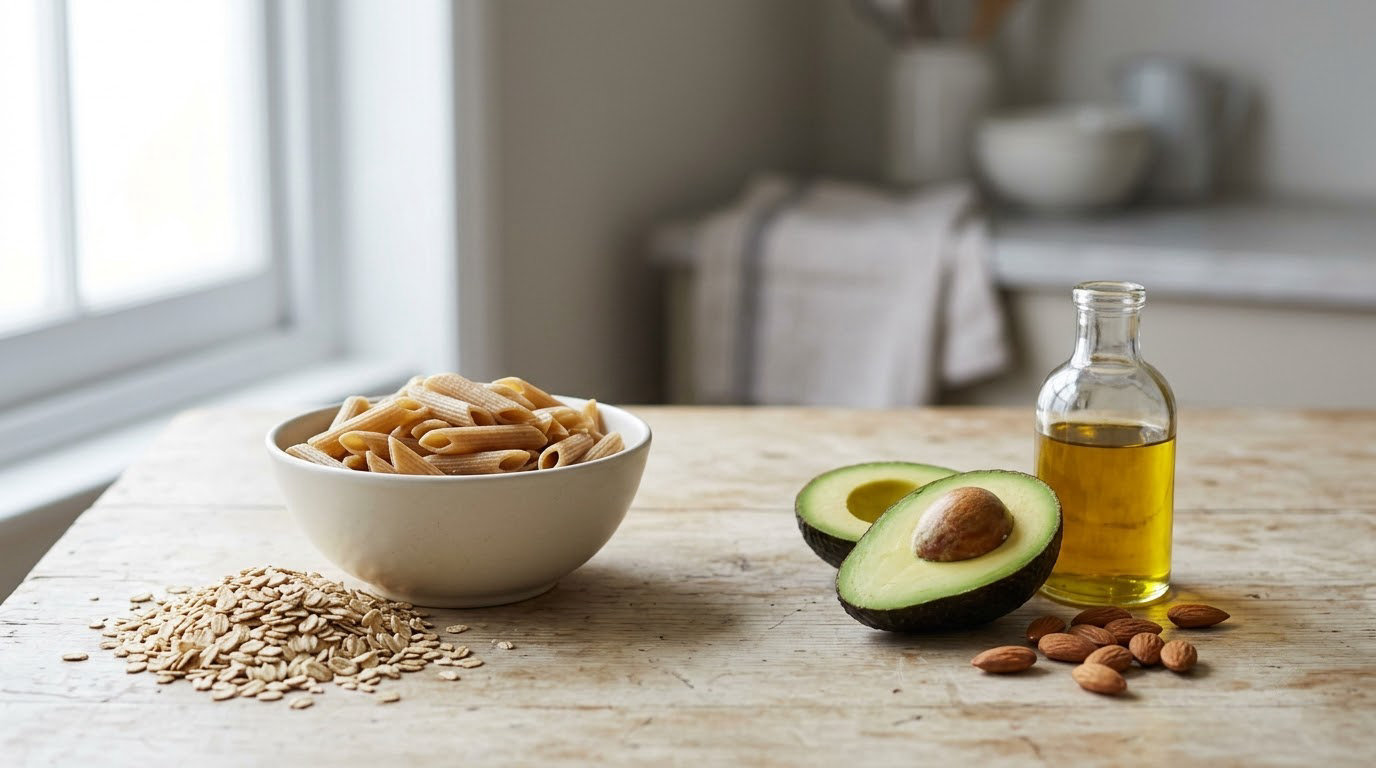
Fat packs more energy into each gram than carbohydrate, roughly 9 calories against 4. But carbohydrate is the fuel your body burns fastest and most easily, which is why carbs tend to feel like immediate energy and fat feels like long-haul fuel. For most people, carbs vs fat for energy explained comes down to one thing: which demand you are trying to meet.
That is genuinely the short answer. Both are usable fuel, both are stored in advance, and your body switches between them many times a day without announcing it.
This guide is written for readers who are tired of the argument and just want a working framework. It covers how each fuel is produced and used, why timing and fullness differ, and how to match your plate to your actual week. If you have a medical condition, are pregnant, or manage diabetes, kidney disease or an eating disorder history, talk to a doctor or registered dietitian before changing your intake.
Table of Contents
Carbs vs Fat for Energy Explained at a Glance
| Criterion | Carbohydrates | Fat |
|---|---|---|
| Energy per gram | 4 calories | 9 calories |
| How the body gets it | Broken down to glucose, then stored as glycogen in liver and muscle | Broken down to fatty acids, and to ketone bodies when carbohydrate runs low |
| Speed of availability | Fast, often within minutes of eating | Slower; digestion, absorption and mobilization take longer |
| Where it is stored | About 400 to 500 grams of glycogen across liver and muscle | Body fat, which holds many times more total energy |
| Needs oxygen | No, anaerobic energy works without it | Yes, fat oxidation depends on available oxygen |
| Effect on insulin | Raises blood glucose and insulin, especially refined forms | Minimal direct effect on blood glucose |
| Typical fullness | Moderate, unless high in fiber | High, slows stomach emptying |
| Best fit for | Higher-intensity work and quick nourishment | Long, moderate efforts and staying satisfied between meals |
| Food examples | Oats, rice, potatoes, fruit, bread, beans | Olive oil, avocado, nuts, seeds, fatty fish, eggs |
One number worth holding on to: fat is 2.25 times more energy-dense than carbohydrate. That single fact explains most of the rest of this guide.
How Carbs and Fat Provide Energy
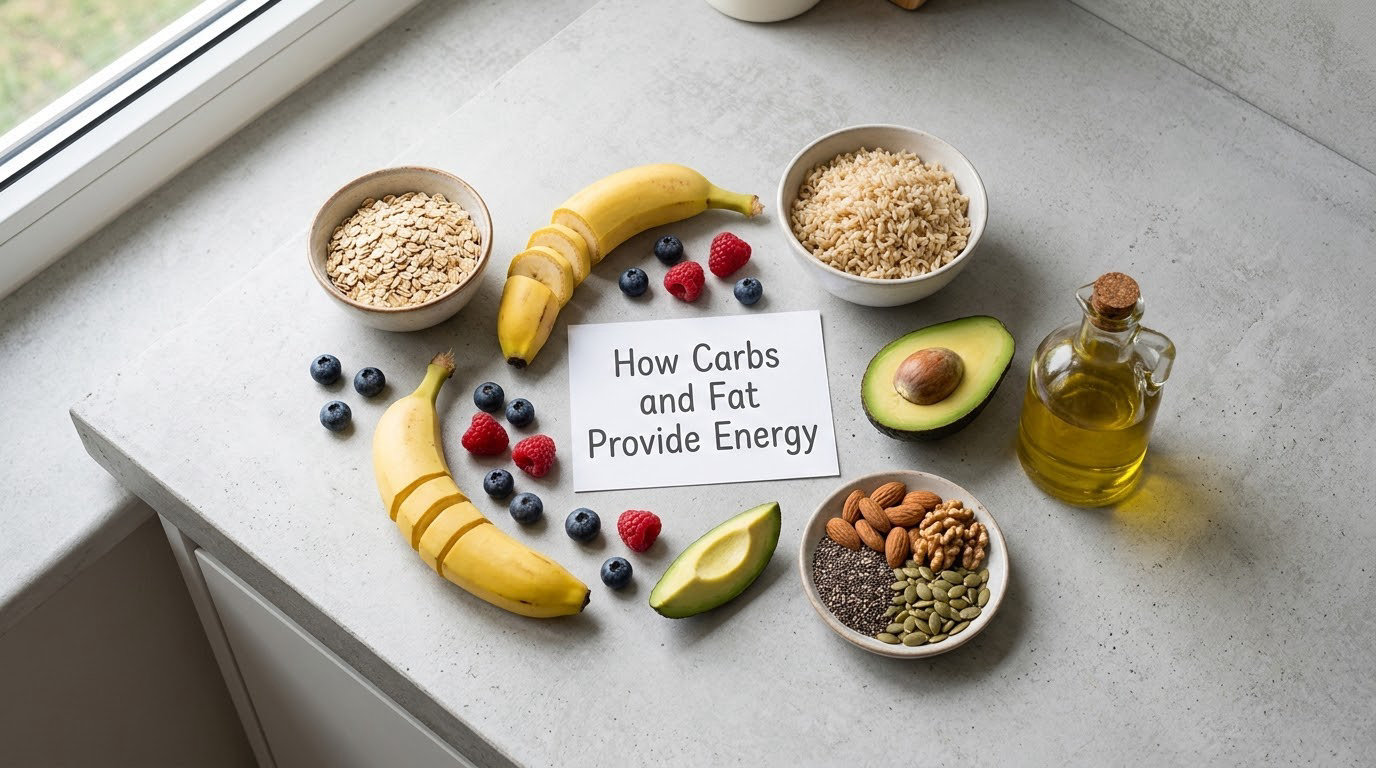
Carbohydrates become glucose and ATP
Cellular respiration is the same machinery for every fuel: glucose or fatty acid molecules are broken down and the released energy is captured as ATP, the usable currency of the cell. Most of that ATP gets made inside mitochondria through oxidative phosphorylation.
Carbohydrate has the shorter route. Digestive enzymes break starch and sugar down to glucose, glucose enters the blood, and cells take it up. With plenty available, the body stores extra glucose as glycogen, mainly in the liver for fasting use and in muscles for local use during effort.
Liver glycogen is limited, roughly 80 to 120 grams in a typical adult. Muscle glycogen varies a lot with training and diet, often landing somewhere around 300 to 400 grams.
Fat becomes fatty acids and ketones
Dietary fat is stored as triglycerides and released through lipolysis. Those fatty acids travel to muscle, enter mitochondria and go through beta-oxidation before joining the same ATP-producing pathway carbohydrate uses.
When carbohydrate runs low, the liver converts fatty acids into ketone bodies, which the brain and other tissues can burn. That state, ketosis, is a genuine alternative fuel source rather than a magic switch.
Why fat cannot burn as fast as carbohydrate
This is the piece most online arguments skip. Carbohydrate can produce ATP with or without oxygen, so it supports efforts where oxygen delivery lags behind demand, such as a sprint or a heavy set of squats.
Fat oxidation cannot. It needs ample oxygen delivered to working muscle, so its rate rises gradually and plateaus at a fairly low ceiling even with training. For a long, steady effort, fat is the dominant fuel and there is no contest.
Put simply: fat gives more energy per gram, carbohydrate gives more energy per minute.
Carbs vs Fat: Which Gives Faster Energy?
Carbohydrate wins on speed. Glucose from a meal can be reaching working muscle within an hour, and stored glycogen can be released on demand, which is why pre-exercise carbohydrate matters for anything hard.
Fat takes the long path. A fatty meal has to be digested, absorbed, packaged into chylomicrons, stored, then mobilized before the fatty acids become widely available. That delay is usually irrelevant across a day and very relevant in the 60 minutes before a race.
The energy spike myth
Carbohydrate does not automatically cause a crash, and fat does not leave energy untouched. A spike followed by a slump is far more often about the whole meal: refined carbohydrate with little fiber and little protein, eaten in a large portion on its own.
Thread that through this guide and you get carbs vs fat for energy explained honestly: neither nutrient is inherently calm or chaotic. Dose, fiber, protein, portion size and what else is on the plate do most of the work.
Carbs vs Fat: Which Is More Satiating?
Neither one wins on its own. Protein and fiber have a larger effect on fullness than carbohydrate versus fat, and they are the two things people most often under-eat.
Why protein and fiber outrank both
Protein carries the strongest satiety signal of any macronutrient and adds a small thermic cost as it is digested. Fiber resists digestion, holds water, slows emptying and feeds gut bacteria that signal fullness upward.
A bowl of lentils beats a bowl of white rice because of what the lentils add, not because lentils are lower in carbohydrate.
When fat wins on fullness
Fat slows gastric emptying measurably, which stretches the time between hunger signals. Meals built around olive oil, avocado, nuts or seeds tend to hold people longer than meals built on refined carbohydrate alone.
When carbs win on fullness
Whole grains, legumes and fruit bring fiber and volume with them, and starchy carbohydrate eaten earlier in the day tends to leave people less hungry at the next meal. Refined carbohydrate does not do this well.
Carbs vs Fat: Which Is Better for Exercise?
Match the fuel to the intensity and the duration. That single habit outperforms any argument between the two nutrients.
- Easy to moderate effort, long duration: fat is the main fuel. Walking, easy cycling, hiking and a steady Zone 2 session run comfortably on fatty acids with little need for carbohydrate.
- Zone 2 base training: mostly fat with a carbohydrate contribution that rises as pace increases. This is where metabolic flexibility shows up most clearly.
- Higher intensity, 45 to 90 minutes: carbohydrate oxidation climbs sharply and matters more than it does at easy pace.
- Hard intervals, sprints, heavy lifting: carbohydrate leads. Anaerobic work depends on ATP and glycogen available immediately, which is why a carbohydrate-focused meal beforehand makes sense.
- Very long endurance events: carbohydrate is still central because gut training and topping up glycogen matter more than fat adaptation at race pace.
- Recovery: carbohydrate replenishes glycogen quickly, while protein supplies amino acids for repair. Fat plays a supporting role rather than the leading one.
If you train early and need something quick and practical, my guide to what to eat before a morning workout for energy walks through the timing and portion side of this.
Metabolic flexibility, in plain English
Metabolic flexibility is your ability to burn fat when fat is the sensible fuel and carbohydrate when carbohydrate is the sensible fuel. It tends to be better in people who train regularly, eat a moderate amount of carbohydrate, and move most days of the week.
You improve it with habits rather than tricks: consistent aerobic work, enough carbohydrate to fuel hard sessions, protein spread across the day, sleep, and resistance training. Restricting carbohydrate hard for long stretches and then adding a hard session on top is the pattern most likely to leave you flat.
Carbs vs Fat: How to Choose a Balanced Mix
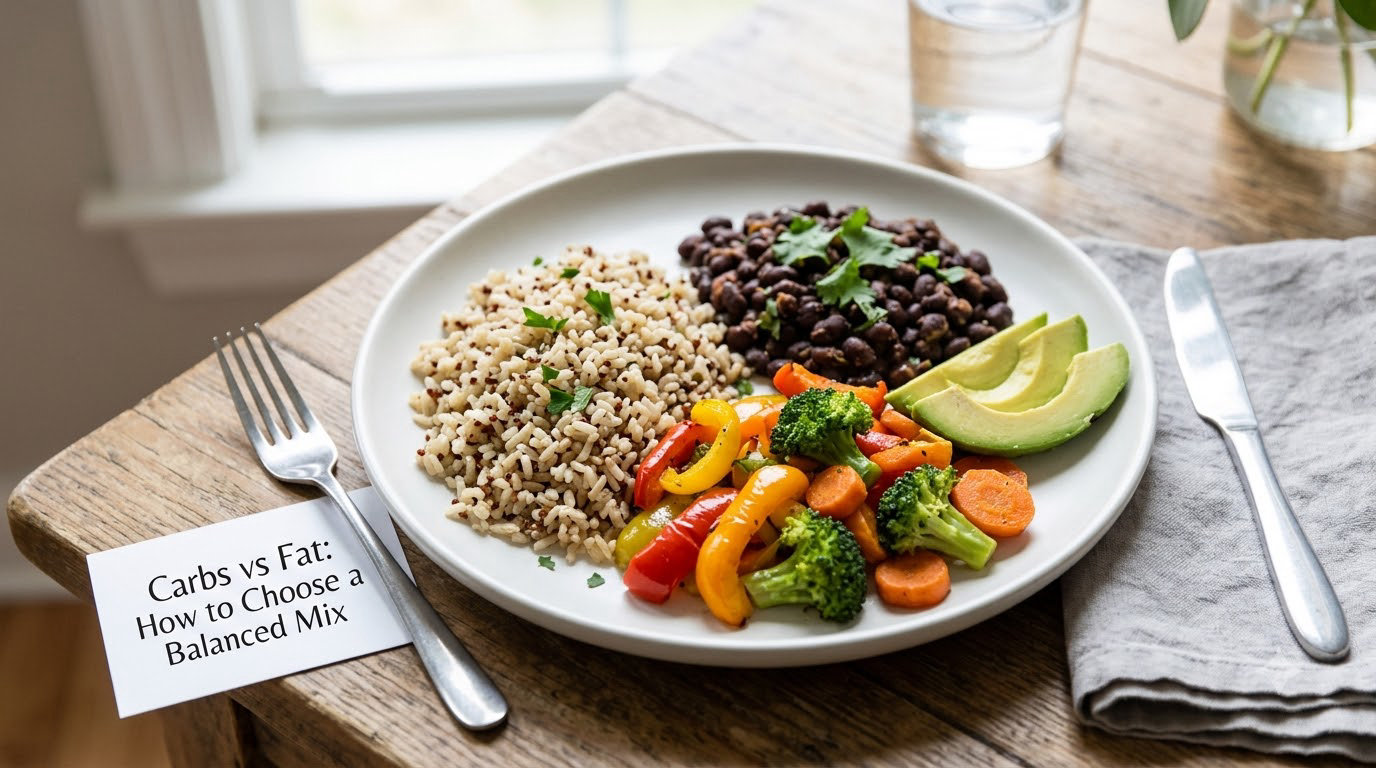
Build meals from components rather than macros. A carbohydrate source, a protein source, something with fat, and vegetables or fruit will carry most people through a normal day without any further math.
Three patterns that work
The steady day. Oats with fruit and nuts at breakfast, a grain and legume lunch with olive oil, a protein and vegetable dinner. Energy holds steady because each meal carries all three nutrients.
The training day. More carbohydrate around sessions, especially before harder ones, with fat pulled back a little in those same meals since fat slows digestion. Fat stays where it is not competing for absorption time.
The lower-carbohydrate day. Eggs, avocado, nuts, seeds, fish, leafy greens and non-starchy vegetables. It suits some people fine, and the first one to three weeks often bring the flatness and irritability people describe on r/keto. Most notice improvement by around two to four weeks, though some take longer.
Where fat does structural work
Fat is not only fuel. It helps absorb vitamins A, D, E and K, supports cell membranes and hormone production, and it makes food taste good enough that you eat it. Replacing fat with refined carbohydrate tends to backfire on fullness.
Choosing unsaturated sources, mostly olive oil, nuts, seeds, avocado and fish, is the pattern mainstream dietary guidance points toward.
Which Should You Choose?
Carbohydrate-forward meals suit high-intensity training, quick nourishment, and anyone who wants that fast, reliable fuel. Fat-rich foods help meals feel satisfying and make low-carbohydrate patterns workable for people who prefer them.
A mixed eating pattern is the most flexible starting point for the widest range of people, and the pattern mainstream guidance recommends: roughly 45 to 65 percent of calories from carbohydrate and 20 to 35 percent from fat, with the rest from protein.
Adjust from there rather than defending a position. More carbohydrate and more training for hard efforts. More fat and more protein or fiber for a desk-bound afternoon. Either way, the numbers matter less than consistency across weeks.
Blood glucose and lipid panels respond to food patterns, and so does your own energy. If you are managing a condition, taking medication, pregnant, or have a history of disordered eating, get individual guidance from a doctor or registered dietitian rather than copying a generic plan.
Frequently Asked Questions
Does fat provide more energy than carbohydrates?
Yes. Fat supplies about 9 calories per gram while carbohydrate supplies about 4, making fat 2.25 times more energy-dense. Density is not the whole story though. Carbohydrate can be oxidized faster, and it works without oxygen, so it supports short high-intensity efforts that fat cannot. More energy per gram does not mean more usable energy per minute.
Are carbohydrates bad for energy?
No. Carbohydrate is the body’s preferred fuel for most daily activity and the main fuel for the brain. Quality and context matter more than the nutrient itself. Whole grains, legumes, fruit and starchy vegetables come packaged with fiber and nutrients, while refined carbohydrate eaten on its own in a large portion is the version most likely to leave you hungry again an hour later.
Is a low-carbohydrate diet better for weight loss?
It depends on the person and on adherence. Restricting carbohydrate often reduces total calorie intake, and for some people that lower appetite alone drives weight loss. Studies show similar average weight loss across well-matched low-carbohydrate and low-fat diets when calories and protein are matched. Plenty of people find a moderate carbohydrate pattern easier to sustain, and sustainability is what decides long-term results.
Should I eat carbs or fat before exercise?
For an easy or moderate session, either is fine and fat will often make you feel comfortably full. For anything hard, more than about 45 minutes, or competitive, go heavier on low-fiber carbohydrate beforehand, such as rice, bananas, toast or bagels, because fat slows digestion and fiber adds bulk. That is the practical answer behind carbs vs fat for energy explained: intensity decides the timing.
Why do I feel tired after eating a high-fat meal?
Large high-fat meals commonly cause a wave of sleepiness and mental fog afterward. Fat is energy-dense and slows stomach emptying, so a heavy meal can feel like a lot of volume sitting there, and blood flow shifts toward digestion. Some people also feel it after high-fat meals because they cut carbohydrate the same day. Smaller portions, more protein, and pairing fat with vegetables usually resolves it.
How many grams of carbohydrates and fat should I eat per day?
For a 2,000 calorie intake, mainstream guidance puts carbohydrate at about 225 to 325 grams and fat at about 44 to 78 grams a day, with the remainder from protein. Those are population ranges rather than personal targets. Athletes training hard often sit at the upper end for carbohydrate, and people training little may sit lower while keeping fat in a sensible range.
Start with one meal: add a carbohydrate source, a protein source and some fat to what you already eat tomorrow, and notice how your afternoon feels. From there, shift the carbohydrate up around hard training days and keep fat doing its job of making the rest of your meals satisfying. That is the whole argument, minus the shouting.