
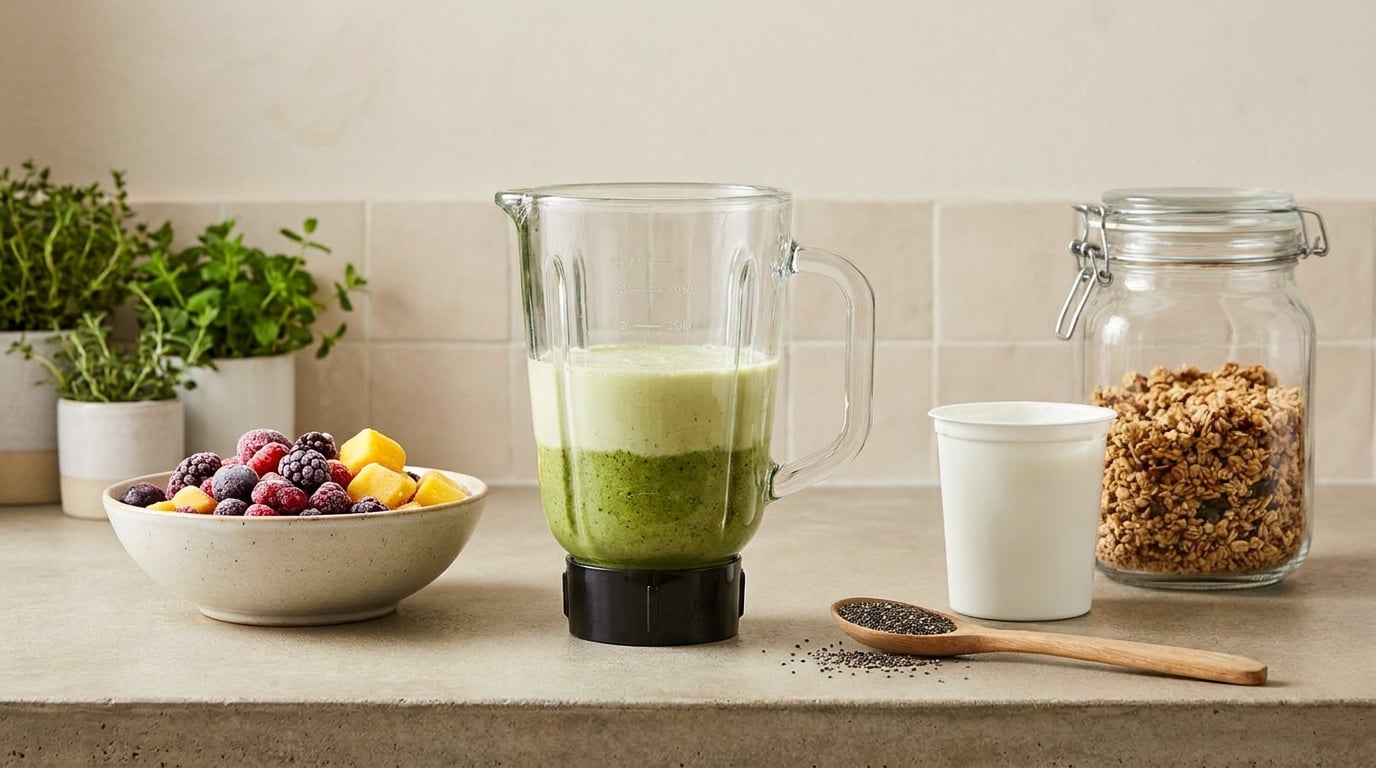
If you are wondering why my smoothie separates in the fridge, the short reason is simple: blending only holds ingredients together for a few hours. Fruit pulp, fiber and frozen pieces are denser than the water and juice around them, so once the blender stops and the smoothie cools, gravity pulls the heavy stuff down and the thin liquid rises. A split smoothie is usually physics, not spoilage.
That said, a split smoothie is annoying to drink and it is a waste of good fruit if you pour it down the sink. Once you know which part of the blend is doing the splitting, you can fix the current jar in a minute and adjust the next batch so it survives the night.
Table of Contents
Why Does a Smoothie Separate in the Fridge?
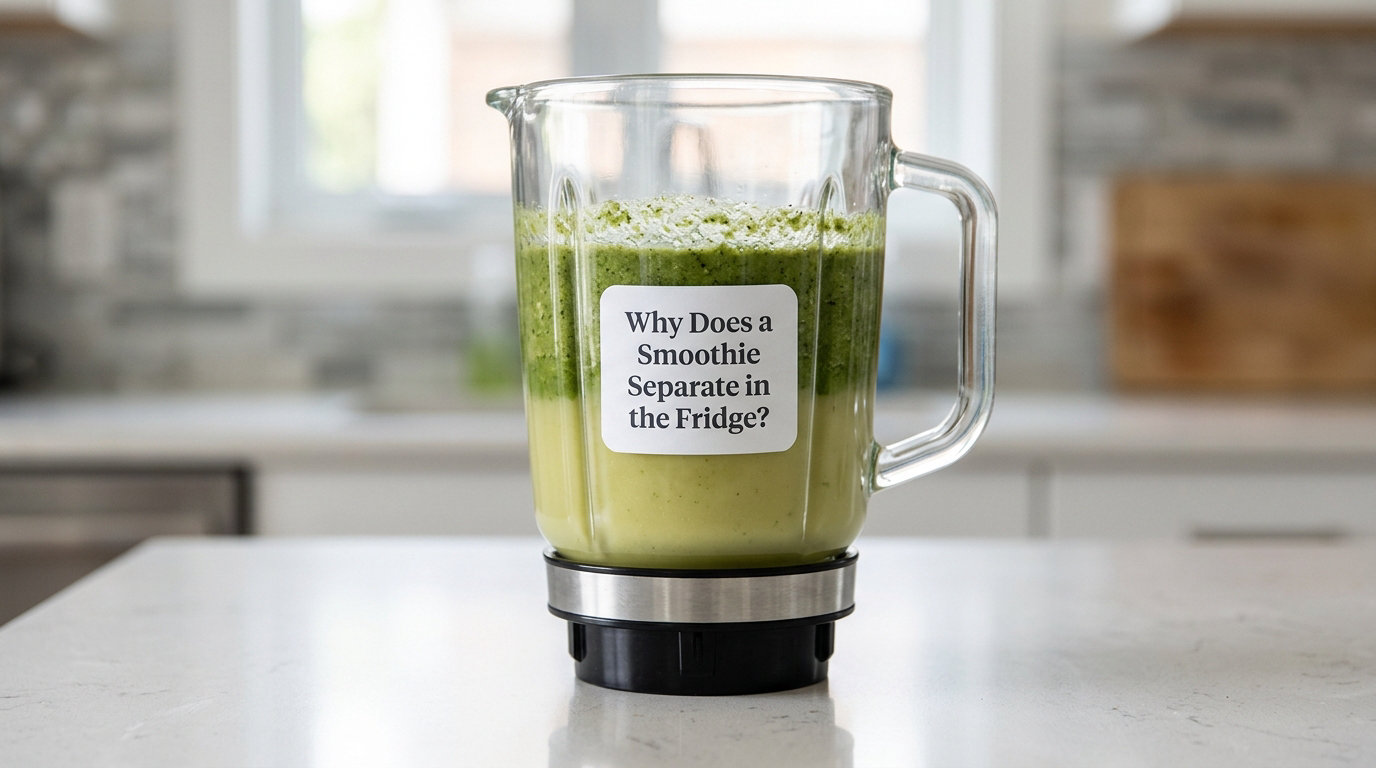
A smoothie separates because it is a suspension, not a stable mixture. The blender forces fruit pulp, seeds, oil and water into an even cloud for a few minutes, and when the blades stop, the denser particles sink while the lighter liquid rises. Refrigeration speeds this up: cold thickens the fat and pulp and thins the water, which widens the difference between the two phases.
It works the same way a vinaigrette splits. Shake it and the oil disperses again for a while, but nothing in the jar is actually bonded together, so it separates once more.
Two different problems get lumped under the word separation, and they need different fixes. The first is layering, where pulp and thick sediment fall to the bottom and clear liquid sits on top. The second is dilution, where ice has melted and thinned the whole drink. A jar can do both at once, and that is usually why it looks bad by breakfast.
Time and temperature do most of the work here. A blend that is stable for thirty minutes on the counter will often look split after eight hours at 4°C. The cold gives the fat and fiber time to firm up while the water thins out, so the contrast between the layers grows rather than shrinks.
Some batches never split at all, and it is usually because something in them is acting as a thickener. Greek yogurt, nut butter, chia, ground flaxseed and avocado all add body that keeps particles suspended instead of letting them drop. A smoothie built only from fruit and water has nothing doing that job.
How to Fix a Smoothie That Has Separated
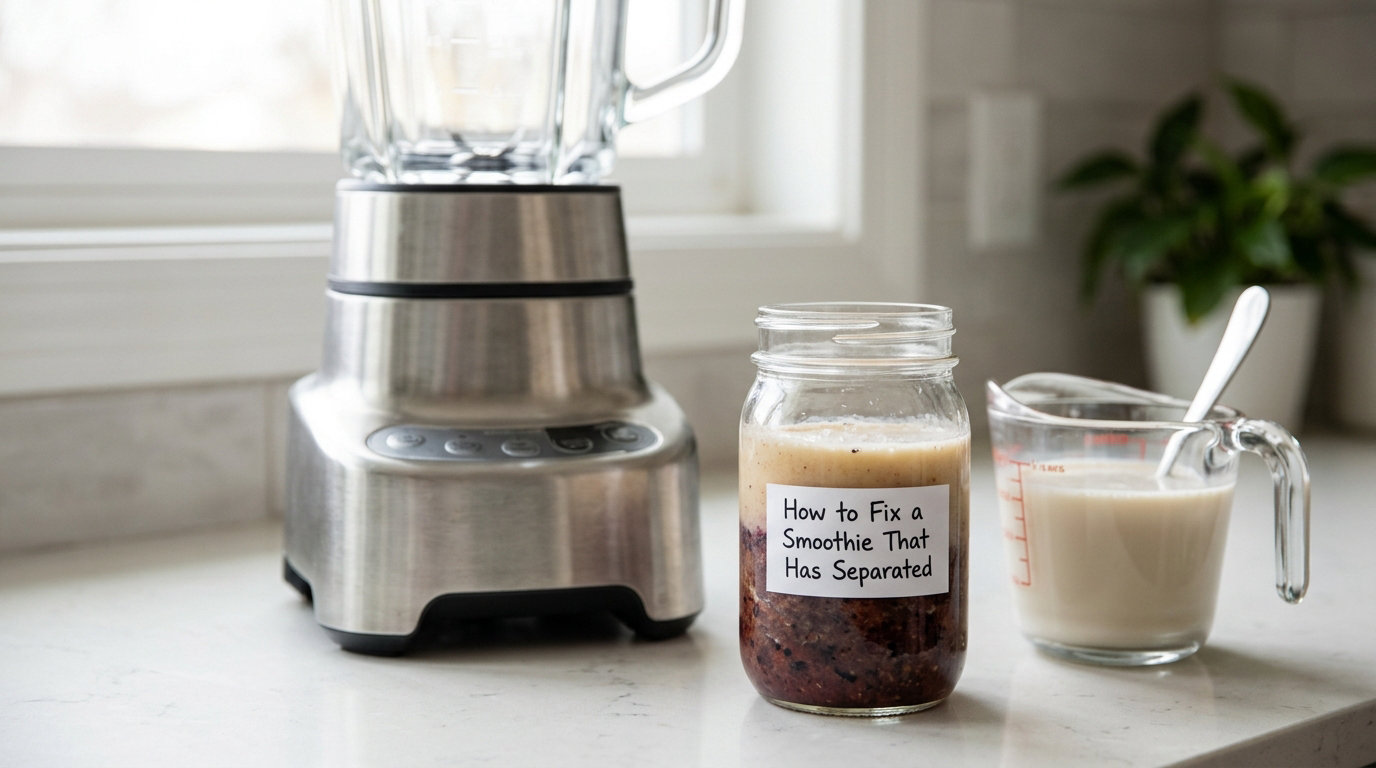
Start by checking that it is safe to drink, not by checking that it looks pretty. Smell it and look at it in daylight, and toss it if anything is off rather than trying to blend the problem away.
What to do when your smoothie separates in the fridge overnight
1. Check the smell and the color. Fresh fruit, dairy sourness and a faint fruity smell are all normal. An off smell, visible fuzz, a slimy surface or a fizzy, blown-up seal means the jar has been warm or warm enough for something to grow, and no amount of shaking fixes that.
2. Loosen the lid and shake it. Put one hand over the top, invert the jar and shake hard for fifteen to twenty seconds. That is usually enough to pull the sediment back into suspension, and it costs nothing. If the lid is a pop-top, open it before you invert so you do not spray the ceiling.
3. Add liquid if it is thinner than you like. A layered smoothie often just needs thinning back to where it started. Add a tablespoon or two of the same liquid you blended with, cold milk, water or plant milk, and shake again. Do the reverse if it has turned gluey: add a splash of liquid and shake.
4. Re-blend briefly if the container is blender-safe. A mason jar with a removable blade, or a cup that came off a blender, can go back on the blades for five to ten seconds. A short pulse is enough, and it does more for texture than ten minutes of stirring.
5. If you cannot re-blend it, use a blender at home. Pour it in and blitz for fifteen seconds. If it is at work and you are stuck with a sealed bottle, shaking is the only real option, so getting the next batch right matters more.
One thing people get wrong is reaching for ice to fix a thin smoothie. Ice melts into extra water and pushes you further from the texture you wanted. Blend in a small handful of frozen fruit instead, or add a spoon of yogurt or nut butter to push the thickness back up.
Which Ingredients Make Smoothies Separate?
Some ingredients actively pull a blend apart, and knowing which ones lets you predict the problem before it happens.
Chia and flax seeds are the biggest surprise culprits. They absorb water and swell for hours after blending, which changes the texture overnight and leaves a dense layer at the bottom. A spoonful is fine for a smoothie you drink straight away. It is a poor choice for a make-ahead jar, and ground flaxseed does the same thing faster.
Protein powder behaves the same way. Powders disperse in liquid, but once the liquid thins out in the fridge the protein clumps and drops. This is why protein smoothies often separate faster than fruit smoothies with no powder in them. Mixing the powder into the liquid before adding the fruit reduces it, though it never removes it entirely.
Nut butter and coconut oil add fat, and fat rises. A little fat is useful because it carries flavor and coats particles, but a thick layer of almond butter or melted coconut oil will pool at the top. Fat that is too heavy to be held by the liquid rises first, and cold makes it firmer and more obvious.
Yogurt and dairy are the stabilizers that hold everything else up. The protein and fat in Greek yogurt keep particles in suspension for far longer than fruit and water alone do. Plain yogurt that curdles is a different issue, usually caused by acidic fruit sitting on dairy overnight.
Frozen fruit is steadier than ice. Frozen fruit adds fiber and body as it blends, so it thickens rather than thins. Plain ice is just water that will melt into the jar and dilute whatever you made.
Here is how the common ingredients behave once they sit overnight:
| Ingredient | What it does in the jar | Better for make-ahead |
|---|---|---|
| Chia seeds | Swells and settles into a thick bottom layer | Not ideal, use a small amount |
| Ground flaxseed | Gums the liquid, then drops sediment | Not ideal |
| Protein powder | Clumps as the liquid thins | Mixed into liquid first |
| Nut butter | Fat pools near the top | Yes, a tablespoon is fine |
| Coconut oil | Sets into a solid layer when cold | Keep it under a teaspoon |
| Greek yogurt | Protein and fat hold particles up | Yes, the best single fix |
| Avocado | Adds fat and fiber, thickens | Yes, a quarter is plenty |
| Frozen fruit | Adds fiber and body as it blends | Better than ice |
| Plain ice | Melts and dilutes the whole drink | No, skip it |
| Almond or coconut milk | Thin liquid with little protein | Fine, but not stabilizing |
| Berries and citrus | Acid can curdle dairy overnight | Pair with non-dairy milk |
How to Keep a Smoothie Smooth in the Fridge
Most of the prevention work happens at the blender, and only a little happens in the fridge. Asking why my smoothie separates in the fridge usually comes down to one thing: thin liquid with nothing doing the job of holding particles up. These are the changes that made the biggest difference in my own batches.
Frozen fruit instead of ice. This is the single biggest change. Fruit ice carries fiber and flavor, so the drink keeps its body, while water ice just thins the drink and gives the pulp somewhere to fall.
Get the liquid-to-solid ratio right. If the fruit will not move at the start of blending, the mixture is too dry and the blades are just spinning air. Start with a generous pour of liquid, then add more fruit if you need thickness back.
Ramp the speed up instead of hitting high straight away. A quick burst on low pulls everything into a vortex, then a steady high speed emulsifies it. Dropping frozen fruit straight onto full speed often leaves chunks behind, and chunks are what end up at the bottom of the jar by morning.
Add liquid ingredients before dry ones. Liquid first, then soft fruit, then frozen fruit and powders, with any nut butter or yogurt after that. It gives the blades something to work with instead of dry powder caking on the sides.
Build in one thickener. Two tablespoons of Greek yogurt, a tablespoon of nut butter, a quarter of an avocado or a teaspoon of a gum like xanthan all do the job. On the Ask MetaFilter thread about natural stabilizers, pectin and gums came up repeatedly as the commercial answer, and the same principle applies at home.
Fill the container to the brim and seal it tight. Users on the Mumsnet overnight smoothie thread reported that filling the jar completely, leaving almost no air gap under the lid, made a real difference to how the drink looked the next morning. The air is what drives oxidation, and oxidation is what turns banana brown and dull.
Store it in the coldest part of the fridge, not the door. A door warms up every time it opens, and the temperature swings make texture changes faster. A back shelf holds a steadier chill.
Make single portions. A small jar you will drink in one sitting has less time to break than a large bottle you sip over two days. The second day of a big bottle is when a smoothie tastes most watery.
If your mornings are the problem, there is a trick several people on those forums use: load the blender cup the night before with everything except the liquid, refrigerate it, and blitz first thing. Thirty seconds of work, and the smoothie tastes like it was just made.
Why Some Smoothies Separate More Than Others
The type of smoothie you made matters more than how long you keep it.
Green smoothies separate the fastest. Spinach, kale and celery are mostly water and fiber, and that fiber is heavy and loose. With no fat and no protein in the blend, the leaves drop almost immediately, which is why a green smoothie can look layered within ten minutes.
Fruit smoothies hold the best. Banana, mango and berries bring pectin and fiber along, and pectin is exactly the stuff that thickens a drink and holds particles up. A fruit-only smoothie with no added liquid is fairly stable.
Dairy smoothies are steady but can curdle. Milk and yogurt proteins and fats give you a natural emulsifier, so they rarely split. The risk is acid: berries, pineapple, kiwi and citrus can make dairy proteins clump overnight, and the result looks curdled rather than separated.
Plant-milk smoothies are thinner. Almond, oat and coconut milks are mostly water with far less protein than dairy, so they do not hold structure. They are lighter in taste too, which makes the separation more obvious.
Nut butter and coconut smoothies split upward. More fat means a richer flavor, but that fat rises when the drink gets cold. A tablespoon of almond butter is fine, a quarter of a cup is not.
Adding fat and fiber to a green or low-protein smoothie fixes the most common complaint. Half a banana, a spoon of almond butter or two tablespoons of Greek yogurt will hold together overnight where the plain version sat in two layers by breakfast.
How Long Does a Smoothie Last in the Fridge?
Treat a freshly blended smoothie as a perishable food and keep the fridge window short. It is a blended product made from cut fruit and often dairy, so the same storage logic as any other cut produce applies.
Same day is the best window. The texture is what you just made, and nothing has had time to settle, which is the whole reason people make smoothies in the morning.
One day overnight is the practical limit for most make-ahead batches. A well-built smoothie with a thickener and a full, sealed container should be drinkable the next morning with a good shake.
Two days is pushing it, and day three is where I throw it out. If it has been at room temperature for more than two hours, or sat in a warm car, discard it even if it smells fine. Bacteria do not always change the smell.
There are other signals worth trusting over the calendar. Visible fuzz, a slimy top, a swollen or leaking lid, or a fizzy smell when you open it all mean the same thing. If in doubt, throw it out, and blend a smaller amount next time.
Freezing works well as a longer option. Pour the finished smoothie into a jar with room for expansion, freeze it solid, then move it to the fridge and let it thaw overnight in the morning. The texture comes back closer to freshly blended than anything you would get by storing it liquid, and it is the approach people on the Mumsnet thread reported liking most for a workday bag.
Frequently Asked Questions
How do I keep my smoothie from separating?
Add one thickener such as two tablespoons of Greek yogurt, a tablespoon of nut butter, a quarter avocado or a teaspoon of xanthan gum, and blend it in early. Use frozen fruit instead of plain ice, fill the container completely, seal it tightly, and keep it on a back fridge shelf. Most splits come from thin liquid and no body, not from the container.
Why does my smoothie look separated?
Because blending creates a temporary suspension rather than a permanent mixture. Denser pulp, fiber and protein settle downward while water, juice and melted ice rise to the top, and the fridge makes it worse as cold thickens the fat and thins the liquid. Time alone is often enough. You can fix most cases by shaking the jar hard for fifteen seconds.
Do chia seeds make my smoothie thicker overnight?
They do, and that is the problem for a make-ahead jar. Chia keeps absorbing water after blending, so it thickens, forms a dense layer at the bottom and leaves the liquid above thinner than you intended. It is a good thickener for a smoothie you drink immediately. For a jar that sits overnight, use Greek yogurt or avocado instead.
Do smoothies go bad in the fridge?
Treat them as perishable. Same day is best, one day overnight is the practical limit for a make-ahead batch, and day two is pushing it. Discard anything that smells off, shows fuzz, feels slimy, has a swollen lid or was left at room temperature for more than two hours. Freezing the blended smoothie and thawing it in the fridge is a safer route for longer storage.
Should I put flax or chia seeds in my make-ahead smoothie?
Usually not for a jar that sits overnight, since both keep swelling and drop sediment after you blend. Ground flaxseed works faster than whole, so it separates quicker. If you want the nutrition and you are drinking the smoothie within the hour, either one is fine. If it is sitting in the fridge, choose Greek yogurt, avocado or nut butter for texture instead.
Does separation mean the smoothie has gone bad?
No, not by itself. A split layer at the bottom and a thinner layer on top is a normal physical change, and the nutrition has not vanished, it has just stratified. Smell it, look at it, and if both are normal, shake it and drink it. Fuzz, slime, an off odor or a fizzy lid are different signs entirely and mean discard it.
Conclusion
Shake it. That is the first thing to do with a jar that split in the fridge, as long as it smells and looks normal. Fifteen seconds of hard shaking fixes most drinks, and a splash of the liquid you used originally fixes the rest.
A separated smoothie is not a spoiled one. It is a suspension that lost its temporary structure, and that is expected once cold fruit, pulp and liquid sit together for hours.
For your next batch, swap ice for frozen fruit, add two tablespoons of Greek yogurt or a tablespoon of nut butter, fill the container to the brim, and keep it at the back of the fridge. Those four changes fix most of what I used to find in my work bag every morning.