
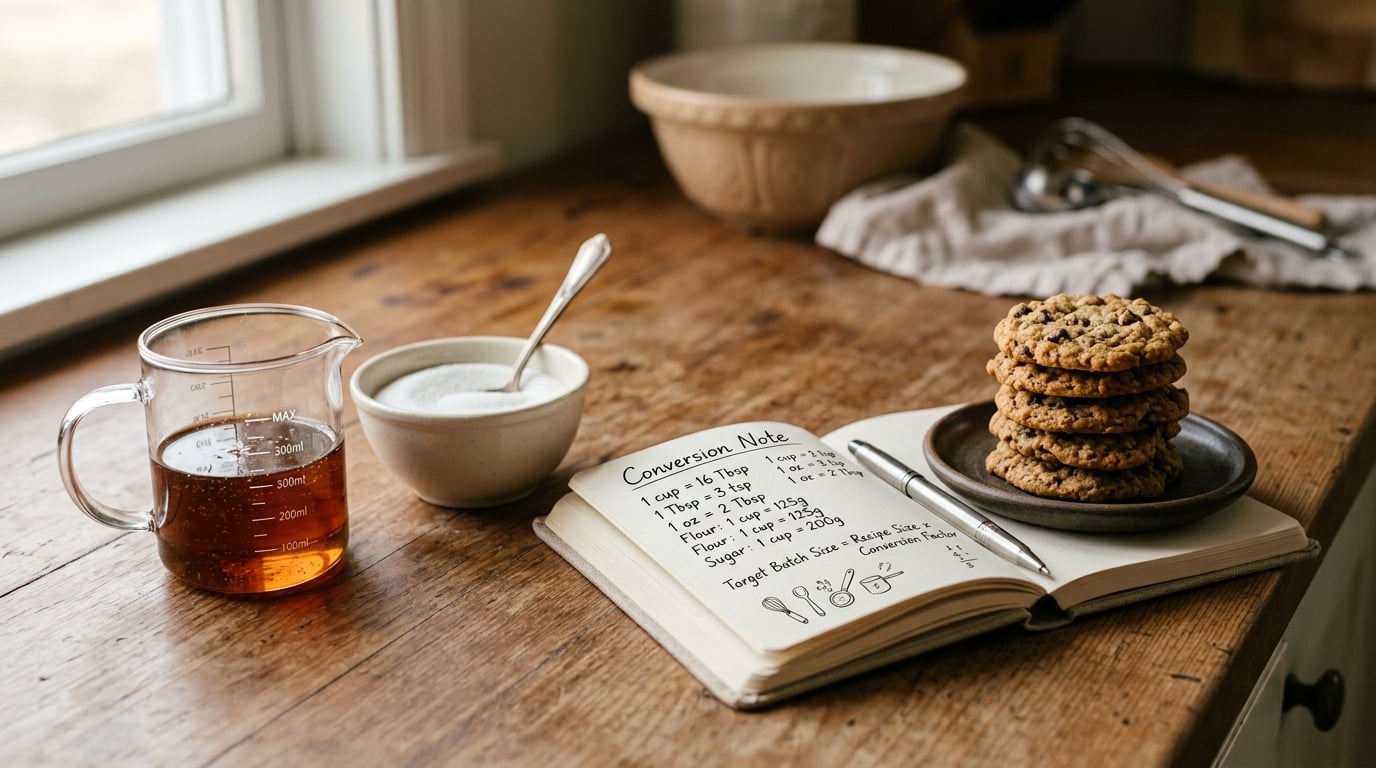
Use 3/4 cup of maple syrup for every 1 cup of granulated sugar, then remove 3 to 4 tablespoons of the recipe’s other liquid. That is the whole trick, because maple syrup is roughly 75% sugar and 25% water, so a one-for-one swap turns batter into soup. The ratio published by King Arthur Baking and the Vermont Maple Sugar Makers’ Association works well across cookies, quick breads, muffins and glazes once you account for that extra water.
How to substitute maple syrup for sugar in recipes takes about five minutes of arithmetic per recipe, and it changes the flavor profile more than the sweetness. Syrup bakes darker, stays chewy and carries a woodsy note that plain white sugar does not have.
Table of Contents
Key Adjustment Steps at a Glance
These are the adjustments that make the swap work, in the order I would make them:
- Measure by volume first: 3/4 cup maple syrup for every 1 cup of granulated sugar.
- Pull back the other liquid by 3 to 4 tablespoons per cup of syrup used, taken from milk, water, coffee or the melted butter.
- Add 1/4 to 1/2 teaspoon of baking soda per cup of syrup, unless the recipe already contains an acidic ingredient like molasses, brown sugar, honey, yogurt or cocoa.
- Drop the oven by about 25F so the edges and the pan bottom do not scorch before the center sets.
- Use maple sugar 1:1 when you want the swap to be completely painless. Granulated maple sugar is dehydrated, so it needs no liquid reduction at all.
What You Need
You need three tools, and honestly only one of them matters. A liquid measuring cup is essential, because the standard ratio is a volume ratio and dry sugar cups and syrup cups are not interchangeable on a kitchen scale. A small digital scale is a nice second tool for the weight-based version of the same math. A written note or a notes app catches the ratio that worked, which saves you re-deriving it next time.
The syrup itself deserves a quality check. Grade A amber maple syrup is the grade sold for table use, and it is what a baking conversion assumes. Cooking-grade syrup, the stuff sold in bulk to make fudge and candy, tastes flatter and is often thinner, so it will not carry the same maple flavor once it bakes. Pure maple syrup, not a corn syrup blend, is the other thing to confirm. Blended “maple-flavored” syrup behaves more like a neutral sugar syrup, so it cooks up flatter and leaves you wondering where the flavor went.
Then check three variables in the recipe before you convert anything. First, the amount of sugar by volume or weight. Second, the total liquid in the batter, which is usually milk, water, coffee, yogurt, egg or melted butter. Third, the leavening. Sugar does more in a recipe than sweeten it, and understanding which of those three jobs sugar is doing in your recipe tells you how much trouble the swap will cause.
What You Need also includes a cooling rack and a decent timer, because the last step in this process is tasting something that has stopped steaming. Maple-syrup bakes run a little differently on the inside even when the outside looks done, and a straight-from-the-oven slice will mislead you.
Step-by-Step
Step 1: Check Whether the Recipe Can Take Maple Syrup
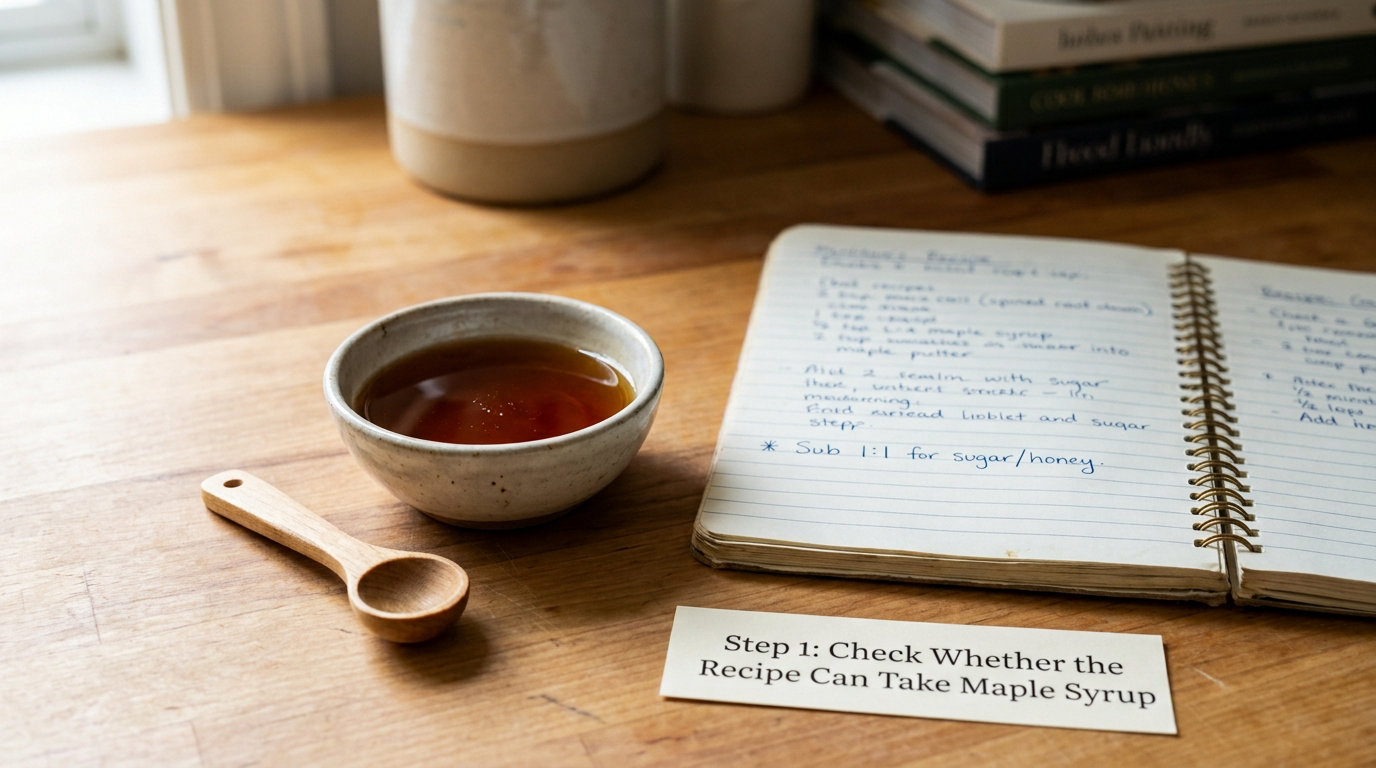
Start by sorting the recipe into one of two groups: recipes where sugar is only sweetness, and recipes where sugar is also structure or chemistry. In the first group, sugar dissolves into the batter and its only job is to make things taste sweet. Oatmeal, smoothies, salad dressings, fruit compotes, marinades, glazes and poured batters sit here, and in all of them the swap is close to a straight conversion with a small liquid cut.
In the second group, sugar does something physical. It forms the crisp shell of a cookie, it stabilizes a meringue into foam, it feeds the crystals in rock candy, and it sets a custard through its effect on the egg proteins. Those recipes are where the swap fails, and no amount of ratio adjustment rescues them.
The recipes that convert well and are worth doing first are oatmeal and overnight oats, quick breads such as banana or pumpkin bread, muffins, granola, fruit sauces, salad dressings, smoothies, pancakes and waffles, and any glaze or drizzle. Cookies and brownies convert too, but they need the texture work in step 3. A plain vanilla cake is where people get disappointed, because the maple flavor overwhelms the delicate vanilla. A spice cake or gingerbread is a much better canvas for syrup.
The ones to skip are meringues, custards and puddings, hard candies and toffee, any recipe that needs a dry sugar crust for snap, and very light angel-food-style cakes that depend on whipped egg whites for lift. Structural cookie recipes also suffer: a recipe calling for a specific dough texture that puffs and sets crisp will not behave the same way with syrup in it.
Step 2: Calculate the Starting Amount
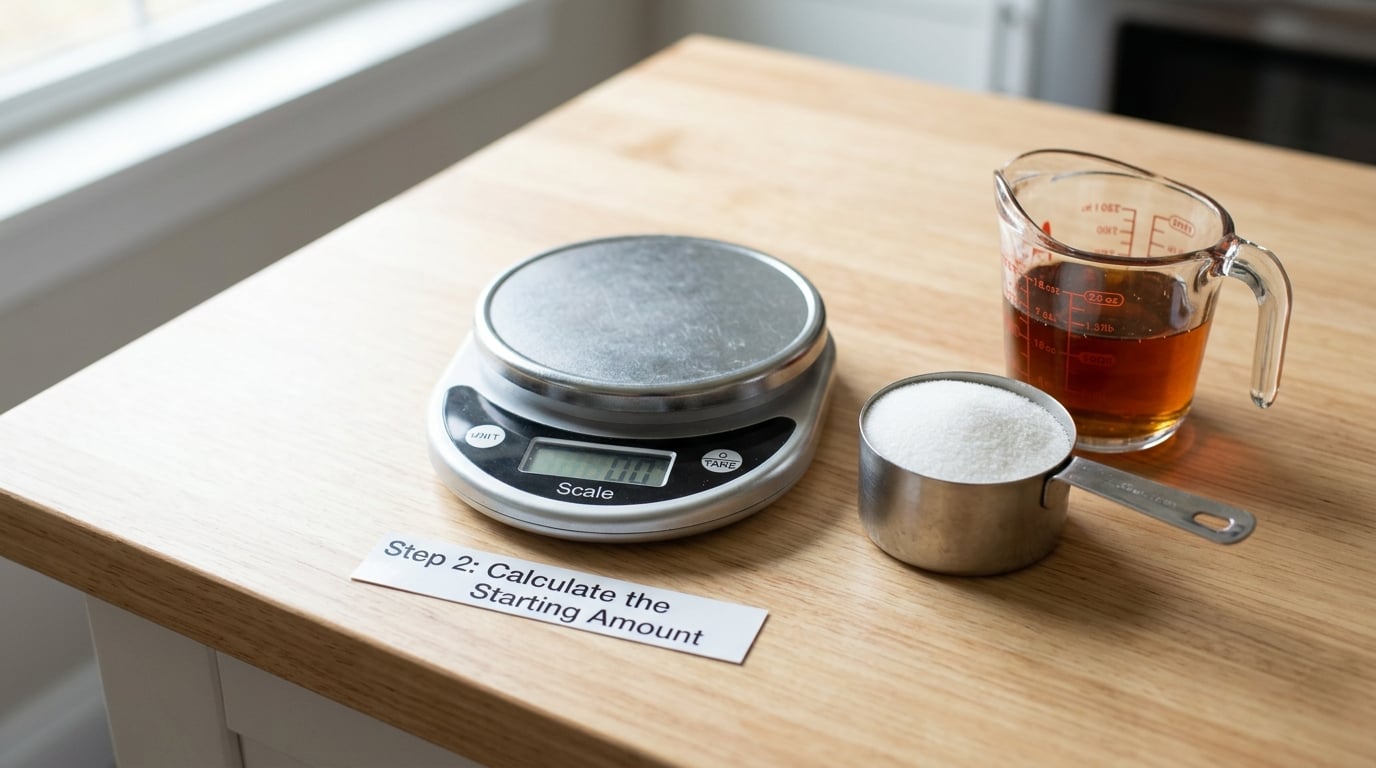
Multiply the recipe’s sugar by three quarters. One cup of sugar becomes 3/4 cup of syrup, 1/2 cup becomes 3/8 cup, 1/3 cup becomes 1/4 cup, and a quarter cup becomes 3 tablespoons. If you work in grams, a cup of granulated sugar is 200 grams, so three quarters of the weight is 150 grams of syrup by weight. That last number matters, because it is where the well-known 75 percent figure comes from.
Here is the source of the confusion most people run into. King Arthur Baking and the Vermont Maple Sugar Makers’ Association say 3/4 cup of syrup per cup of sugar, and that is a volume ratio. Bakers on r/Baking say to use 75 percent of the weight, so 4 ounces of white sugar becomes 3 ounces of syrup. A Discuss Cooking thread recommends 2/3 cup per cup of sugar with no other changes. None of them are wrong, and they are answering slightly different questions.
The volume ratio and the weight ratio differ because a cup of granulated sugar weighs 200 grams while a cup of maple syrup weighs about 312 grams. The syrup’s water is the extra weight. So when you measure 3/4 cup of syrup, you are actually adding roughly 234 grams of material to replace 200 grams of sugar, and that surplus is water. The 2/3 cup suggestion shows up in recipes that are already fairly wet, like a fruit-heavy banana bread, where the batter has less capacity to absorb more moisture. The 3/4 cup figure assumes a standard all-purpose cookie or cake batter.
Maple Syrup Conversion Chart
This is the chart I keep by the stove. The third column is the amount to remove from the milk, water, coffee or melted butter in the same recipe.
| Granulated sugar | Maple syrup | Liquid to remove |
|---|---|---|
| 1 cup (200 g) | 3/4 cup | 3 to 4 tablespoons |
| 3/4 cup (150 g) | 9/16 cup | 2 to 3 tablespoons |
| 1/2 cup (100 g) | 3/8 cup | 2 tablespoons |
| 1/3 cup (67 g) | 1/4 cup | 1 to 2 tablespoons |
| 1/4 cup (50 g) | 3 tablespoons | 1 tablespoon |
| 1 tablespoon (12 g) | 3/4 tablespoon | none |
| 1 cup brown sugar (220 g) | 1 cup sugar plus 1 tablespoon syrup | none |
| 1 cup sugar (200 g) | 1 cup maple sugar | none |
Everything below 1/4 cup of sugar is small enough that rounding to the nearest teaspoon beats precision.
Use 3/4 cup as your default. If the recipe already contains a lot of moist ingredients, like bananas, zucchini, berries or a heavy fruit sauce, drop toward 2/3 cup. If you are weighing rather than measuring, 75 percent by weight is the same ratio expressed a different way, not a competing rule.
The other conversions worth keeping in your head: to stand in for brown sugar, use 1 cup of granulated sugar plus 1 tablespoon of maple syrup, which is the trick a popular BlogChef recipe uses to fake the molasses depth. To replace maple sugar, nothing changes because granulated maple sugar is a 1:1 replacement. To partially substitute, which is genuinely the best move for a first attempt, replace half the sugar with half the syrup amount, for example 1/2 cup sugar and 3/8 cup syrup for a one cup recipe, and leave the other liquids alone.
Step 3: Adjust for Texture and Browning
Take 3 to 4 tablespoons out of the recipe’s other liquid for every 3/4 cup of syrup you add. That liquid can come from milk, water, coffee, or from the melted butter, and pulling a little from the fat is often the least disruptive because it barely shifts the formula. What you are correcting for is the fact that syrup is hygroscopic, which simply means it pulls in and holds onto water. Bakers on r/AskBaking describe it well: a hygroscopic sweetener sweetens and traps extra moisture at the same time, which is exactly why syrup cookies stay chewy on day three while their sugar-baked cousins go hard.
That moisture is the reason a cake converted to syrup comes out tender and a little denser. It is the reason cookies spread further on the sheet. And it is the reason you should not go further than 3/4 cup by volume, because more syrup pushes a dough past the point where it holds its shape.
For leavening, add 1/4 to 1/2 teaspoon of baking soda per cup of sugar replaced, unless the recipe already includes an acidic ingredient. Molasses, brown sugar, honey, cocoa, yogurt and buttermilk all acidify the batter, and extra soda on top of them pushes the pH too high, which tastes soapy and can turn the crumb gray. Check the ingredient list before you add any.
Then turn the oven down about 25F. Syrup contains water, so it holds heat longer than dry sugar, and the sugars in it reach caramelization at a lower temperature than granulated sugar does. That is why converted cookies brown at the edges long before the centers set, and why the bottom of a quick bread can scorch while the top is still pale. A slightly lower, slightly longer bake gives the middle time to finish without burning the outside. Start checking about five minutes earlier than the recipe’s stated time, not later, because syrup bakes catch fast.
Two smaller adjustments are worth knowing. A scant 1/4 teaspoon of maple extract in a loaf or cake deepens the flavor that baking sometimes mutes, and bakers on r/Baking note that it is a decent stand-in when you have used the last of a bottle. And for a chocolate bake, cut the syrup by a couple of tablespoons, because chocolate plus maple is a lot of flavor in one bite.
For glazes, drizzles and salad dressings, skip the liquid reduction entirely. A glaze wants to be loose, and a dressing wants to be pourable. Use roughly 3/4 cup syrup for 1 cup sugar, thin with water or lemon juice until it coats a spoon, and remember that the syrup thickens as it cools.
Step 4: Test, Cool, and Adjust
Let the finished bake cool completely on a rack before you judge it. A slice taken straight from the pan has no structure, and both sugar and syrup versions of most recipes look worse hot than they taste. Judge four things separately, since a swap can succeed on one axis and fail on another.
Flavor first. If the maple reads as a flavor rather than a sweetness, and the recipe was not already a maple recipe, the ratio was too high for that recipe. Cut back to 2/3 cup next time rather than reaching for more syrup. Second, sweetness. If the result tastes flat rather than cloying, your three quarters cup was low for that recipe, or the sugar was doing more work than you expected. Third, texture. Gummy in the middle means underbaked or too much syrup holding water; dry and tight means not enough. Fourth, spread. Cookies that ran into each other on the sheet went too far, and an extra 10 to 15 minutes in the fridge before baking, or a reduced liquid, fixes it next time.
Write down what worked before you forget. One line is enough: 1 cup sugar became 3/4 cup syrup, minus 3 tablespoons milk, minus 10F, and the cookies spread an inch wider than usual. Convert two or three of your regular recipes this way and you will have your own chart that fits your oven, which is worth more to you than any published ratio.
Common Mistakes
Swapping one for one. The most common error by a wide margin, and it is why so many first attempts come out soggy. One cup of syrup for one cup of sugar adds both sweetness and a quarter cup of water. The fix is the three-quarter ratio plus a 3 to 4 tablespoon liquid cut.
Forgetting the liquid reduction. This is the same mistake viewed from the other side, and forum complaints about runny batter almost always trace back to it. The clue is a batter that looks slack when the eggs are beaten in and a cookie sheet that merges into one sheet of cookie. Cut the milk, water or melted butter, not the syrup.
Using a full cup of syrup in a banana bread. A recipe that already carries half a cup of mashed banana, an egg and a stick of melted butter has very little room for extra moisture. This is where the 2/3 cup advice from home bakers is the right number. Reduce the liquid by only 1 to 2 tablespoons in these recipes.
Expecting identical browning. Syrup browns earlier and darker than dry sugar because its sugars caramelize at a lower temperature and its water holds heat. The result is dark edges with a pale middle. Drop the oven about 25F, move the pan to a lower rack, and pull it a few minutes earlier than the original timing suggests.
Substituting where sugar is structural. Meringues, custards, hard candy and any recipe needing a crisp sugar shell will not work. There is no fix, because the sugar is doing a mechanical job that liquid cannot do. Use granulated maple sugar instead if you want the maple flavor in those, or leave the recipe alone.
Going all in on a delicate recipe. Plain vanilla cake, plain muffins and white bread are where maple flavor stacks up and drowns everything else. A 50/50 split works much better in these, and it is also the move a lot of home bakers land on after a full swap disappoints them.
Double-substituting by accident. Vegan bakers have hit this one. If a recipe already calls for maple syrup as its liquid, you cannot also use syrup to replace its sugar without the batter going thin. Replace the sugar with maple sugar 1:1, or cut the added syrup in half and use the freed room for the sugar swap.
Two smaller mistakes: using a blended maple-flavored syrup instead of pure syrup, which leaves you wondering why the flavor is flat, and pulling the loaf too soon because the top looks done. A thermometer into the thickest part of the center is more reliable here than color alone.
Frequently Asked Questions
How much maple syrup should I use instead of sugar?
Use 3/4 cup of maple syrup for every 1 cup of granulated sugar, then cut 3 to 4 tablespoons of the recipe’s other liquid. By weight, that is 75 percent of the sugar’s weight, which is why 4 ounces of white sugar becomes 3 ounces of syrup. In very wet recipes such as banana bread, drop to 2/3 cup.
Can I use maple syrup in cakes and cookies?
Yes, in both, with adjustments. Cakes convert well because the added moisture produces a tender crumb, and the loaf usually needs 25F less oven heat. Cookies convert well too, but they spread further and bake darker, so chill the dough for 10 to 15 minutes and watch the edges. Delicate flavors like plain vanilla cake do better with a 50/50 split.
Does maple syrup make baked goods too moist?
It can, and that is the most common failure. Maple syrup is hygroscopic, which means it draws in and holds water, so a full one-for-one swap makes batter loose and cookies thin. Pull 3 to 4 tablespoons out of the milk, water or melted butter for every 3/4 cup of syrup, and the texture usually lands where you want it.
Is maple syrup healthier than white sugar?
Not in any meaningful way, and it is worth saying plainly. A cup of maple syrup runs about 210 calories and 54 grams of sugar, close to a cup of white sugar at roughly 200 calories and 50 grams. It does supply small amounts of manganese and antioxidants, and it is less processed, but it remains an added sugar with a similar load.
Can I use maple syrup in savory recipes?
Yes, and this is one of the swap’s best uses. Maple syrup works in vinaigrettes, glazes for roasted vegetables and chicken, pan sauces, salad dressings and marinades for pork or tofu. Use 3/4 cup per cup of sugar, and skip the liquid reduction. Add it near the end of cooking in a pan sauce so the flavor stays bright.
How do I store a recipe made with maple syrup?
Maple-syrup baked goods keep well because syrup holds moisture instead of letting it escape. Store cookies, quick breads and muffins loosely covered at room temperature for about three days, then move them to the refrigerator for up to a week. For longer storage, wrap individual slices and freeze them, thawing at room temperature. A frosted cake keeps in the fridge for about five days.
Start with the three-quarter ratio, the 3 to 4 tablespoon liquid cut, and a 25 degree lower oven, then convert one quick bread rather than a cake. Quick breads are forgiving, already heavy on moisture, and the maple flavor has room to sit. Write down the result and your own chart builds itself from there.