
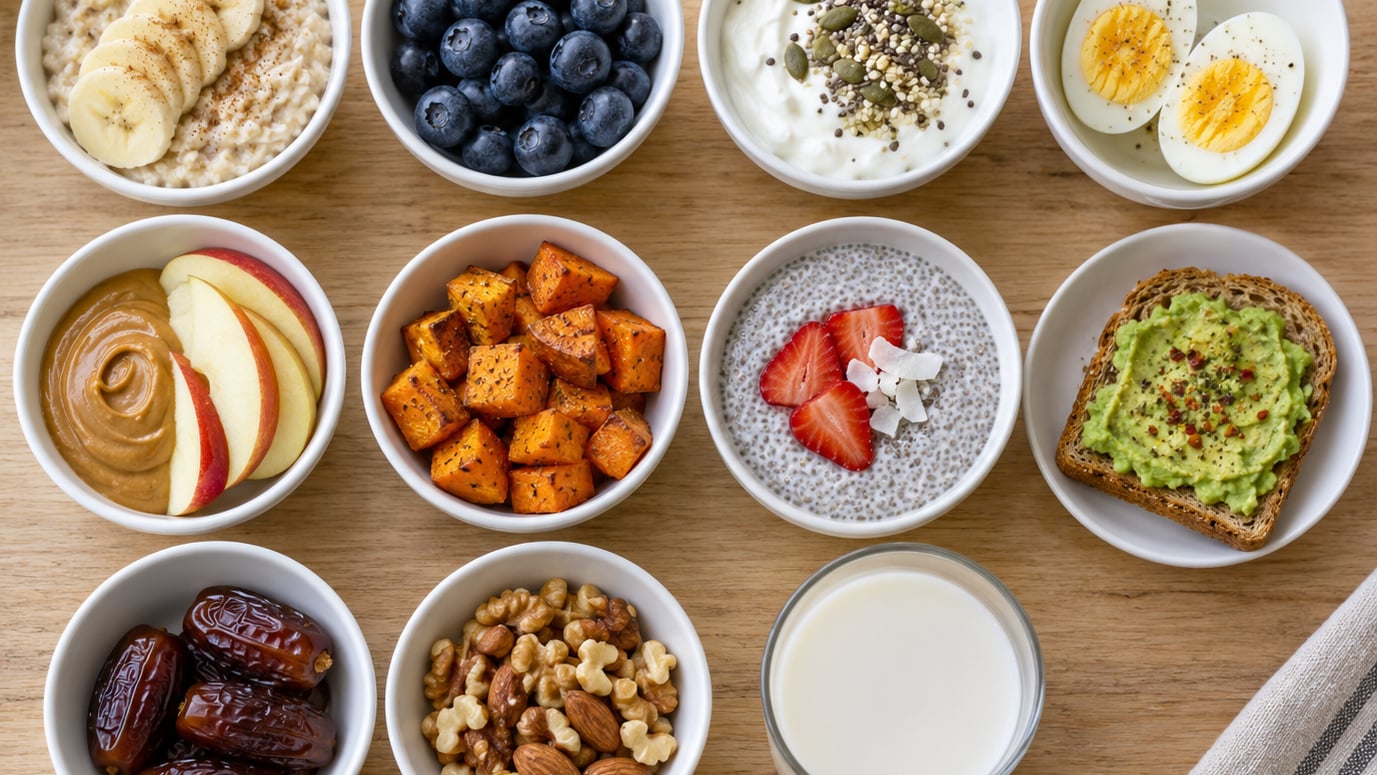
The foods that give you energy in the morning are the ones built from three things: steady carbohydrates, enough protein, and some fat. A banana on its own fades fast, while an apple with peanut butter holds you until lunch. This list covers twelve everyday options with a serving idea for each, so you can pick what fits your morning rather than rebuilding the same bowl every day.
Morning energy is less about a magic food and more about how your body handles the first meal of the day. Carbohydrates feed your brain directly, protein and fiber slow digestion so blood sugar climbs gently instead of spiking, and fat gives the meal staying power. When one of those three is missing, the result is usually that familiar mid-morning slump where you can barely focus on your second coffee.
A note before we start: this is general nutrition information, not medical advice. If you have diabetes, a thyroid condition, anemia, or a history of disordered eating, talk to a doctor or registered dietitian before changing what you eat. Persistent daytime fatigue is worth mentioning at a checkup too, because food rarely explains all of it.
Table of Contents
Foods That Give You Energy in the Morning at a Glance
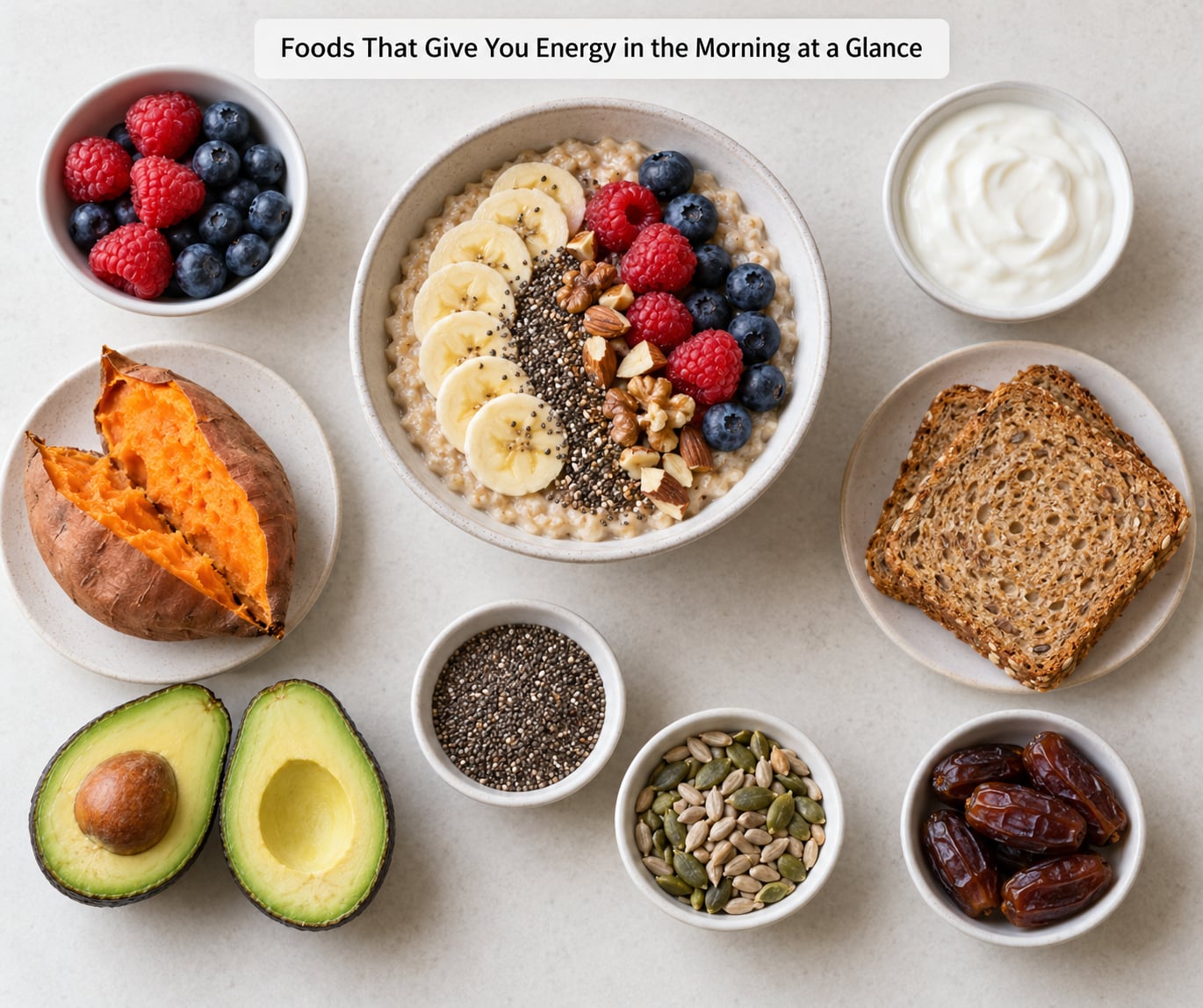
There is no single best answer, which is why foods that give you energy in the morning work better as a group than as a ranking. Pick two or three from this list and build a meal around them, rather than chasing whichever one is trending that week.
Here is the short version. The nutrient column tells you what each food is actually contributing, and the serving column is a real breakfast you can assemble in under ten minutes.
| Food | Main energy-supporting nutrients | Best for | Quick serving idea |
|---|---|---|---|
| Oats | Complex carbohydrates, fiber, beta-glucan | Long, steady mornings | Overnight oats with banana, chia and peanut butter |
| Bananas | Carbohydrates, potassium, vitamin B6, fiber | Pre-workout fuel | Blended into a smoothie with oats and milk |
| Blueberries | Fiber, vitamin C, anthocyanins | Adding volume without bulk | Scattered over Greek yogurt or pancakes |
| Greek yogurt | Protein, calcium, live cultures | Satiety on a short morning | Plain yogurt with fruit, seeds and a drizzle of honey |
| Eggs | Complete protein, fat, choline, B12 | People who skip breakfast without trouble until 11am | Two boiled eggs with whole-grain toast and fruit |
| Nut butter | Calories, unsaturated fat, protein | Fast, portable fuel | Peanut butter on toast with apple slices |
| Sweet potatoes | Complex carbohydrates, fiber, vitamin A | Batch cooking on a Sunday | Roasted cubes with eggs and yogurt |
| Chia seeds | Omega-3 ALA, fiber, plant protein | Make-ahead mornings | Chia pudding made the night before with milk and berries |
| Whole-grain toast | Complex carbohydrates, fiber, B vitamins | Busy mornings, five-minute breakfasts | Avocado, egg or nut butter with fruit alongside |
| Avocado | Monounsaturated fat, fiber, potassium | Slowing a fast breakfast down | Mashed on toast, or sliced next to a soft-boiled egg |
| Dates | Concentrated carbohydrates, fiber, potassium | Shifts, travel, early starts | Two dates stuffed with almond butter |
| Fortified soy or nut milk | Protein, calcium, vitamin D when fortified | Filling smoothies and dairy-free mornings | Unsweetened soy milk as the smoothie base with oats and fruit |
1. Oats
Oats are the most reliable thing on this list. They are mostly complex carbohydrates, which your body breaks down steadily rather than all at once, and the insoluble beta-glucan fiber in the oat bran slows that digestion further.
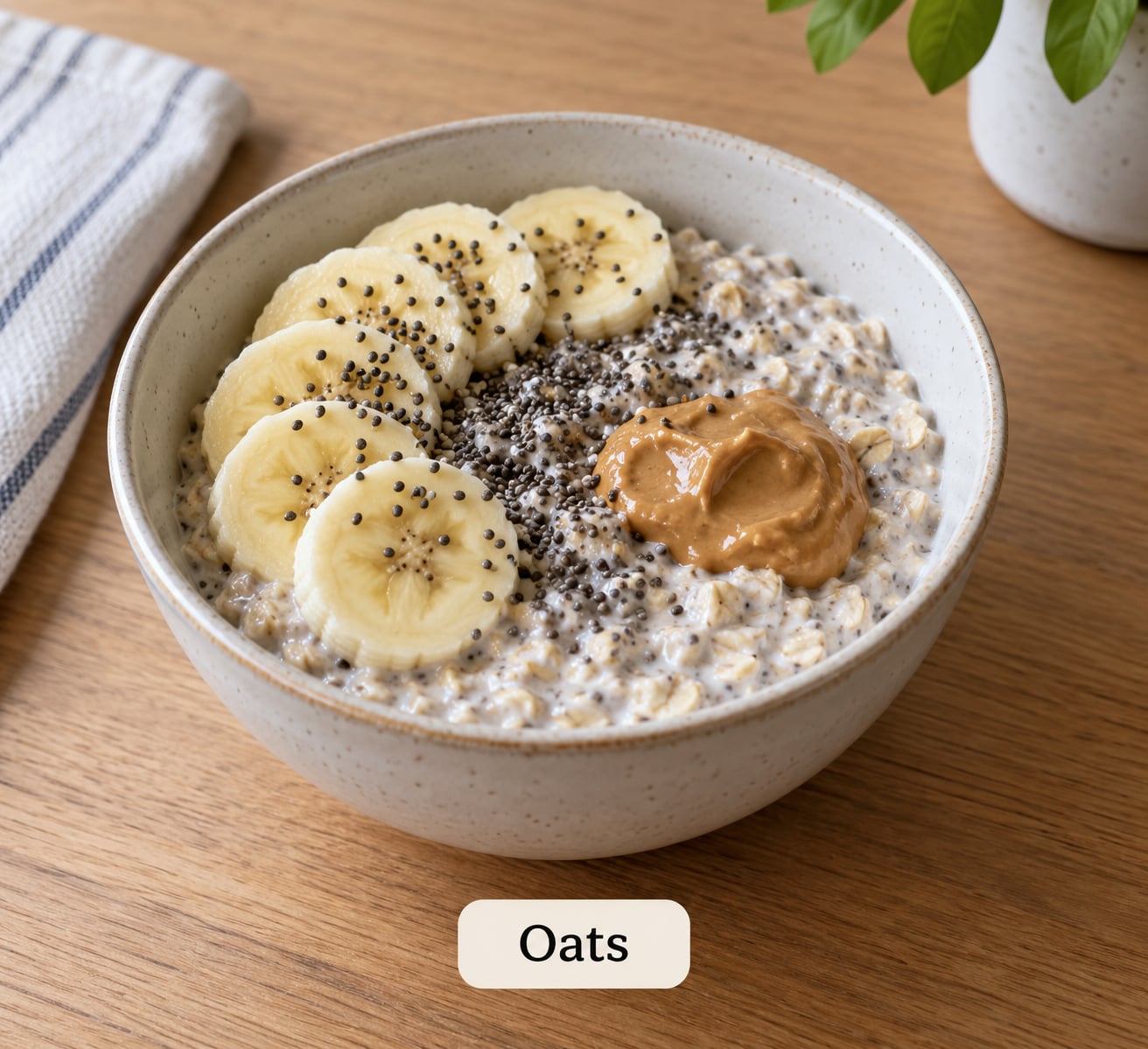
The practical version takes two minutes. Stir half a cup of rolled oats with a splash of milk or fortified soy milk and a spoonful of nut butter, refrigerate overnight, and top with a sliced banana in the morning.
How to use oats for morning energy
Plain oats on their own can feel like they run out around 10am, usually because the meal has almost no protein. Add a protein source and the same bowl behaves completely differently, which is why the overnight oats recipe pairs nut butter or Greek yogurt with the oats rather than serving them dry.
Steel-cut and rolled oats are less processed than instant, and they hydrate more slowly, so they tend to keep blood sugar steadier. Instant oats are fine when you are in a hurry, just check the label for added sugar, which is common in flavored and fruit-flavored varieties.
2. Bananas
Bananas are portable, cheap, and almost always there. They deliver easily digested carbohydrates plus potassium, which matters on mornings when you sweated through a run or a hot commute, and vitamin B6, which plays a role in the making of serotonin and dopamine.
A banana alone is a fine pre-workout snack about 30 to 60 minutes before training, and our guide to what to eat before a morning workout goes further on timing. It is not, on its own, a complete breakfast, because its sugar arrives quickly and its protein content is minimal, so most people are hungry again within an hour.
Are bananas good for energy in the morning?
Yes, and the ripeness changes what you get. A slightly green banana has more resistant starch, which digests like fiber in the gut. A yellow one with brown spots has converted most of that starch into sugar, which is faster energy but shorter lived, so on a morning when you need to last, pair the sweeter banana with something containing fat and protein.
3. Blueberries
Blueberries are one of the easiest ways to add volume to breakfast without adding a lot of calories. They carry fiber plus anthocyanin pigments, the plant compounds that give them their color and show up repeatedly in nutrition research on inflammation and vascular function.
Use them however is convenient: over Greek yogurt, folded into oatmeal, dropped into pancake batter, or thrown in the blender with a banana and some oats. Frozen berries work as well as fresh in a smoothie and cost less, which matters if you are buying breakfast every week.
4. Greek Yogurt
Greek yogurt earns its place on a list of morning energy foods because of protein density. Strained plain varieties typically carry roughly twice the protein of regular yogurt per serving, and that protein is what delays stomach emptying and holds off hunger.
The serving I come back to is plain Greek yogurt with a spoonful of berries, a teaspoon of chia or hemp seeds, and a small drizzle of honey. Choose plain when you can, since flavored versions often carry a surprising amount of added sugar, which is exactly the ingredient behind a lot of mid-morning crashes.
5. Eggs
Eggs supply complete protein, fat, choline for memory and attention, and vitamin B12. They also digest slowly enough that most people find them satisfying, which is why egg-based breakfasts tend to hold better than carbohydrate-only ones.
A vegetable omelet with a side of whole-grain toast is the version I make most often, since it can be cooked in one pan and reheated. Hard-boiled eggs are worth batching, because a dozen cooked on Sunday covers four or five grab-and-go mornings.
6. Nut Butter
Nut butter is calorie-dense in a useful way. A single tablespoon adds meaningful calories, mostly from unsaturated fat, with a small amount of protein and vitamin E, and that fat slows the absorption of the carbohydrates it is spread on.
Peanut butter on whole-grain toast with apple slices is the budget classic and it works well. Almond butter has more vitamin E, cashew butter is the sweetest, and sunflower seed butter is the option to look at if you are avoiding peanuts, though you will still check the label since it is often made on shared equipment.
7. Sweet Potatoes
A medium sweet potato gives you complex carbohydrates, a good amount of fiber, and beta-carotene, which the body converts to vitamin A. The fiber means the energy arrives gradually, which makes it a solid breakfast for a long morning rather than a quick one.
Roast a tray of cubes on a Sunday and you have three or four mornings handled. The cubes reheat well in a hot oven or an air fryer, and they pair naturally with boiled eggs, a spoonful of Greek yogurt, or blended into a smoothie with cinnamon and a little milk.
8. Chia Seeds
Chia seeds are small and quiet but dense in fiber, plant protein, and ALA, the plant-based omega-3 your body converts in small amounts to the long-chain version. They swell in liquid and form a gel, which is part of why they keep you full for hours.
Chia pudding is the zero-effort version: stir two tablespoons into a cup of milk or fortified soy milk with a splash of vanilla, refrigerate overnight, and add berries and a few chopped nuts in the morning. One tablespoon stirred into a glass of water is the simplest option if you only want the fiber, though it does not fill you up much on its own.
9. Whole-Grain Toast
Look for bread where whole grain is the first ingredient, whether that is wheat, rye, or a sprouted-grain loaf. The point is the fiber and the B vitamins that come with it, since a slice of white bread gives you the same fast carbohydrate jolt that white sugar does, just in bread form.
Build on it rather than serving it plain. Avocado and a poached egg, peanut butter and a banana, or cottage cheese with tomatoes and pepper all turn two slices into a meal that carries you to lunch. If you avoid gluten, the same toppings work just as well on buckwheat or sourdough bread made from GF flour.
10. Avocado
Avocado brings monounsaturated fat, fiber, and potassium, and its fat is the piece that changes how the rest of the breakfast behaves. Half an avocado on toast is a common pairing in research on satiety and meal timing, where fiber-rich, fat-containing first courses tend to reduce how much people eat later in the day.
Eat it on toast, sliced alongside a soft-boiled egg with salt and pepper, or blend half of one into a banana and oat smoothie where you would not taste it. Ripe ones mash easily; firmer ones need a fork and a little patience, or a night in a paper bag with a banana.
11. Dates
Dates are the most concentrated carbohydrate on this list, with fiber and potassium behind it. Two or three give you a fast lift, which makes them genuinely useful for shift workers, early appointments, or a morning where there is no kitchen involved at all.
Because that sugar arrives quickly, pair them rather than eating them alone. Two dates stuffed with almond butter, or a date alongside a handful of walnuts and a glass of milk, slows the response and turns a snack into something closer to a small meal.
12. Smoothie-Friendly Nut Milks
The liquid in a smoothie decides how long it holds you. Unsweetened fortified soy milk is the strongest of the plant milks nutritionally, with roughly the protein content of dairy, plus calcium and vitamin D when fortified. Almond, oat, and rice milks are lighter, mostly fat and carbohydrate, and lower in protein unless the carton says otherwise.
Use a fortified soy or nut milk as the base with oats, fruit, and a spoon of nut butter, and the drink turns into something with staying power. If you use dairy, plain milk is the closest match. Check the label for added sugar, since flavored versions can carry as much as a dessert, and shake the carton, because the fortified minerals settle to the bottom.
How to avoid the mid-morning crash
The crash most people describe at 10:30am usually traces back to breakfast being mostly refined carbohydrate. A pastry, flavored yogurt, or sweetened cereal raises blood sugar quickly, insulin follows, and two hours later you feel worse than when you started.
The fix is not eating less. It is building the same meal with a protein source and some fat attached to the carbohydrate. Across the foods that give you energy in the morning, the pattern holds: oats with nut butter, toast with egg and avocado, and yogurt with seeds all behave nothing like those carbohydrates eaten alone.
Protein at breakfast also matters for the rest of the day, where meals with 20 to 30 grams tend to keep people full longer than low-protein meals of the same size. Which of the two macronutrients is doing more for you depends on the hour and the hour after, and carbs versus fat for energy explained breaks that down. On a rushed morning, one of the easier ways to hit that protein mark is Greek yogurt, eggs, or a glass of fortified soy milk rather than another carbohydrate choice.
Frequently Asked Questions
Why does my energy crash after breakfast?
Most often because the meal is high in refined carbohydrate and low in protein and fat, so blood sugar spikes and then falls quickly. Adding an egg, Greek yogurt, nut butter, or avocado to the same carbohydrate slows digestion and flattens the curve. Portion size, coffee on an empty stomach, and poor sleep the night before all make it worse.
What foods give you immediate energy?
Dates, banana, honey, and white bread act fastest, because their carbohydrates reach your bloodstream with little delay. The tradeoff is a quick return, so they suit a 10am meeting or a hard session at the gym. For energy you can count on until lunch, choose oats, sweet potatoes, whole-grain toast, or yogurt with berries.
How can I get energy quickly in the morning?
Drink a glass of water first, since mild dehydration reads as tiredness, then eat a meal with all three parts: a complex carbohydrate like oats or whole-grain toast, a protein like eggs or Greek yogurt, and a fat like nut butter or avocado. If your morning genuinely will not allow food, a piece of fruit with peanut butter is the smallest version of the same idea.
What should I eat for breakfast to avoid sleepiness?
Skip anything that is mostly refined sugar, and include protein with your carbohydrate instead. Fried-heavy meals also tend to leave people groggy, as do large portions eaten right before sitting down at a desk. Most people do best with 20 to 30 grams of protein plus a slow carbohydrate, then a short walk after eating.
Which nuts are best for energy in the morning?
Almonds and walnuts are the everyday standouts, offering vitamin E, magnesium, and omega-3 respectively. Cashews are higher in carbohydrate, which makes them useful before a demanding morning, and peanuts are a budget option with good protein. Portion matters, since a small handful is around 160 calories and a full bowl is a different meal entirely.
Conclusion
If you only change one thing, add a protein source to whatever you already eat. Oats with yogurt instead of oats alone, toast with egg instead of toast alone, a banana with peanut butter instead of a banana on its own. Same foods, different breakfast, and most people find the 10:30am slump either shrinks or stops altogether.
Then pick one combination you can actually repeat on a bad morning, when you are tired and the kitchen is not appealing. Overnight oats with banana, boiled eggs with toast, or a yogurt bowl with seeds and berries will all hold up. Consistency beats variety here, because the goal is a breakfast that works on the days you least want to cook. And if caffeine is doing most of the work in your morning, matcha versus coffee for steady energy is worth a look before you reach for a second cup.