
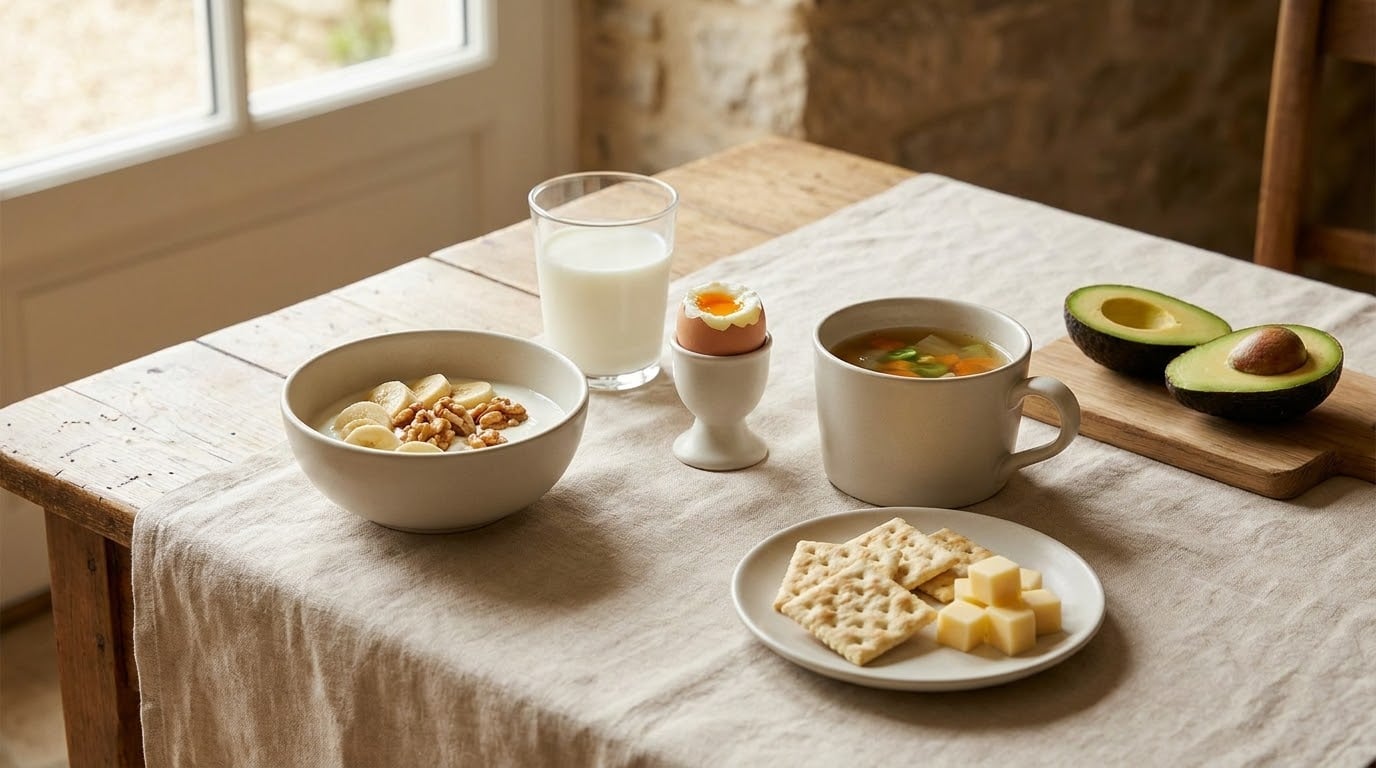
When hunger disappears, the answer is almost never a normal plate of food. What to eat when you have no appetite is usually something small, calorie-dense and close to effortless: a milky drink, full-fat yogurt, a few crackers with cheese, soup, or ice cream straight from the bowl. Think of it as fuel with low effort rather than as dinner.
The ideas below are general nutrition guidance for a temporary appetite dip. If the loss of appetite is severe, lasts more than a couple of weeks, or comes with rapid weight loss, talk to a doctor or a registered dietitian rather than working through it on your own.
Table of Contents
- What to Eat When You Have No Appetite
- Easy-to-Tolerate Foods and Drinks
- How to Build a Small, Nutritious Meal
- Simple Meal and Snack Ideas for Low Appetite
- Smoothies and Drinks When Eating Feels Hard
- How to Eat When Your Appetite Stays Low
- How Long Should You Wait Before Concerned?
- Foods and Habits to Avoid Making the Problem Worse
- Frequently Asked Questions
- Start with One Easy-to-Tolerate Meal
What to Eat When You Have No Appetite
Short answer: choose small, calorie-dense, easy-to-digest foods that need almost no preparation, and eat them five or six times a day instead of three large meals. Full-fat dairy, eggs, soups, yogurt, nut butters and drinks carry more calories per bite than plain crackers or raw vegetables, which is what matters when volume is the problem.
Best foods to eat when your appetite is low
- Full-fat yogurt: protein plus fat in a few spoonfuls, no cooking and no chewing required.
- Eggs: a soft-boiled or scrambled egg is about 70 calories and roughly 6 grams of protein in one item.
- Whole milk or a milky drink: an 8 ounce glass is around 150 calories and easier to finish than solid food.
- Soups and broth: warm liquid that goes down without much effort, and easy to sip instead of eat.
- Avocado: a quarter to half an avocado adds calories and fat with almost no preparation.
- Peanut or almond butter: a spoonful on toast or crackers adds roughly 90 to 100 calories.
- Ice cream and frozen yogurt: cold and sweet, often more tempting than a warm meal when nothing appeals.
- Rice, potatoes or plain toast: bland, soft and cheap carbohydrate that settles an empty stomach.
- Cheese cubes and crackers: no utensils, no heat, and easy to put on a plate and leave within reach.
Cold or room-temperature food often works better than hot food when appetite is low. Hot meals send up more aroma, and aroma is one of the things that can turn a queasy stomach off entirely.
How to eat when you have no appetite
- Aim for five or six small meals or snacks every two to three hours rather than three big ones.
- Drink your fluids between meals, not during them, because liquid fills the stomach fast and kills the next meal.
- Choose full-fat versions of yogurt, milk and cheese, and skip diet or low-fat products during a low week.
- Eat your favourite foods first, even if the rest of the meal goes untouched.
- Keep food that needs no cooking within arm’s reach, so the decision to eat stays easy.
- Use smell deliberately: sautéed garlic and onion, grilled meat or freshly baked bread can pull an appetite back before a meal starts.
If you train in the morning, timing your small meals around training matters too. Our guide to what to eat before a morning workout for energy covers the pre-session options that sit light before exercise.
Easy-to-Tolerate Foods and Drinks
The foods that get eaten when nothing else will are rarely the most impressive ones. They are soft, mild, cool and small, and most of them are already sitting in a typical kitchen.
Soft, bland and easy to chew
Cooked rice, mashed or baked potatoes, plain toast, oatmeal cooked in milk, scrambled eggs and canned beans all qualify. When your mouth feels dry or chewing is a chore, add butter, olive oil, avocado or nut butter to raise the calories without raising the volume.
Cold and frozen options
Ice cream, popsicles, frozen yogurt, cold yogurt drinks and sliced fruit are routinely listed by people managing appetite loss as the foods that actually went down. Cold also means less cooking smell in the house, which matters more than most people expect.
Texture is the real decision point, so here is how the main groups compare. Calorie and protein figures are approximate per serving and vary by brand and portion.
| Group | Typical options | Approximate calories | Approximate protein | Prep effort |
|---|---|---|---|---|
| Drinks | Whole milk, milky drink, cocoa, oral nutrition drink | 150 to 250 per 8 ounce glass | 6 to 9 grams | None, or one minute blending |
| Soft and creamy | Full-fat Greek yogurt, pudding, oatmeal in milk | 150 to 250 per three-quarter cup | 12 to 17 grams | None |
| Cold and frozen | Ice cream, popsicle, frozen yogurt | 140 to 200 per half cup | 2 to 4 grams | None |
| Protein | Egg, cottage cheese, soft fish, canned beans | 70 to 180 per serving | 6 to 20 grams | Zero to five minutes |
| Fats | Avocado, nut butter, olive oil, cheese | 90 to 240 per serving | 2 to 7 grams | None |
| Soups | Bean, chicken or lentil soup, bone broth | 120 to 250 per cup | 6 to 12 grams | Reheat only |
Drinks deserve special mention because they do the most work per minute. A glass of milk, a cocoa-style milky drink or a blended yogurt drink carries the calories of a small meal with none of the chewing, which is why dietitians often suggest them first. If you reheat soup or rice, bring it to a steaming 165°F (74°C) in the center, and refrigerate anything perishable within two hours.
How to Build a Small, Nutritious Meal
You do not need a large plate. You need four components in a small portion: a carbohydrate for energy, a protein to hold muscle, a fat to make the calories count, and one colorful fruit or vegetable for vitamins and fiber. Pick two or three of those and stop. That is a complete enough meal when appetite is the limiting factor.
Scale the portion down rather than cutting components out. A third of a normal serving still works; an empty plate does not.
- Rice with beans and avocado: carbohydrate, protein and fat in one soft, mild bowl.
- Full-fat yogurt with banana and chopped walnuts: no cooking, and easy to eat slowly over ten minutes.
- Toast with a soft egg and a slice of cheese: about 250 calories and 15 grams of protein in three bites’ worth.
- Soup with crackers on the side: broth counts as a meal, and crackers give it some substance.
- Apple slices with peanut butter, or a banana with nut butter: a snack that holds more calories than a plain biscuit.
If solid food feels like too much right now, build the same plate as a drink instead. Blend the fruit, the yogurt and the nut butter and drink it slowly over ten minutes rather than gulping it.
Simple Meal and Snack Ideas for Low Appetite
Realistic low-appetite eating is mostly repetition of a short list rather than variety. Pick three things you tolerate and repeat them until your appetite returns.
What to eat when you have no appetite in the morning
Mornings are often the hardest part, before you have had any fluid. A milky drink or a small bowl of yogurt eaten slowly with a spoon usually beats a cooked breakfast. Toast with peanut butter, or oatmeal made with whole milk instead of water, works too. If you can only manage a few bites, have the rest of your calories as a mid-morning snack.
Lunch and dinner that need almost no cooking
- Soup from a can, reheated, with crackers or a slice of cheese.
- Canned beans warmed with a spoon of olive oil, served with rice or toast.
- Baked potato with butter and cheese, no toppings that need chopping.
- Soft scrambled eggs with a splash of milk, which keeps them tender and mild.
- Macaroni and cheese made with whole milk, eaten warm but not hot.
- Cold leftovers eaten at room temperature rather than straight from the fridge.
Snacks that carry calories between meals
- Cheese cubes with a small handful of crackers.
- Full-fat Greek yogurt with a spoonful of honey or fruit compote.
- Ice cream, which is difficult to treat as a serious food and easy to eat slowly.
- Peanut butter straight from the spoon, if textures are not a problem today.
- Milky drinks, fruit smoothies and cocoa-style drinks.
- Popcorn, which is light in volume but high in fat, if you can tolerate crunchy foods.
What a small-frequent day looks like
One possible shape of the day, adjusted to your own schedule:
- 8 a.m. small glass of milk or milky drink while sitting down, before anything else.
- 10 a.m. full-fat yogurt with banana.
- 1 p.m. soup with crackers.
- 4 p.m. cheese and crackers, plus a piece of fruit if it goes down.
- 6.30 p.m. toast with egg and cheese, or rice with beans.
- 8 p.m. ice cream or a cocoa-style drink while watching something.
Nobody has to eat all six. The point is that there is a next small bite available every couple of hours rather than three big obligations.
Smoothies and Drinks When Eating Feels Hard
Liquid calories are the least effortful food there is, which makes them the standard bridge when chewing is impossible. A useful base is whole milk, yogurt, or a neutral drink; useful add-ins are banana, berries, avocado, nut butter, oats, cocoa powder and a scoop of protein powder.
Blend one banana, a handful of spinach, half an avocado, three-quarters cup of Greek yogurt, a tablespoon of nut butter and milk to the thickness you like. That single glass usually lands somewhere between 350 and 500 calories with a real amount of protein in it, and it fills a genuine gap rather than pretending to be a meal.
People managing their blood sugar, or anyone who has been told to watch fluid intake for a medical reason, should ask their clinician how to fit dense drinks into their day. Drink in small glasses over twenty minutes rather than one large bottle, because volume is what makes a thick shake unmanageable.
Oral nutrition drinks sold for people who struggle to eat are calorie-dense and ready in seconds, and they are worth discussing with a doctor or dietitian. People who have tried them often describe the thickness, not the taste, as the problem, so check whether a lighter powder or a homemade version suits you better. If you drink them, keep eating solid food too whenever you can tolerate it, and consider our ideas on what to eat after a workout without a shake for the solid side of the day.
How to Eat When Your Appetite Stays Low
Appetite responds to routine more than it responds to willpower. Set a fixed schedule of small eating moments and let the habit do the work on the days when hunger does not show up.
- Eat every two to three hours, on schedule, even when you are not hungry.
- Use smaller plates and shallower bowls, so a full-looking portion is a portion you will finish.
- Eat slowly, ideally over twenty minutes, because satiety signals arrive late and large bites overshoot them.
- Keep three to four ready-to-eat options stocked at all times, at eye level, in the front of the fridge.
- Sit down to eat rather than eating over the sink while doing something else.
- Do not cook when cooking is the reason you are not eating. Reheat, open a can, or ask someone else.
- Keep a simple food journal for a week, noting which foods, smells and textures actually got eaten and which triggered nausea.
What to give someone else who has no appetite
Cooking for someone with no appetite is tiring, and pressure to eat often makes a person feel worse, not better. Ask what smells and tastes are tolerable right now, then offer two or three small options rather than one large plate.
- Offer a drink before food. A glass of milk or a milky drink is often accepted when a meal is not.
- Bring cold things: ice cream, yogurt drinks, sliced fruit.
- Make soup or broth and keep it in the fridge so it can be reheated in seconds.
- Put favorite foods on a plate and let the rest go, without comment.
- Bring a home oral nutrition drink and let the person decide whether to finish it.
- Ask what the person wants to be asked about weight. It is the thing caregivers worry about most and the thing most people do not want discussed.
Appetite loss on GLP-1 weight loss injections is common and is not a sign that anything is broken, but training hard on very little food is a separate risk. If you lift or train several times a week, high-protein, low-volume options matter more than meal size: Greek yogurt blended with protein powder, cottage cheese, eggs, or a glass of milk with a scoop added all add calories quickly without adding bulk. If the daily protein total stays low for weeks, a dietitian can help you set a realistic target instead of guessing.
How Long Should You Wait Before Concerned?
Short appetite dips are extremely common and usually track something specific: a cold, a stomach bug, a stressful week, a medication change, travel, or low mood. A few days of eating less during one of those is usually not a problem on its own.
Loss of appetite that persists beyond roughly two weeks, or that comes with weight you did not intend to lose, deserves an appointment with a doctor. Common causes they can look into include viral illness, medication side effects, depression and anxiety, gastrointestinal conditions, thyroid problems, and dehydration.
Some signs should not wait for an appointment:
- Rapid weight loss, or clothes becoming noticeably loose within weeks.
- Signs of dehydration: very dark urine, a dry mouth, dizziness when standing, no urination for many hours.
- Being unable to keep fluids or medicines down.
- Fainting, confusion, chest pain, or difficulty breathing.
- A persistent fever, or abdominal pain that is getting worse.
- Inability to manage basic daily tasks because of weakness.
For chest pain, trouble breathing, fainting or sudden confusion, seek emergency care rather than waiting. This article is general nutrition information, not a diagnosis or a treatment plan, so anything persistent belongs with a doctor or a registered dietitian.
Foods and Habits to Avoid Making the Problem Worse
- Do not start a restrictive diet while your appetite is already low. Cutting volume is the wrong direction.
- Do not force large meals. Sitting down to a full plate that goes in the bin teaches your body to ignore the table.
- Do not skip fluids because you are not hungry for food. Dehydration makes low appetite feel worse and shows up fast.
- Do not take appetite-stimulating supplements or herbal products on the advice of a forum thread. Ask a doctor or pharmacist first, because interactions and side effects are real.
- Do not lean on diet soda, low-fat yogurt or reduced-calorie drinks during this period. The calories are the point.
- Do not try to diagnose the cause online or wait months hoping it resolves.
- Do not eat only what is healthiest. Nutrient-dense and tolerable beats perfectly balanced and untouched.
It also helps to drop the framing that you are not eating because you are failing. Loss of appetite is a symptom with causes, and it often lifts once the cause is handled.
Frequently Asked Questions
What is the best thing to eat if I have no appetite?
For most people, a milky drink or a small bowl of full-fat yogurt is the easiest thing to get down. Both deliver calories, protein and fat in a form that needs no cooking and no chewing. If you tolerate dairy poorly, try a soup, a soft-boiled egg, or ice cream instead. The right answer is whichever version you would happily eat again tomorrow.
Should I force myself to eat when I have no appetite?
Do not force large meals. The goal is small, frequent, calorie-dense food rather than three normal servings. Aim for five or six small meals or snacks every two to three hours, and stop while the portion still looks like food rather than leftovers. Persistent loss of appetite lasting more than a couple of weeks, or paired with weight loss, is worth discussing with a doctor.
What foods stimulate appetite?
The most reliable triggers are sensory rather than nutritional. Sautéed garlic and onion, grilled meat and freshly baked bread fill a kitchen with aroma that often creates hunger before the food arrives. Cold and frozen items like ice cream and popsicles are frequently reported as easier to face. Eating your favorite foods first, sitting down, and taking twenty minutes over the meal all help.
How can I eat enough when I am not hungry?
Stop trying to eat meals and start eating opportunities. Put five or six eating moments in the calendar every two to three hours, and keep ready-to-eat food where you can see it. Drink calories between meals rather than during them, choose full-fat versions, and add fat to bland staples such as rice, potatoes and toast. Track what you actually ate for a week so you can see the trend rather than guessing.
Why have I lost my appetite?
Common causes include viral illness, stomach bugs, nausea, medication side effects, stress, depression, gastrointestinal conditions, thyroid problems and appetite-suppressing medications such as GLP-1 injections. A short dip alongside a cold or a stressful week usually resolves on its own. Loss of appetite that lasts more than about two weeks, or comes with rapid weight loss or dehydration, needs a doctor’s attention.
When should I be worried about no appetite?
Seek medical care promptly if you are losing weight quickly, cannot keep fluids down, show signs of dehydration such as dark urine or dizziness, faint, or cannot manage daily tasks because of weakness. Call emergency services for chest pain, trouble breathing, fainting or sudden confusion. Persistent loss of appetite without any obvious short-term cause also deserves an appointment rather than another month of guessing.
Start with One Easy-to-Tolerate Meal
Do not wait for hunger to come back before you eat something. Pick one familiar, easy option from the list above, eat a small portion of it, keep your fluids going between those small meals, and build the rest of the day around five or six chances rather than three.
If the low appetite carries on past a couple of weeks, or comes with weight loss, dehydration or fatigue that stops you managing the day, book an appointment. Loss of appetite is a symptom with causes, and those causes are usually easier to fix than an appetite you have been white-knuckling your way through.