
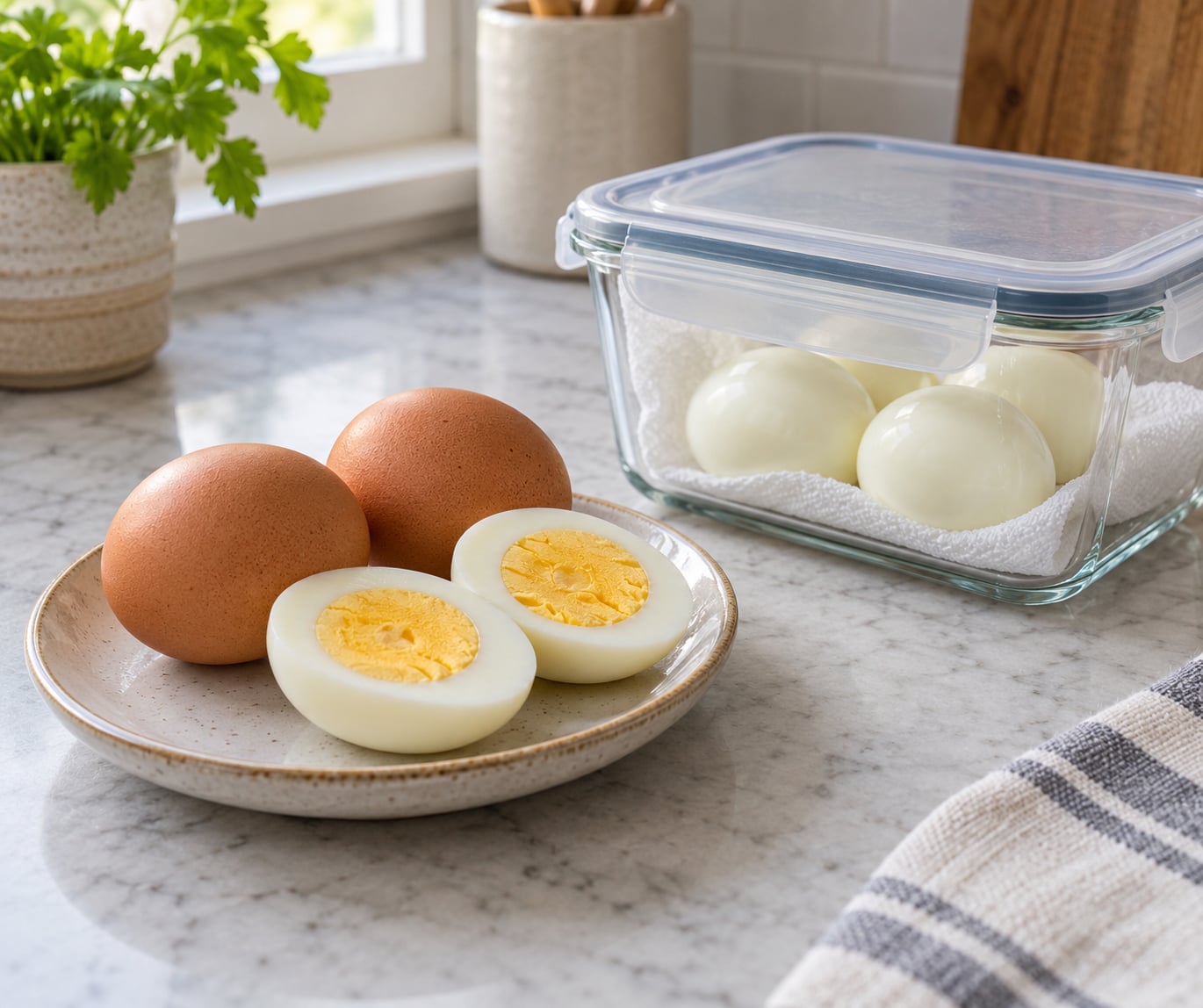
Hard boiled eggs last up to 7 days in the refrigerator, whether they are peeled or unpeeled, as long as you refrigerate them within two hours of cooking and keep them at or below 40°F (4°C). That one-week window comes from the USDA Food Safety and Inspection Service and is repeated by the FDA.
Seven days is a ceiling, not a promise. Eggs boiled on Monday and pushed to Sunday are cooked food sitting for the best part of two weeks, and past that point you are guessing. My rule is simple: peel on the day you plan to eat, keep the rest in the shell, and write the cook date on the container.
Table of Contents
- How Long Do Hard Boiled Eggs Last in the Fridge?
- How to Store Hard Boiled Eggs Safely in the Fridge
- Should You Peel Hard Boiled Eggs Before Refrigerating Them?
- How to Tell When Hard Boiled Eggs Have Gone Bad
- Why Do Refrigerated Hard Boiled Eggs Taste Bad?
- Can You Freeze or Reheat Hard Boiled Eggs?
- Frequently Asked Questions
- How long do hard boiled eggs last in the fridge with the shells on?
- How long do peeled hard boiled eggs last in the fridge?
- Can hard boiled eggs be stored in their original carton?
- Are hard boiled eggs safe if they were left out overnight?
- Can you freeze hard boiled eggs after boiling them?
- How should I reheat hard boiled eggs without making them rubbery?
- Conclusion
How Long Do Hard Boiled Eggs Last in the Fridge?
The short answer is seven days refrigerated, for both peeled and unpeeled hard boiled eggs. The clock starts when the eggs finish boiling, not when they go into the fridge, and it assumes continuous cold storage at 40°F (4°C) or below.
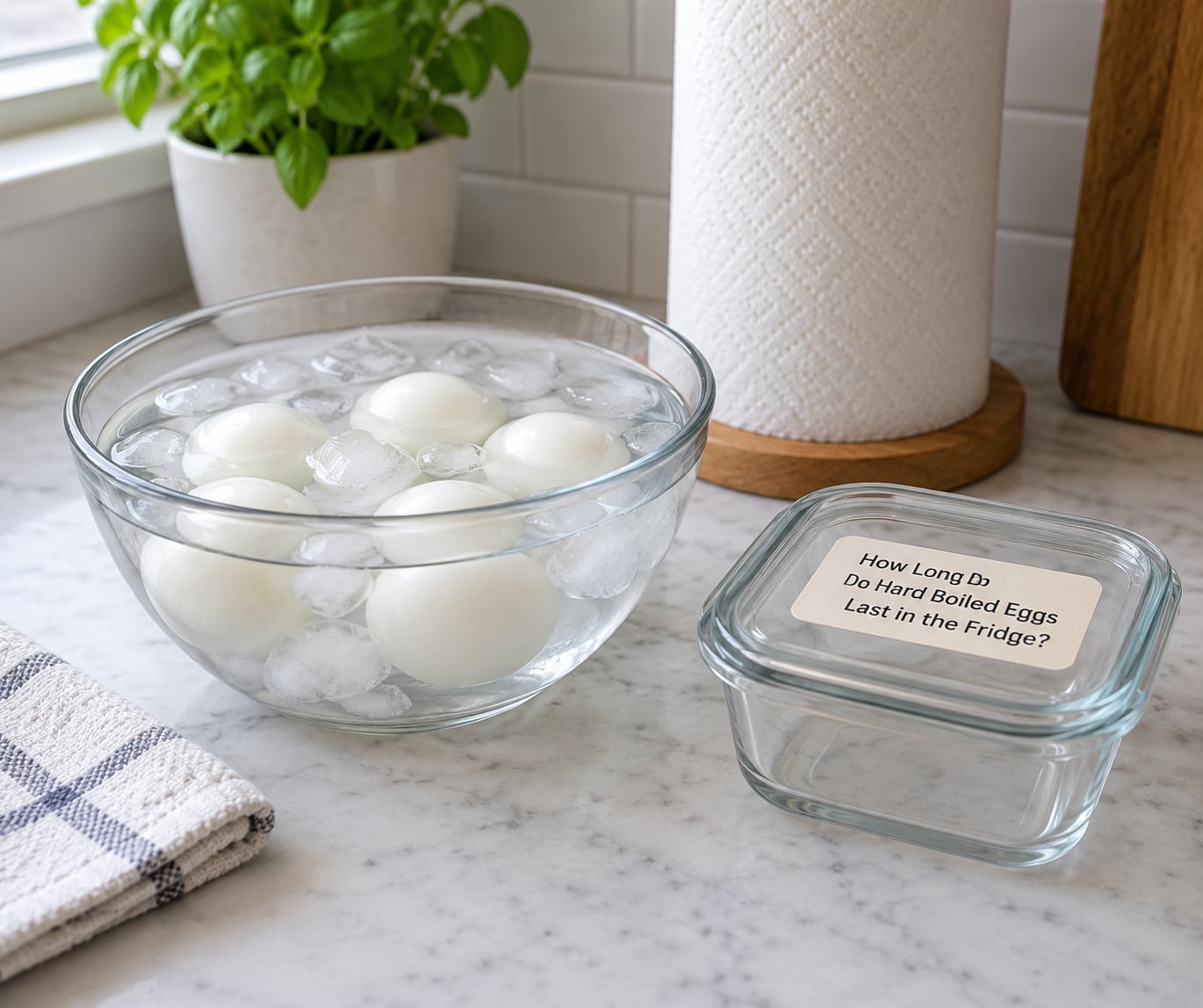
How long does the 7-day window hold for each egg form?
Egg form changes the window, and some forms change it a lot. Raw eggs in the shell keep for three to five weeks refrigerated, which is where most of the confusion comes from. Cooking shortens that dramatically because boiling strips away the cuticle, the thin protective film on the shell, and denatures the proteins in the white, leaving a porous surface bacteria can work with.
| Egg form | Fridge shelf life at 40°F or below | Best storage method |
|---|---|---|
| Raw eggs in the shell | 3 to 5 weeks | Original carton, inside shelf, do not wash before storing |
| Hard boiled, unpeeled | Up to 7 days | Airtight container or the empty carton, inside shelf |
| Hard boiled, peeled | Up to 7 days | Airtight container with a damp paper towel, submerged if storing more than a few hours |
| Soft boiled in the shell | 1 to 2 days | Upright in a covered container, coldest part of the fridge |
| Deviled eggs | 3 to 4 days | Sealed container, no plate left uncovered |
| Cooked yolks only, fridge | About 4 days | Airtight container or a silicone tray with a lid |
| Cooked yolks only, freezer | 2 to 4 months | Silicone tray, then sealed bag; thaw in the fridge overnight |
| Any cooked egg at room temperature | 2 hours, or 1 hour above 90°F | Ice packs in an insulated bag if it has to travel |
Key takeaways
- Refrigerate within two hours of cooking, one hour in hot weather.
- Keep the fridge at 40°F (4°C) or below.
- Leave eggs in the shell until you need them.
- Put them on an inside shelf, not in the door.
- Label the container with the cook date.
- Discard anything that smells sour or sulfurous, no matter the date.
You may see 4 to 7 days, 7 days and 10 days quoted across different sites. The USDA figure of one week is the anchor, and the shorter ranges are simply conservative readings of it. Where a source says 10 days, treat it as a maximum for perfect conditions rather than a target.
How to Store Hard Boiled Eggs Safely in the Fridge
Storage method decides whether you land at day 7 eating a good egg or day 3 eating a disappointing one. Six steps cover it.
- Cool them fast. Straight into ice water for at least 10 minutes. This stops carryover cooking, which is what turns a firm white into a bouncy, rubbery one.
- Dry the shells completely. Blot them on a paper towel before they go anywhere near a container. Moisture trapped against the shell encourages mould in the crevices.
- Choose the container. An airtight container, a sealed bowl under cling film, a ziplock bag with the air pushed out, or even the empty egg carton with the lid on. All of these beat a bare bowl.
- Add a damp paper towel if they are peeled. It keeps the whites from drying out and going mealy, and it stops the eggs picking up fridge smells like onion or garlic.
- Use an inside shelf. The door is the warmest spot and its temperature swings every time someone opens it, which shortens the window in real kitchens.
- Write the date on the lid. A strip of masking tape or a sticky note with the cook date. This single habit is what stops the day 3 versus day 8 argument at the fridge door.
People often skip step 2 and wonder why their eggs smell like the leftovers above them. Same idea as how to store summer berries so they last longer, by the way: airflow and a dry surface are what keep soft food from breaking down early.
Should You Peel Hard Boiled Eggs Before Refrigerating Them?
No. Store hard boiled eggs in the shell and peel them when you are ready to eat. Both forms keep for the same seven days, but the shell protects against moisture loss and odour absorption, and it removes the temptation to graze on a mid-week egg that then sits for four more days.
Peeled eggs are not worse, they just need more care. Fully submerged in water in a sealed container, or wrapped in a damp paper towel in an airtight box, they stay pleasant for the full week. Left peeled on a plate under cling film, they go dull and leathery well before day 7.
You do not have to peel right away. That question comes up constantly, and the answer is that you have up to seven days to get around to it. When you do peel, tap the shell on a hard surface, roll the egg between your palms, and peel under a thin stream of water, which helps the membrane lift away in pieces instead of dragging the white with it.
How to Tell When Hard Boiled Eggs Have Gone Bad
Appearance alone will not clear an egg. Smell does almost all of the work, so use your nose before you use your eyes.
- A sour or sulfurous smell. Peel the shell or sniff the end. Rotten eggs release hydrogen sulfide, which smells like rotten eggs and dirty drains. One whiff is enough. Do not taste to test.
- A slimy or chalky shell surface. A dry, powdery, oddly soft shell points to mould that has been sitting in moisture.
- Liquid sloshing when you shake it. Air and moisture should have left the cooked egg. A sloshing sound means the contents are degrading.
- Any pink, orange or black colouring in the white. Pink or orange spotting in cooked eggs is linked to overheating during boiling, so quality is affected even when it is safe. Black, green or purple is a different story. Discard it.
- An off taste or a texture that is past chewy. If you already tasted it and it tastes flat, sour or chemical, spit it out.
Two things people panic about are actually fine. A grey-green ring around the yolk comes from overcooking and iron reacting with sulfur, not from spoilage. A faint off smell from hydrogen sulfide in a cooked egg is a normal byproduct of the cooking reaction, but it should be faint. If it hits you across the room, that egg is done.
Past day 7, use the conservative call. If you cannot remember when the eggs were cooked and there is no label on the container, throw them out. If you do know the date and they are at day 8 or 9, smell every one, and expect a worse texture rather than a stomachache. At day 14 I would not eat them, and that is what the Food Safety and Inspection Service guidance amounts to in practice.
If you did eat a questionable egg, watch for vomiting, diarrhoea, stomach cramps and fever, which can start six hours to six days later. Pregnant people, adults over 65, young children and anyone with a weakened immune system should contact a doctor promptly after eating a suspicious egg, and so should anyone with bloody stools or signs of dehydration.
Why Do Refrigerated Hard Boiled Eggs Taste Bad?
Refrigeration slows bacteria but it does something unkind to the texture. The white is mostly water held in a denatured protein network, and cold plus time draws moisture out of that network and tightens it, so the egg goes from tender to rubbery. The yolk dries out separately and turns grainy and chalky.
Duration is the biggest factor. Day 2 eggs are noticeably better than day 6 eggs from the same batch. Cooling speed is next: eggs dropped straight into the fridge without an ice bath keep cooking from inside, overcooking the white near the shell. Shell removal matters too, since the shell is a moisture barrier. Reheating finishes the job, because cooking an already-cooked egg drives off more water and firms the proteins further.
The sulphur flavour that shows up on day 4 or 5 is chemistry rather than spoilage. Hydrogen sulfide forms when the egg cooks and it lingers in the cold. Boiling the eggs in water that already has a splash of vinegar reduces it, though it changes the texture slightly.
Can You Freeze or Reheat Hard Boiled Eggs?
Freeze the yolks, not the whole egg. Whole hard boiled eggs rupture when thawed, and the white turns watery and rubbery at the same time. Yolks freeze cleanly.
Cool the eggs, peel them, separate the yolks, and press each yolk into a silicone ice cube tray. Freeze solid, pop them out, and move them to a sealed freezer bag. They keep 2 to 4 months. Thaw one in the fridge overnight and use it mashed into egg salad, as a sauce thickener, or crumbled over a dish. Freeze the whites separately only if you have reason to, and treat them as short-lived once thawed.
To reheat, bring the whole egg straight from the fridge into a pan of barely simmering water and give it three to five minutes, or microwave it in ten-second bursts in a cup of water. That stops the white turning to rubber. Avoid a hard boil and avoid the microwave on a plate, which makes the white leathery at the edges. If you are reheating for someone pregnant, very young, elderly or immunocompromised, cook the egg until the whites and yolk are set and steaming, which means 165°F (74°C) internally.
If your eggs are for eating cold, freezing is overkill. For boiled eggs that need to survive a commute or a day outdoors without a fridge, plan the day around the two-hour rule instead. It is worth reading how to fuel a long walk or hike with real food if you are packing eggs for a trip, because temperature control matters more than the boil itself.
Frequently Asked Questions
How long do hard boiled eggs last in the fridge with the shells on?
Up to 7 days, counted from the moment they finish boiling. USDA and FDA guidance both say one week for cooked eggs stored at or below 40°F (4°C). Keep them in an airtight container or the empty carton on an inside shelf, not in the door. Smell them before eating past day 5, and label the container with the cook date so you are not guessing.
How long do peeled hard boiled eggs last in the fridge?
Also up to 7 days, the same as unpeeled eggs. Peeled eggs lose moisture faster, so store them submerged in water or wrapped in a damp paper towel inside a sealed container. A peeled egg left sitting on a plate under cling film still keeps for a week, but the white turns dull and leathery well before then.
Can hard boiled eggs be stored in their original carton?
Yes, and it is one of the better storage options. An empty egg carton with its lid on holds the eggs upright, protects them from knocks and stops them absorbing smells. Just make sure the carton is clean and dry, and put it on an inside shelf rather than in the door, where the temperature rises every time the fridge is opened.
Are hard boiled eggs safe if they were left out overnight?
Generally no. The two-hour rule applies, so cooked eggs sitting out for eight hours or more should be discarded. Bacteria such as Salmonella can multiply fast once eggs are cooked, because boiling removes the protective cuticle on the shell. The same caution applies to deviled eggs and egg salad, which are even more perishable.
Can you freeze hard boiled eggs after boiling them?
Freeze the yolks only. Whole hard boiled eggs rupture during thawing and the whites turn watery and tough. Press cooked yolks into a silicone ice cube tray, freeze them solid, then bag them; they keep 2 to 4 months. Thaw in the fridge overnight and use them in egg salad, sauces or as a garnish. Whites can be frozen separately but thaw poorly.
How should I reheat hard boiled eggs without making them rubbery?
Use gentle heat. Put the egg straight from the fridge into barely simmering water for three to five minutes, or microwave in ten-second bursts in a cup of water. Boiling the egg again or heating it on a bare plate drives off moisture and tightens the proteins, which is what causes the rubbery texture.
Conclusion
Hard boiled eggs last up to 7 days in the fridge, peeled or unpeeled, at 40°F (4°C) or below. Right after cooking, move them to an ice bath for ten minutes, dry the shells, and put them in a sealed container on an inside shelf. Label the lid with the date you boiled them, and peel only when you are ready to eat.
Labeling and prompt use do more for you than any sell-by date on the carton. Once you are past day 7, trust the smell and discard anything sour or sulfurous rather than reasoning about it.