
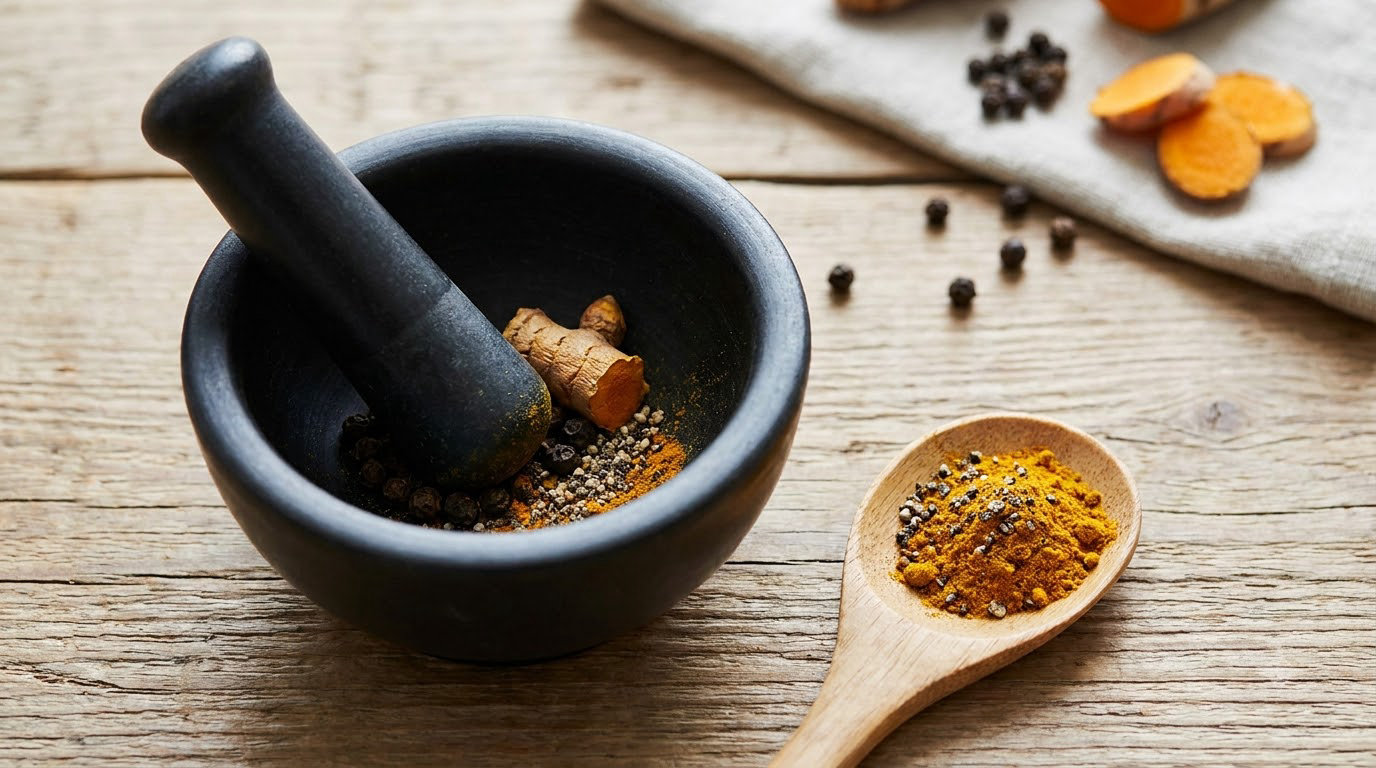
Why is black pepper added to turmeric? Because turmeric’s active compound, curcumin, is absorbed poorly on its own, and black pepper contains piperine, an alkaloid that appears to slow the enzymes and pumps your body uses to clear curcumin out. In one small human study, adding piperine raised curcumin bioavailability by roughly 2,000%. The size of that number is disputed, and more is not automatically better.
I cook with both nearly every day, and the reason they show up together in so many recipes goes back centuries. What follows is what the research actually supports, what it doesn’t, and how to use the pair without turning a spice into a dosing problem. We keep this updated for 2026.
The short version
- Curcumin makes up only about 2 to 5 percent of turmeric by weight, and less than 1 percent of an oral dose tends to reach your bloodstream intact.
- Piperine, the heat-producing compound in black pepper, interferes with several of the body’s curcumin-clearing pathways at once.
- Curcumin dissolves poorly in water, so some fat in the same meal matters just as much as the pepper.
- More pepper is not better. A small amount is enough, and going heavier raises the odds of stomach upset and medication interactions.
- Food-level use is a different proposition from a concentrated piperine extract or a curcumin supplement. Check your doctor’s or pharmacist’s advice if you take prescription medicines.
Table of Contents
- What Does Black Pepper Do for Turmeric?
- Why Black Pepper Is Added to Turmeric
- What Does the Research Actually Show?
- How to Use Turmeric and Black Pepper Together
- Is Piperine Safe With Food and Supplements?
- Common Myths About Turmeric and Black Pepper
- Frequently Asked Questions
- Does black pepper really increase turmeric absorption?
- How much black pepper should be added to turmeric?
- Is turmeric with black pepper better than turmeric alone?
- Can you take turmeric and black pepper with prescription medications?
- Does black pepper help the body absorb turmeric if the food does not contain fat?
- Is it better to use whole black peppercorns or ground black pepper?
- Conclusion
What Does Black Pepper Do for Turmeric?
Black pepper does one useful thing for turmeric: it helps more of the curcumin you eat reach your bloodstream before your body disposes of it. That single effect comes from piperine, the same alkaloid that gives black pepper its heat.
The starting problem is that turmeric is mostly not curcumin. Ground turmeric is roughly 2 to 5 percent curcuminoids by weight, and curcumin makes up the bulk of that small share. The rest is starch, fiber, oils and pigment. Even with a full teaspoon of turmeric powder in a curry, the curcumin dose is small.
Then there is the second problem. Curcumin barely dissolves in water, and it gets broken down and tagged for excretion almost as soon as it crosses the gut wall. Researchers often report that under 1 percent of an ingested curcumin dose shows up in plasma unchanged. Bioavailability simply means the share of what you swallowed that actually gets into circulation in usable form.
So why black pepper is added to turmeric comes down to a math problem rather than a flavour one. Small input, poor absorption, and a compound sitting next to it that pushes against the machinery doing the clearing.
Why Black Pepper Is Added to Turmeric
Piperine appears to slow down the processes that dispose of curcumin, and laboratory work on this is consistent. Human evidence is thinner and messier. The pairing is popular, the mechanism is plausible and well described, but the headline percentage comes from one small study that later trials have not always reproduced at the same magnitude.
There is an older tradition underneath the science too. Haldi doodh, a turmeric-and-milk drink seasoned with pepper and ginger, has been made in South Asian households for a very long time. Nobody involved was measuring CYP3A4. The pairing worked as a kitchen habit, and the biochemistry arrived much later to explain part of why it stuck.
One thing that habit got right: pepper with turmeric, turmeric with fat. That combination shows up repeatedly because it addresses two different failure points at once, and a turmeric drink that skips the fat and the pepper is missing the part that matters.
How Piperine May Increase Curcumin Absorption
Plain language first, then the names. Curcumin gets absorbed through the gut lining and then faces a gauntlet of enzymes and transporters designed to clear foreign compounds. Piperine interferes with several of those checkpoints at the same time.
Researchers describe four main effects. The exact mechanism in people, and how much it matters clinically, is still under study.
- Intestinal CYP3A4 inhibition. CYP3A4 is a workhorse enzyme found in the gut wall and the liver that breaks down curcumin and a large share of prescription drugs. Slowing it lets more curcumin pass through untouched.
- Reduced glucuronidation. Before curcumin can leave the body, the liver tags it with a small molecule, a process called glucuronidation, which makes it easier to excrete. The tagging is a form of disarmament, and it is fast.
- P-glycoprotein blockade. These transporters sit in the gut lining and pump absorbed compounds back into the intestine, a process called efflux. Block the pump and absorbed curcumin stays put.
- Loosened gut-wall membranes. Piperine appears to increase the permeability of the intestinal lining, letting larger molecules slip through more easily.
The last two are worth dwelling on, because they explain the nagging point that piperine is not only a turmeric trick. It boosts the absorption of several other nutrients, including vitamin B12, beta-carotene and resveratrol. That is a useful property in a kitchen and a genuine reason for caution in a supplement aisle.
Why Fat Matters With Turmeric
Curcumin is fat-soluble. Whisk turmeric into cold water and most of it sits on the bottom. Add oil, butter, ghee, coconut milk or whole milk and the curcuminoids have something to travel in.
That is why golden milk works as well as it does, and why so many traditional preparations pair turmeric with fat rather than with a cup of plain water. Fats also stimulate bile flow, which helps move fat-soluble compounds along.
Black pepper is a separate strategy. It changes the enzymes and transporters rather than the physics of dissolution, so the two approaches do not compete and neither replaces the other. Food without fat plus pepper is a weaker combination than food with fat plus pepper, though not a useless one.
What Does the Research Actually Show?
Three tiers of evidence sit behind this topic, and they do not all say the same thing.
Laboratory and animal work. This is the strongest and most consistent tier. Piperine reliably changes drug-metabolising enzymes and transporters in cell and animal models, and curcumin levels in those models go up when piperine is present. Researchers also take the 2,000 percent figure from a 1998 paper by Shoba and colleagues in Planta Medica, which reported the increase in curcumin bioavailability in human volunteers.
The human study behind the number. In that 1998 work, healthy volunteers took 2 g of curcumin, and a separate group took the same curcumin with 20 mg of piperine. Blood samples were drawn over several hours and curcumin exposure was compared using area under the curve, a measure of how much compound the body was exposed to over time. The piperine group showed dramatically higher exposure.
Now the caveats, which most short posts skip. It was a single small study, roughly ten volunteers, in healthy people, using a purified curcumin dose rather than kitchen powder. Measuring curcumin in blood is genuinely hard, because it is quickly metabolised and several of its breakdown products also show up on the assay. Later trials and reviews have found an effect but not always at the same size, and results vary with formulation and dose.
| Evidence tier | What it shows | How much weight it carries |
|---|---|---|
| Cell and animal studies | Piperine reliably alters enzyme activity and transporters involved in curcumin handling | Strong and consistent, but not the same as a human effect |
| Small human trials | Curcumin blood exposure rises substantially when piperine is added | Real signal, limited size, results not always reproduced at the same magnitude |
| Long-term outcome trials | Whether the pairing changes health outcomes in real populations | Limited and often short, which is why big claims stay in the lab |
Two practical conclusions follow. More than a small amount of pepper adds nothing measurable, and the difference between a measured piperine dose and a kitchen pinch means a turmeric supplement and a turmeric latte are not delivering the same thing. A shake of pepper in a soup is not a 20 mg capsule.
Curcuminoid concentration varies by product too. Kitchen powder sits around 2 to 5 percent curcuminoids, so reaching the 500 mg curcumin in a supplement capsule would take on the order of a couple of tablespoons of powder. A standardized extract at 95 percent curcuminoids is a very different quantity of the active compound, which is why supplement and spice advice should never be swapped for each other.
How to Use Turmeric and Black Pepper Together
Most of the benefit available to a home cook comes from seasoning habits, not from replicating a laboratory dose. A few of these have held up well for me.
Season the pan, not the plate. Bloom turmeric and pepper in oil for 30 to 60 seconds before liquid goes in. Cooking releases the oils from the spice and the fat gives curcuminoids something to dissolve into, which is the whole point.
Use pepper in dishes that already have fat. Dals, curries, soups with coconut milk, roasted vegetables with olive oil, scrambled eggs. The pepper lands somewhere useful instead of on dry rice.
Whisk golden milk properly. Warm a cup of whole milk or unsweetened plant milk with a small pinch of black pepper, a pinch of cinnamon, a slice of ginger and a small turmeric pinch. Heat gently, whisk until the fat emulsifies, then sweeten with a little honey after it cools a touch. Milk provides fat and protein, which is close to the format that works.
Grind pepper fresh. A jar of pre-ground pepper has been sitting open to air for months. Whole peppercorns keep their aromatic oils longer, and a short grind right before use gives a noticeably brighter result.
On how much to use, forum conversations and search data agree on the same instinct: a small amount is plenty, and consistency over weeks matters more than the size of any single pinch. Here is roughly what the volume amounts look like in piperine terms, using black pepper at about 3.3 percent piperine by weight.
| Amount of black pepper | Approximate piperine | Realistic verdict |
|---|---|---|
| Pinch, about 1/20 teaspoon | Roughly 5 mg | Fine for everyday cooking |
| 1/8 teaspoon | Roughly 20 mg | Matches the dose used in the 1998 study |
| 1/4 teaspoon | Roughly 40 mg | More than the studied dose, with more irritation risk |
| 1/2 teaspoon | Roughly 80 mg | Unnecessary for food use |
| 1 teaspoon | Roughly 160 mg | Well past anything worth taking deliberately |
Those figures describe seasoning amounts, not a treatment plan. If you are considering a curcumin or piperine supplement, the dose is a conversation to have with a doctor or pharmacist, particularly if you take any regular medication.
One more timing note. Absorption of curcumin in these studies shows up in blood within roughly 45 minutes, which is a measurement curiosity rather than a result you will feel. Any effect people attribute to turmeric tends to build across several weeks of regular use, not appear after one cup. Users on supplement forums consistently describe the same pattern: consistency over four to eight weeks, not the size of the pinch.
Is Piperine Safe With Food and Supplements?
Food-level amounts of black pepper alongside turmeric are safe for most people. Concentrated piperine supplements are a different question, mostly because the dose and the drug interactions scale with it.
The mechanism of concern is the same mechanism that makes the pairing work. If piperine slows CYP3A4 and P-glycoprotein, it can also slow the clearance of prescription medicines that rely on those pathways, pushing their levels higher than intended. That is why it is not a question of whether you eat curry with pepper, but whether you are taking a standardized extract alongside a drug with a narrow therapeutic window.
Groups worth discussing with a clinician before regular concentrated use:
| Group | Why it needs a conversation |
|---|---|
| People on blood thinners or antiplatelet medicines | Both turmeric and pepper can affect bleeding tendency, and the combination may add to the effect |
| People on medicines metabolised by CYP3A4 | Piperine can raise drug levels, which matters for drugs with a narrow range between too little and too much |
| People with reflux, gastritis or ulcers | Black pepper is a common trigger, and forum reports from people managing gastritis specifically describe piperine extract as aggravating |
| People with gallbladder disease or a history of gallstones | Turmeric stimulates bile secretion, which can worsen symptoms |
| People with iron deficiency | Curcumin can interfere with iron absorption, so it is worth spacing out from iron-rich meals or supplements |
| People with diabetes on medication | Blood sugar effects may stack with prescribed medication |
| People who are pregnant or breastfeeding | Concentrated piperine supplements are not well studied in these groups |
| Anyone facing surgery | Clinicians often ask about supplements in advance for bleeding and medication reasons |
On the claim that circulated widely online that piperine starts degrading within 15 minutes of grinding and that cooking destroys the pairing: that figure is repeated constantly and sourced almost never. Ground pepper does lose aroma compounds gradually through oxidation, which is why fresh grinding tastes better, and piperine is comparatively stable in a normal pan. For flavor, grind fresh. For the absorption effect, cooking temperature is not the thing to worry about.
If you take a curcumin supplement, read the label for piperine or a branded equivalent such as BioPerine before adding pepper on top. Doubling up on piperine is a real and easy mistake, and forum users describe exactly that confusion when they cannot tell whether the capsule already contains it.
Common Myths About Turmeric and Black Pepper
The 2,000 percent increase is a guarantee. It is a result from one small 1998 study, not a promise about your response. Later work finds a real increase in curcumin exposure but not always at that magnitude, and the effect depends on the form, the dose and the person.
More pepper means more benefit. The studied dose was about 20 mg of piperine, roughly an eighth of a teaspoon. Beyond that you are mostly adding irritation risk and drug-interaction risk.
It works the same way for everyone. Gut pH, bile flow, medications, liver function and genetics all change the outcome. People managing gastritis or reflux often find pepper extract makes things worse rather than better.
Piperine makes curcumin dissolve in water. It does not. Curcumin remains fat-soluble, and pepper changes enzyme activity rather than solubility. If your meal has no fat, adding pepper helps less than it would otherwise.
A pinch on food equals a supplement dose. It does not. Kitchen powder is 2 to 5 percent curcuminoids, and a turmeric capsule may be 95 percent. These are different quantities, and supplement dosing advice should come from a clinician.
It replaces treatment for a health condition. Turmeric is a spice with a plausible and still-developing evidence base. It has no established role as a replacement for prescribed treatment, and anyone with a diagnosed condition should talk to their doctor before changing anything.
Frequently Asked Questions
Does black pepper really increase turmeric absorption?
Yes, in the sense that studies show more curcumin reaching the bloodstream when piperine is taken with it. The best known human trial, published in Planta Medica in 1998, found a dramatic increase in curcumin exposure when 20 mg of piperine was added to a 2 g curcumin dose. That trial was small, and later studies confirm an effect without always matching that size.
How much black pepper should be added to turmeric?
For cooking, a small pinch up to about an eighth of a teaspoon of freshly ground black pepper is plenty. Black pepper is roughly 3.3 percent piperine by weight, so an eighth of a teaspoon lands near 20 mg, the amount used in the 1998 study. Going heavier does not add measurable benefit and increases the chance of stomach irritation.
Is turmeric with black pepper better than turmeric alone?
For absorption, yes. Turmeric alone delivers very little usable curcumin, and piperine appears to slow the enzymes and transporters that clear it. Pairing is the practical default rather than an optional extra. If you cannot tolerate pepper, adding a source of fat to the same meal still improves absorption, and some people use a phospholipid-complexed curcumin instead.
Can you take turmeric and black pepper with prescription medications?
Food-level amounts of pepper in a meal are rarely a problem. Concentrated piperine or curcumin supplements are different, because piperine can slow the metabolism of many medicines and raise their levels. This matters most for blood thinners, antiplatelet drugs, diabetes medicines and anything metabolised by the CYP3A4 enzyme. Ask your doctor or pharmacist before starting a supplement.
Does black pepper help the body absorb turmeric if the food does not contain fat?
It helps, but less than it would with fat. Curcumin is fat-soluble and barely dissolves in water, so a little oil, butter, ghee or whole milk gives it something to travel in. Piperine works through a different route, slowing enzymes and transporters that clear curcumin. The two approaches are complementary, and combining both gives the best result.
Is it better to use whole black peppercorns or ground black pepper?
Whole peppercorns keep their aromatic oils better and stay fresher for longer, so grinding right before you cook gives a brighter flavor and a steadier piperine dose. Pre-ground pepper on a shelf has been exposed to air for months and loses aroma gradually. If you have a mill, a short grind each time is the simplest upgrade to the habit.
Conclusion
Why black pepper is added to turmeric comes down to absorption. Curcumin is a small fraction of the spice and less than 1 percent of a normal dose reaches your bloodstream, and piperine appears to slow the enzymes and pumps that clear it out.
Start in the kitchen. Bloom a pinch of turmeric and pepper in oil, add a source of fat, and eat it regularly rather than heavily. Treat concentrated curcumin and piperine supplements as a separate decision, and raise them with a doctor or pharmacist if you take any prescription medicine or have reflux, gallbladder issues or iron deficiency.