
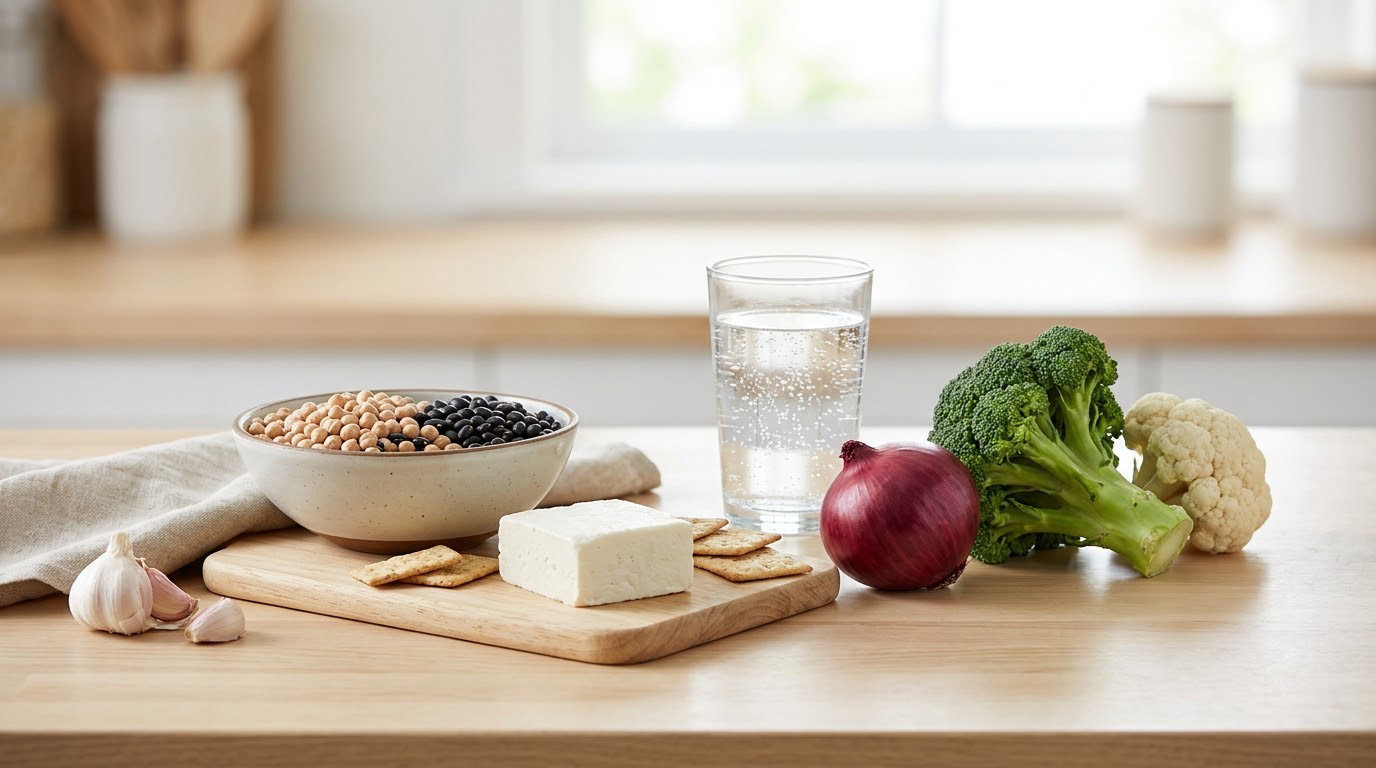
Bloating shows up as a tight, full feeling in the abdomen, often with visible swelling, and it usually comes down to gas, water retention, or swallowed air. The most common triggers are beans and lentils, onions and garlic, cruciferous vegetables, wheat in large portions, high-fructose fruit, dairy, carbonated drinks, fried food, and sugar-free sweeteners. None of them is a problem for everyone, and the same food can bloat one person badly while barely registering for the person sitting next to them.
That variation is the part most “worst foods” lists get wrong. What actually matters is not whether a food is on a list, but which mechanism your gut is reacting to, how much you ate, and how it was prepared. So this guide covers the foods that trigger bloating for many people, the reason behind each one, and the smallest change that usually makes it easier to tolerate.
One note before we start: this is general information, not medical advice. If bloating is constant, painful, comes with weight loss, or keeps you up at night, talk to your doctor or a registered dietitian rather than working through a list on your own.
Table of Contents
- Foods That Trigger Bloating for Many People at a Glance
- 1. Beans and Lentils
- 2. Onions and Garlic
- 3. Broccoli, Cabbage, and Brussels Sprouts
- 4. Wheat and Other Gluten-Containing Grains
- 5. Apples, Pears, and Stone Fruits
- 6. Milk and Soft Cheese
- 7. Carbonated Drinks and Chewing Gum
- 8. High-Fat Fried Foods
- 9. Artificial Sweeteners
- 10. Avocado and Other Large Portions of Healthy Fat
- 11. Fermented Foods, Pickles, and Sauerkraut
- 12. Large Portions of Raw Salads and Seed-Based Foods
- Frequently Asked Questions
- How do I find my own trigger foods without cutting everything out?
- How long after eating does bloating usually start?
- Is a low FODMAP diet worth trying for bloating?
- What should I eat when I feel bloated and gassy?
- Can I train my gut to tolerate beans and broccoli again?
- When is bloating a sign I should see a doctor?
- Conclusion
Foods That Trigger Bloating for Many People at a Glance
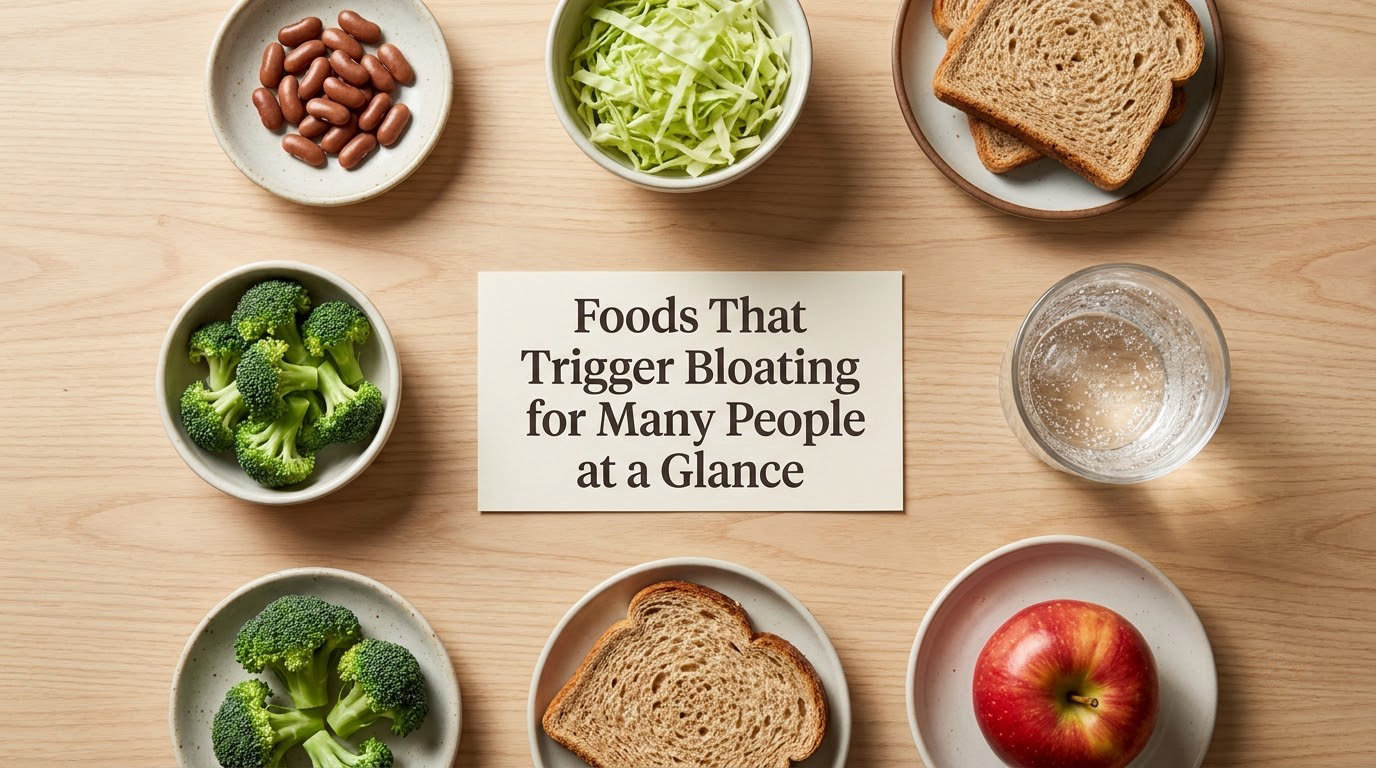
The table below covers the twelve most commonly reported triggers, why each one may cause trouble, and the prep or portion changes people find most useful.
| Food | Why it may cause bloating | Portions or preparation that help | How to test your tolerance |
|---|---|---|---|
| Beans and lentils | Raffinose and other oligosaccharides reach the colon and ferment | Start with 2 to 3 tablespoons; rinse canned beans well; add gradually to soups | Eat a small serving daily for 2 to 4 weeks and note how symptoms change |
| Onions and garlic | Fructans, especially noticeable when eaten raw | Cook them longer, use smaller amounts, or use garlic-infused oil | Compare raw onion in a salad with cooked onion in a stew over one week each |
| Broccoli, cabbage, Brussels sprouts | Fermentable carbohydrates plus sulfur compounds | Cook thoroughly, roast, steam, or start with small chopped portions | Try steamed and raw versions separately and compare the same evening |
| Wheat and gluten-containing grains | Fructans and starch load in large portions; sometimes gluten itself | Smaller slices, sourdough or sprouted bread, refined rather than whole grain | Swap to gluten-free for two weeks, then reintroduce wheat and log the difference |
| Apples, pears, plums, peaches | Fructose plus sorbitol, a sugar alcohol | One small piece, cooked fruit, or fruit eaten with protein and fiber | Eat two servings raw on day one and two cooked on day two, same portion |
| Milk and soft cheese | Lactose without enough lactase to digest it | Lactose-free milk, yogurt with live cultures, firm aged cheese in small amounts | Replace dairy for a week and note whether bloating, gas, or both change |
| Carbonated drinks and chewing gum | Swallowed air, not fermentation | Sip slowly, skip straws, reduce gum chewing, choose still drinks | Cut soda and sparkling water for five days and compare mornings |
| High-fat fried food | Fat slows stomach emptying and delays gas moving along | Smaller portion, baked or grilled versions, add vegetables to the plate | Compare a fried lunch day with a grilled lunch day of similar size |
| Artificial sweeteners | Sugar alcohols such as sorbitol, xylitol, and mannitol | Check labels for polyols, cut back gradually rather than all at once | Read every label for one week and drop one sugar-free item at a time |
| Avocado, nuts, nut butters | Large fat portions sit heavy and slow digestion | Quarter to half an avocado, a small handful, one tablespoon of nut butter | Halve your usual portion for a week and compare afternoon comfort |
| Fermented foods and pickles | High histamine load bothers some people more than others | Introduce one food at a time in small portions | Add one fermented food per week and note the reaction before adding the next |
| Raw salads and seeds | Volume eaten fast, plus fiber-dense chia, flax, or sunflower seeds | Cooked vegetables, smaller salads, seed portions increased slowly | Swap raw for cooked greens for one week and compare how quickly you feel full |
1. Beans and Lentils
Beans and lentils are the single most reported trigger on forums, and the mechanism is well understood. They carry raffinose and stachyose, two oligosaccharides your small intestine cannot break down, so they arrive in the colon intact and get fermented by gut bacteria into gas.
If this is you, start small rather than avoiding them entirely. Two tablespoons of lentils in a soup, or a third of a cup of well-rinsed canned chickpeas, is a reasonable first serving. Rinsing canned beans well removes a meaningful share of the dissolved sugars that cause the trouble.
There is also a timeline worth knowing: people who eat beans most days often report the effect fading over roughly two to four weeks as the gut adapts and bacterial populations shift. That adaptation is the reason many people can eat beans comfortably on a regular schedule but get bloated after a bean-heavy meal they rarely eat.
2. Onions and Garlic
Onions and garlic are high in fructans, a type of carbohydrate that behaves similarly to lactose for people with limited enzyme production. Raw onion is usually the worst case, which is why a big raw onion salad can leave you distended for hours while the same onion simmered in soup does not.
Cooking breaks down some of these compounds, so lightly caramelized onion or slow-roasted garlic tends to sit easier than raw. Garlic-infused oil is the practical swap, since the fructans stay in the oil and the flavor stays in the dish.
Green tops of scallions are another option, and they carry far less of the compounds than the bulb. If garlic and onion are a non-negotiable part of your cooking, the fix is usually quantity and cooking method, not removal.
3. Broccoli, Cabbage, and Brussels Sprouts
Cruciferous vegetables are fermentable and gassy for a straightforward reason: they contain carbohydrates that reach the colon largely undigested, and they carry sulfur compounds that produce the smells people associate with them. Brussels sprouts, broccoli, and cauliflower are named most often, and cabbage, kale, and turnip follow.
Preparation changes the result more than most people expect. Thoroughly steamed or roasted vegetables produce noticeably less gas than raw, and a finely chopped serving is gentler than a large wedge of raw cabbage.
Portion size is the second lever. A cup of raw broccoli and a cup of steamed broccoli are not the same experience for a sensitive gut. If you eat cruciferous vegetables several times a week already, that steady exposure is usually the least disruptive way to keep them in your diet.
4. Wheat and Other Gluten-Containing Grains
Wheat is worth separating into two different problems, because the advice is different for each. Most ordinary bloating after bread comes from volume, fermentable wheat fructans, or both, and shows up as discomfort that passes within a few hours of the meal.
Gluten sensitivity and celiac disease are different again, and neither can be diagnosed by paying attention to bloating. If bloating after wheat is persistent, comes with diarrhea, weight loss, anemia, or a rash, ask your doctor about celiac testing before changing anything.
In the meantime, smaller portions of traditionally prepared bread often help, because long fermentation in sourdough methods breaks down more of the fructans. Reducing total wheat at one meal, and eating it with protein and vegetables rather than on its own, is a reasonable first adjustment.
5. Apples, Pears, and Stone Fruits
Apples, pears, plums, peaches, prunes, and cherries all carry a mix of fructose and sugar alcohols such as sorbitol, and the body absorbs them slowly enough that a large portion can ferment in the gut. This is one of the most commonly reported triggers in people who would never describe themselves as having a “diet problem.”
Two adjustments help most people. First, portion: one medium fruit rather than two large ones. Second, pairing: eating fruit with protein and fiber slows the delivery, which frequently removes the discomfort even when the quantity stays the same.
Cooking also changes things, since heat breaks down some of these compounds. Apple sauce and baked pears are a common quiet swap for people who want to keep the flavor without the effect.
6. Milk and Soft Cheese
Dairy-related bloating usually points to lactose, the milk sugar broken down by an enzyme called lactase. Many adults produce less lactase than they did as children, so the lactose reaches the colon and ferments. The result is often gas, bloating, and sometimes loose stools within thirty minutes to a few hours.
It is worth separating three things that get lumped together: lactose intolerance, milk protein allergy, and sensitivity to additives in processed dairy. The first is a dose-dependent sugar issue, the second is an immune reaction that tends to be immediate and can involve other symptoms, and the third is about emulsifiers and stabilizers rather than dairy itself.
Practical options include lactose-free milk, yogurt with live cultures, and firm aged cheese in modest portions. Many lactose-sensitive people tolerate a small amount fine, which is why hard cheese rarely causes the problem that a glass of milk does.
7. Carbonated Drinks and Chewing Gum
Carbonation is a different mechanism from fermentation. The carbon dioxide in soda, sparkling water, and beer adds gas directly to the stomach, and the expansion is felt quickly, often within minutes of drinking. Chewing gum and swallowing from straws work the same way, because both pull extra air into the gut.
That speed is the useful clue. If the feeling arrives in ten minutes and settles before your next meal, air is the more likely explanation than food fermentation, which tends to build over a longer window.
Sipping rather than gulping, leaving straws alone, and cutting back on gum-chewing are simple changes. Plain water and sparkling mineral water without added carbonation are direct substitutes when the fizz is what you actually enjoy.
8. High-Fat Fried Foods
Large, fatty meals slow digestion. Fat triggers the hormones that slow gastric emptying and slow the movement of gas through the intestine, so a heavy meal can leave you feeling full and tight long after you have stopped eating, even when the food contains very little that ferments.
This is the trigger most often mistaken for a food sensitivity, because the discomfort can last through the evening and the next morning. The pattern of feeling heavy rather than gassy is a useful signal.
The adjustments are practical rather than restrictive: smaller fried portions, baked or grilled versions more often, and a plate built around vegetables with the fried item as a side rather than the whole meal. Fried food eaten once a week is a different proposition from fried food most nights.
9. Artificial Sweeteners
Sugar alcohols are the quiet ones. Sorbitol, xylitol, mannitol, erythritol, and maltitol pass through the small intestine without being absorbed, so they reach the colon and get fermented. Many people notice nothing at all, and many notice a lot, often in sugar-free gum, diet drinks, protein bars, and “healthy” snacks that look nothing like sweets.
Reading the ingredient list is the fastest way to find out. Some products use these under unfamiliar names, and a single daily item such as a protein bar or flavored yogurt can add up more than an occasional dessert would.
If you want to cut back, replacing one sugar-free item at a time works better than removing everything at once, and it lets you see which one mattered. It is also worth knowing how to spot hidden sugar in packaged foods, since the same labels carry both sweeteners and the sugar alcohols listed separately.
10. Avocado and Other Large Portions of Healthy Fat
Avocado, nuts, seeds, and nut butter are nutritious foods, and this entry is about quantity rather than quality. A large fat portion delays stomach emptying the same way fried food does, so a whole avocado plus a scoop of almond butter can produce a heavy, tight feeling in someone who tolerates either one perfectly well on its own.
Typical portions cause very little trouble for most people: a quarter to half an avocado, a small handful of nuts, or a tablespoon of nut butter. The version that tends to cause discomfort is a fat-heavy meal with little fiber alongside it.
If you enjoy these foods, keep them and adjust the serving instead. Pairing them with vegetables and a protein source, rather than eating them as the entire meal, tends to settle digestion comfortably.
11. Fermented Foods, Pickles, and Sauerkraut
Fermented foods are widely promoted as gut-friendly, and many people genuinely do better with them. At the same time, they are high in histamine, and some people’s systems react to a histamine load that others handle without noticing. Sauerkraut, kimchi, pickles, yogurt, and kombucha sit on that list.
This is the item on the list where reactions vary most widely, so a one-size-fits-all rule does not help. Introducing one fermented food at a time, in a small portion, tells you far more than a month of eating several of them together.
Related food stories, like foods that help skin look less dull, often come up in the same conversations, since skin and gut symptoms tend to change together when a food is genuinely wrong for you.
12. Large Portions of Raw Salads and Seed-Based Foods
Big raw salads are a leading real-world trigger among the foods that trigger bloating for many people, and formal lists tend to bury them. Volume eaten quickly, combined with the fact that raw vegetables keep their fermentable carbohydrates intact, means a large salad can produce more discomfort than the same vegetables cooked. Raw spinach and mixed greens come up repeatedly in readers’ accounts.
Seed-based foods are the other half of this entry. Chia, flax, sunflower, and pumpkin seeds are dense with fiber and oil, and a seemingly small spoonful can be a large amount by digestive standards, particularly when added on top of an already high-fiber day.
Cooking your greens, keeping salads to a moderate size, and increasing seed portions gradually over a few weeks are the usual adjustments. Soluble fiber sources such as oats tend to be gentler, and steady water intake helps fiber move along.
Frequently Asked Questions
How do I find my own trigger foods without cutting everything out?
Keep a simple food and symptom log for two weeks, noting what you ate, how much, and when discomfort appeared. Most triggers repeat before you notice the pattern. Then remove one suspected food for a week and reintroduce it, rather than starting a broad elimination diet.
How long after eating does bloating usually start?
Swallowed air from soda or gum can cause a feeling within ten minutes. Lactose usually shows up within thirty minutes to a few hours. Fermentable carbohydrates such as beans, onion, and wheat often take longer, sometimes four to six hours, because they need time to reach the colon and ferment.
Is a low FODMAP diet worth trying for bloating?
A low FODMAP diet is a structured short-term approach developed at Monash University, and it can help people with confirmed IBS symptoms. It works best with guidance, because the diet restricts many nutritious foods and needs reintroduction to restore variety. Do not start it long-term on your own.
What should I eat when I feel bloated and gassy?
Smaller, simpler meals are usually more comfortable than a large mixed one. Options that tend to sit well include rice, oats, bananas, oranges, cucumber, potatoes without skin, eggs, fish, firm tofu, and kefir or yogurt with live cultures. Peppermint tea and a short walk also help many people move things along.
Can I train my gut to tolerate beans and broccoli again?
For most people, yes. Regular exposure in small portions increases tolerance over roughly two to four weeks as gut bacteria adapt, which is why daily bean eaters often feel fine while occasional eaters do not. Increase portions gradually, and back off if symptoms are severe or persistent.
When is bloating a sign I should see a doctor?
See a doctor or registered dietitian if bloating is constant regardless of what you eat, comes with weight loss, blood in stool, persistent diarrhea or constipation, severe pain, difficulty swallowing, or a change in bowel habits that lasts more than a few weeks. These can point to conditions that food changes alone will not fix.
Conclusion
Start with patterns, not rules. Two weeks of honest notes about what you ate and when the tightness showed up will tell you more than any list of forbidden foods, because the foods that trigger bloating for many people rarely match one person’s list exactly.
Once you see a pattern, adjust the two variables that matter most: portion size and preparation method. Cooked instead of raw, rinsed instead of straight from the can, half a portion instead of a full one, eaten with protein and vegetables rather than alone.
Then give tolerance a chance. Small daily servings of the food you suspect will often settle down over a few weeks, which is a better outcome than a permanently narrower diet. If bloating shows up daily no matter what you eat, or comes with pain, weight loss, or a change in bowel habits, that belongs with a doctor or registered dietitian rather than a food diary.
Last updated in October 2026. This article is for general information only and is not medical advice.