
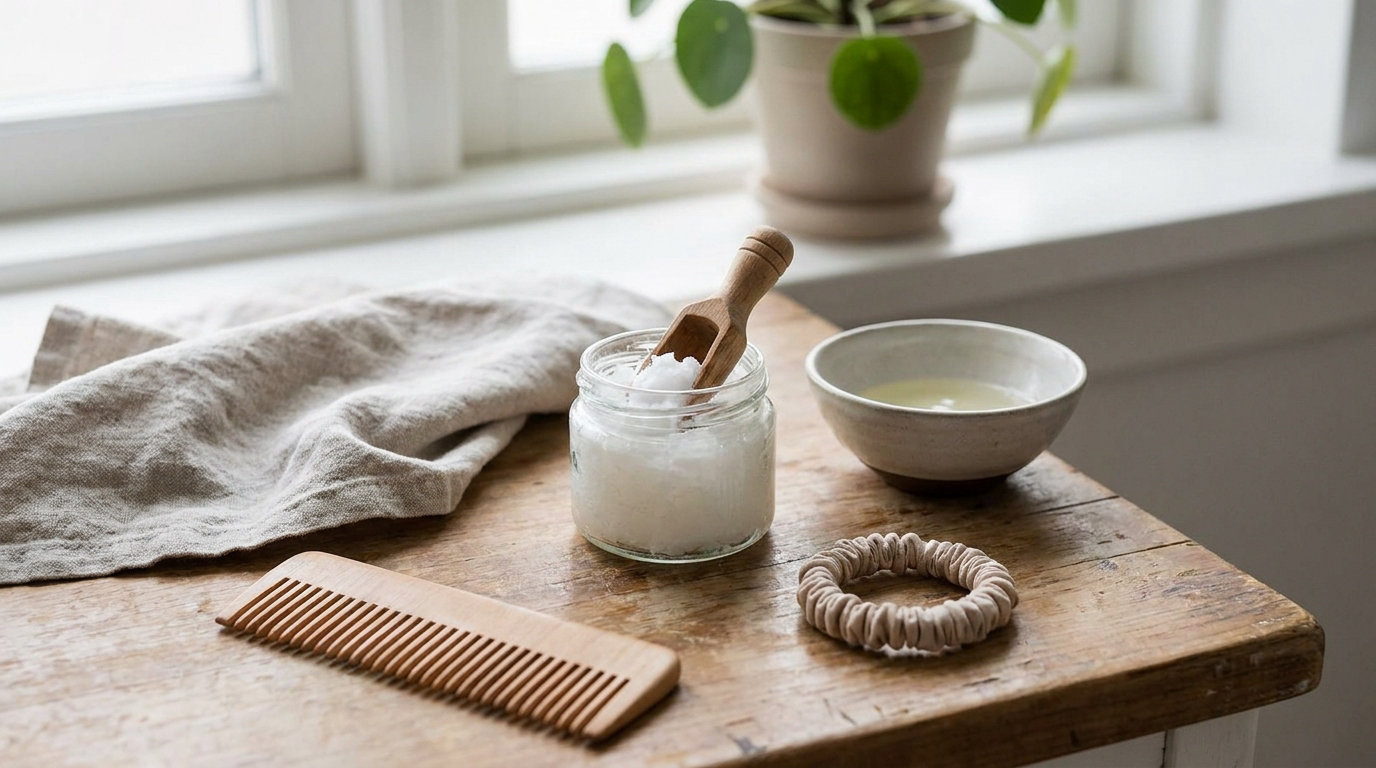
An overnight coconut oil mask takes about ten minutes of work and one ingredient. Warm the oil until it runs, work it through your hair with the mid-lengths and ends getting most of it, gather everything into a loose bun or braid, cover with a shower cap, sleep six to eight hours, then shampoo twice in the morning. That is the whole method, and it costs almost nothing to try once.
It suits dry, brittle, curly, coily, high-porosity or color-treated hair best, and it is a reasonable experiment for anyone whose ends feel strawy by week one. Fine or oily hair can use it too, just less of it and further from the roots. What you should not expect is a miracle: this is a conditioning treatment that softens, smooths and reduces friction, not a repair treatment or a growth product.
I keep a small jar of coconut oil on the shelf year round and update this method each 2026 as formulas and packaging change. Nothing here is a substitute for a dermatologist if you have a scalp condition, and everything below is cosmetic guidance, not medical advice.
Key takeaways
- Patch test first, then warm the oil in a water bath until it is pourable.
- Start small: 1 to 2 tablespoons for most heads, less for fine hair, more for thick or high-porosity hair.
- Saturate mid-lengths and ends first. Roots get a smaller amount, or none at all.
- Hold the oil in with a shower cap, a satin scarf or a cotton bonnet, and keep the style loose.
- Wash out with lukewarm water and two shampoos, not one.
Table of Contents
What You Need
The list is short because coconut oil does the work on its own. You are not building a five-ingredient routine, and adding things to the bowl is optional rather than required.
- Coconut oil. Virgin or unrefined has the strongest natural scent and a deeper color; refined is neutral-smelling and easier to spread. Either works on hair. Fractionated coconut oil stays liquid at room temperature, which is convenient, but it is more expensive and does not lubricate quite as well.
- A small bowl and a shallow dish of warm water for melting the oil. A microwave works too, but a water bath heats it slowly and evenly and keeps the temperature under your control.
- A wide-tooth comb to distribute the oil through saturated sections.
- A soft brush to sweep loose strands out of the way before you start.
- A satin or cotton covering such as a shower cap, a satin scarf, or a cotton bonnet.
- An old towel to protect your shirt collar, pillowcase and hands.
Optional extras: a small amount of a leave-in moisturizer for very porous hair that drinks the oil up in minutes, a gentle shampoo for the morning washout, and a second light oil such as almond to keep the coconut oil spreadable. If you only have the jar of coconut oil, the mask still does its job.
Step-by-Step: How to Use Coconut Oil for a Hair Mask Overnight
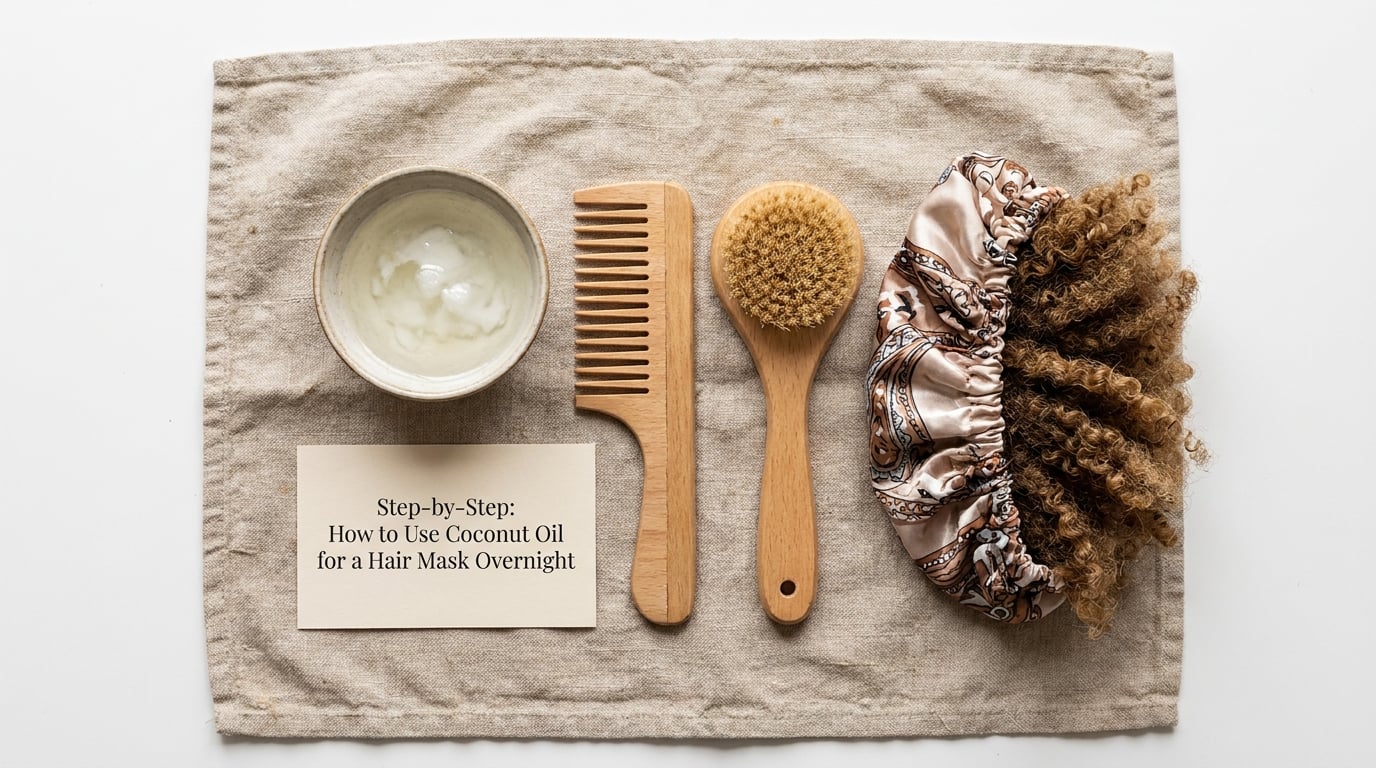
Work through these in order and the mask goes on evenly. The order matters more than precision, because the most common failure is simply too much oil concentrated at the roots.
How to Patch Test Coconut Oil
Test on the skin behind your ear or on the inside of your forearm before you put it anywhere near your head. Dab a small amount, leave it, and watch it for 24 to 48 hours, which covers most delayed reactions.
Stop if you see redness, itching, burning, swelling or a breakout at the test site. Wash the oil off with a mild cleanser and do not apply it to your hair. Persistent irritation, hives or facial swelling need a doctor rather than a second attempt at home. For context, people posting in skincare communities describe coconut oil as harsh on their skin, and that reaction is uncommon but real enough to test for.
How Much Coconut Oil to Use
The goal is a light, even coating, not dripping oil. Squeeze a section after you apply and a faint sheen on your fingers means enough; a visible bead means too much. Start at the low end of these numbers, because you can add more but you cannot easily remove a heavy application in the morning.
| Hair length and type | Starting amount for the whole head | Where it goes |
|---|---|---|
| Short, fine or straight | 1 teaspoon to 1 tablespoon | Ends only, maybe the last 3 inches |
| Shoulder length, medium density | 1 to 2 tablespoons | Mid-lengths and ends |
| Long or very thick | 2 to 4 tablespoons | Mid-lengths and ends, then a little to the roots |
| Curly, coily or high porosity | 2 to 4 tablespoons, plus a splash of water | Every section, fully saturated |
| Color-treated or bleached | 1 to 2 tablespoons | Mid-lengths and ends |
Coconut oil is solid at room temperature, and that is the reason so many people either over-measure or give up. Melt it in the water bath first, and let it cool until it is warm rather than hot.
Apply the Hair Mask from the Ends to the Roots
Start at the ends and work upward. Ends are the oldest part of the strand, the most exposed to sun, heat and friction, and usually the driest. Smoothing oil from the ends up means the mid-lengths get covered on the way and the roots receive whatever is left over, which is roughly the right ratio.
Hair can be damp or dry. Damp hair is easier to saturate and spreads the oil more evenly, which is why most methods start there. Dry hair works fine too, especially if you have low-porosity hair that repels water, and applying to dry hair means less water for the oil to move into. Either way, the result is the same as long as every section is coated.
For thick hair, divide it into four to six sections with the tail of the comb and work one at a time. Rub a small amount between your palms, spread it from mid-length to ends with your fingers, then run the wide-tooth comb through from ends upward to spread it. Do not comb from the roots down on saturated hair, because oil plus tangles equals breakage, which is the exact problem you are trying to fix. Long-hair regulars on r/longhair pair the treatment with a loose braid at the ends overnight, partly for the same reason.
Protect Your Hair and Pillow Overnight
Secure the hair without tension. A loose bun, a topknot or a braid keeps the oil where you put it and stops you waking up with a crease through your hair. Skip anything tight, because tension held for eight hours shows up as a headache and, over time, as traction.
Then contain the oil. A shower cap or satin scarf is the reliable option, and a cotton bonnet works well if your hair is fine enough to slip under it. If you have nothing like that, an old pillowcase and an old towel over your shoulders will save your bedding. People who use oil overnight worry about transfer to the pillow and onto the face, and a covering plus a tucked style solves most of that.
Fine hair gets one adjustment: use less, apply it to the ends only, and cap the total time under eight hours. A full scalp of oil under a cap all night is the most reliable route to limp, greasy roots by morning.
Wash the Coconut Oil Out in the Morning
Let it work overnight, then wash it out properly. Rinsing with lukewarm water first, before any shampoo, loosens the oil so you are not scrubbing it through your strands.
Shampoo twice. The first wash breaks the oil down, and the second actually cleanses the scalp and mid-lengths. Skipping the second wash is the most common reason people end up with greasy hair after an otherwise fine mask, and it is the single fix worth doing. If residue remains, a diluted apple cider vinegar rinse, roughly 2 tablespoons to a cup of water, helps emulsify what is left; rinse that with plain lukewarm water afterwards.
Finish with conditioner on the mid-lengths if your hair likes it, and stick to lukewarm rather than hot water, since hot water strips oil and moisture you have just added. Follow the directions on your own products, and expect your hair to feel soft and slightly heavier until the second wash.
Common Mistakes
- Too much oil. The classic greasy-morning problem. Start with a tablespoon, check a section, add only if it feels dry.
- Skipping the patch test. Twenty-four hours of testing beats a week of itchy scalp.
- Applying to irritated or broken skin. Keep oil off sunburn, eczema flares, razor nicks and active breakouts along the hairline.
- Coating the roots. Heavy root application flattens fine hair and can make an oily scalp oilier.
- Concentrating on the ends only while porous areas stay dry. High-porosity hair drinks oil at the mid-lengths, so saturate there too.
- Pulling the hair tight before bed. A loose style protects both your hair and your head.
- One wash in the morning. Plan on two, and rinse with lukewarm water first.
Readers on r/HaircareScience and r/CurlyHairCare also mention mixing coconut oil with a lighter oil to keep it spreadable, and plenty of people there admit a good store-bought deep conditioner outperforms a DIY mask on their hair. Both are reasonable positions. A mask you enjoy doing is easier to repeat than a perfect one you skip.
How to Choose and Customize the Treatment
Match the oil to your tolerance for scent and texture rather than to a claim on the label.
| Type | What it is like | Best for |
|---|---|---|
| Virgin or unrefined | Solid at room temperature, strong aroma, deeper color | People who like the smell and will melt it first |
| Refined | Neutral scent, lighter color, still solid when cool | Most people who want no fragrance at all |
| Fractionated | Liquid at room temperature, thinner | Convenience and travel, on fine hair |
You can add a small amount of a plain leave-in moisturizer for very porous hair, or a teaspoon of honey for extra humectant pull, without turning this into a multi-product routine. Anything you add means shorter sit times, so skip the extras if you want the oil alone to do the work overnight.
Be clear about what coconut oil can and cannot do. It is a cosmetic conditioner that coats the hair shaft, reduces friction and helps moisture stay in. It is not a treatment for hair loss, it does not extend the growth phase of a follicle, and no overnight mask repairs split ends permanently.
Tips for Softer, More Manageable Hair
Use lukewarm water for every rinse, shampoo twice, and give the mid-lengths conditioner. Skip heat styling right after the washout, since the hair is soft then and any tension or high heat pulls on it while it settles.
For fine hair, keep the amount low and stay away from the roots. For curly and coily hair, apply to soaking-wet hair so the oil spreads along each curl, and expect the definition to relax a little once it is rinsed. For high-porosity hair that drinks oil in minutes, mix in a little water and work in sections.
The expected result is soft, smoother-feeling hair with less frizz, less tangling in the morning and a bit more shine. Individual responses vary, and one night is a treatment, not a transformation. If your hair feels worse rather than better, stop and go back to a smaller amount or a shorter sit time.
Frequently Asked Questions
Is it safe to leave coconut oil in my hair overnight?
For most people, yes, as long as you patch tested first and kept the oil off irritated skin. Coconut oil is a common cosmetic ingredient and food oil, so overnight contact is generally well tolerated. Skip it if you have a known coconut allergy, an active scalp condition, or acne-prone skin along your hairline, and stop as soon as you notice itching, burning or redness.
How often should I use coconut oil as a hair mask?
Once a week is the most common cadence and a sensible starting point. Twice a week suits coarse or high-porosity hair that drinks oil quickly, while fine or oily hair often does better every other week. Watch how your scalp responds across a few cycles, and pull back if your roots start looking heavier or shinier than they should.
Can I use coconut oil on fine or oily hair?
Yes, with less oil and a narrower target. Apply it only to the mid-lengths and ends, use about a teaspoon to a tablespoon for the whole head, and skip the roots. Many people with oily scalps find that root application makes oiliness worse, and the usual greasy-by-morning result comes from too much oil too close to the scalp. When in doubt, use half of what you think you need.
Will coconut oil help my hair grow faster?
There is no good evidence that it does. Coconut oil is a conditioning treatment, so it can reduce the breakage and friction that make hair seem to grow slowly, which some people notice as length that holds up better between trims. It does not extend the growth phase of the follicle, and it is not a treatment for hair loss. If you notice shedding or thinning, speak with a dermatologist.
Should I wash my hair immediately after the overnight mask?
Wait until morning, then plan on two washes. Overnight masking works by letting the oil sit for hours, so rinsing after twenty minutes gives away most of the benefit. In the morning, rinse thoroughly with lukewarm water, shampoo once to break the oil down, shampoo a second time to cleanse the scalp and mid-lengths, and follow with conditioner if your hair likes it.
Conclusion
Start with the smallest version of this: patch test, melt a tablespoon, work it from the ends up, cover your hair, sleep, and shampoo twice in the morning. Add more oil only once you know how much your hair can hold, and keep it off the roots if your hair is fine or your scalp runs oily.
Treat it as an optional experiment rather than a fix. If your skin reacts, stop using it and talk to a dermatologist if the irritation persists. If it does not bother you and your hair feels softer, a 2026 routine of one mask a week is an easy habit to keep.