
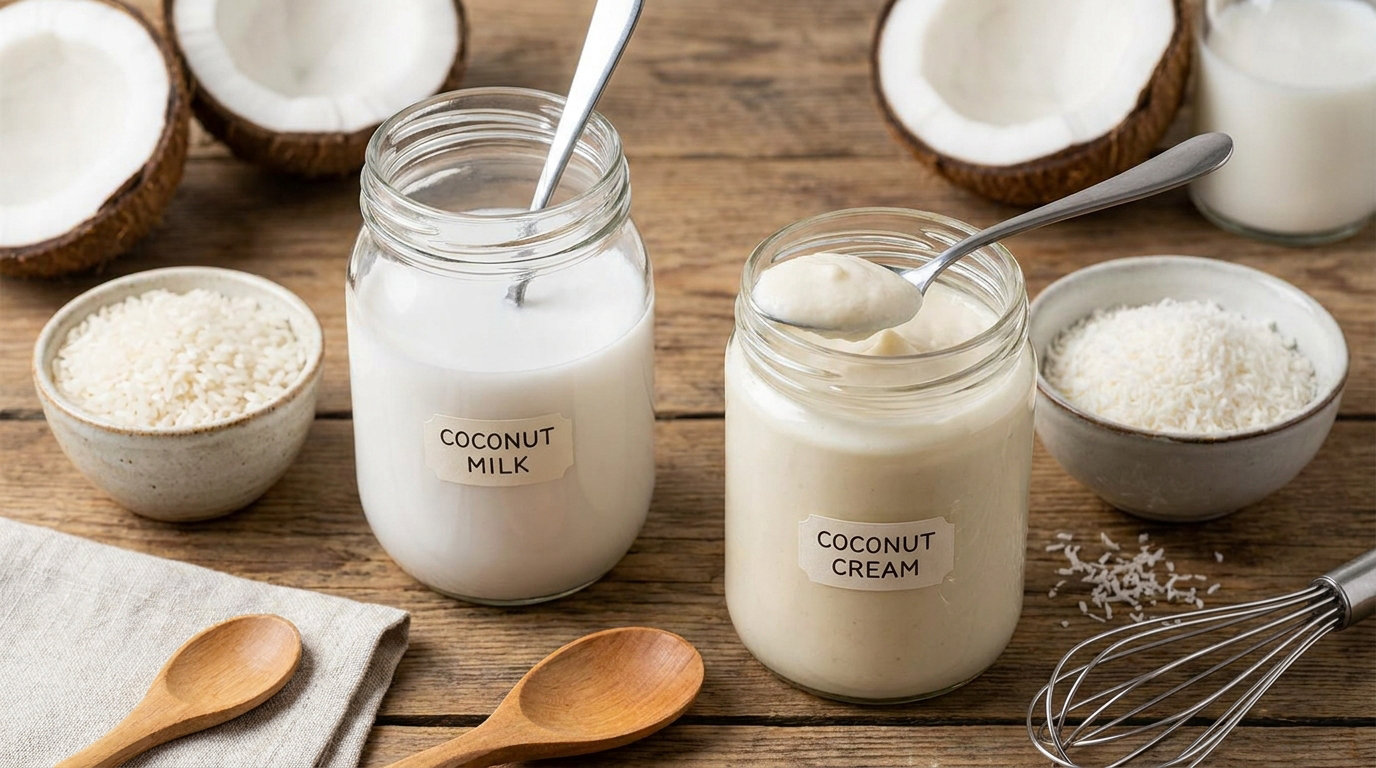
Short answer: coconut milk is the thin, pourable liquid that blends into soups and curries, and coconut cream is the thick, rich layer that adds body, thickens sauces, and whips into a dairy-free topping. Both come from the same coconut meat, so the only real difference is the coconut-to-water ratio. Pick the milk for anything that should stay fluid, and the cream for anything that should taste lush.
The confusion is completely fair, because the cans sit next to each other in the same aisle and the names get used interchangeably in recipes. In coconut milk vs coconut cream in recipes, the choice actually changes the finished dish rather than just the label, so getting it right saves a second pot of dinner. This guide was updated for 2026 and covers the practical differences, the swaps, and the recovery tricks when a swap goes wrong.
Table of Contents
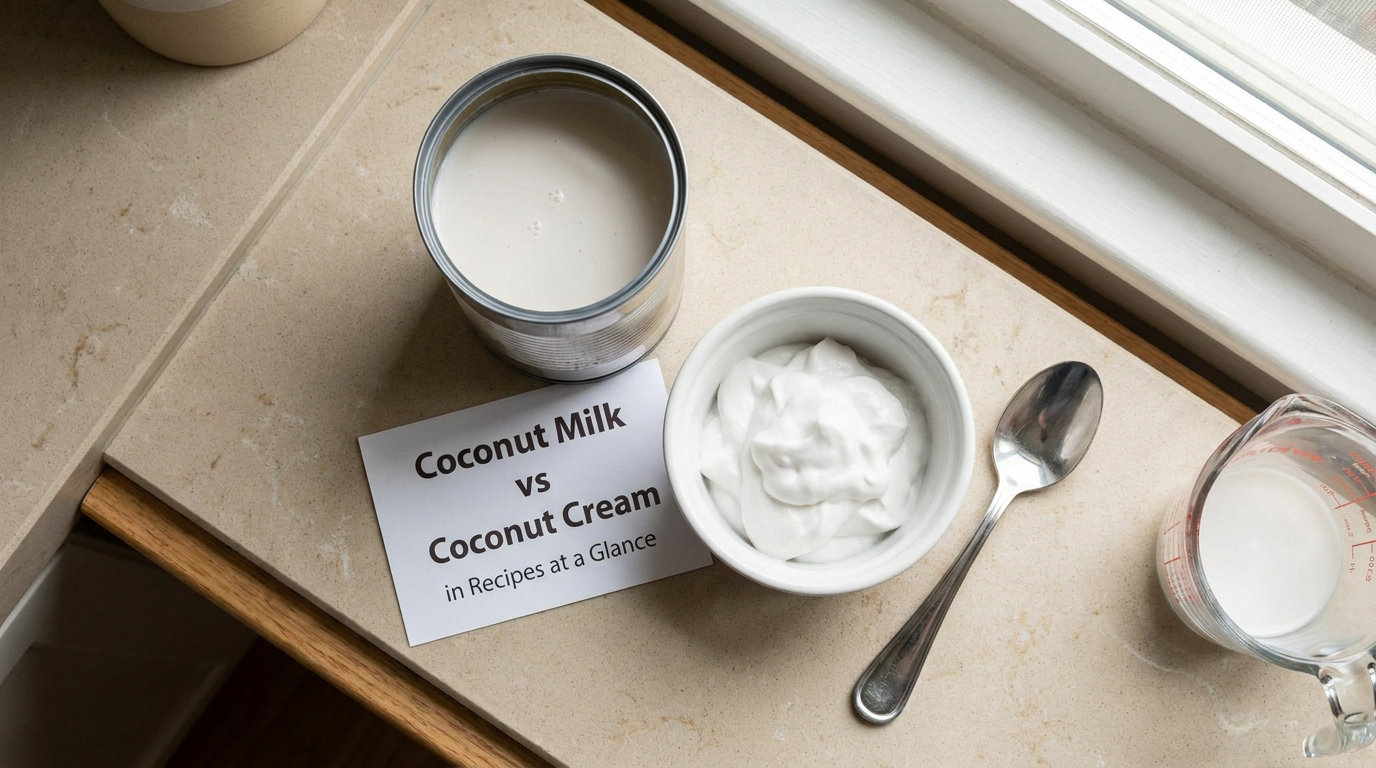
- Coconut Milk vs Coconut Cream in Recipes at a Glance
- What Is the Difference Between Coconut Milk and Coconut Cream?
- Coconut Milk vs Coconut Cream in Recipes: Texture and Flavor
- Nutrition and Ingredient Differences
- Which One Works Best in Soups, Curries, and Sauces?
- Which One Works Best in Desserts and Drinks?
- How to Substitute One for the Other
- Which Should You Choose?
- Frequently Asked Questions
- Is it better to cook with coconut milk or coconut cream?
- Can I substitute coconut cream for coconut milk in a recipe?
- Can I use coconut milk instead of cream in pasta?
- Does Thai curry use coconut milk or coconut cream?
- How much coconut cream should I use instead of coconut milk?
- How long does coconut milk last after opening?
- Conclusion
Coconut Milk vs Coconut Cream in Recipes at a Glance
| Criterion | Coconut milk | Coconut cream |
|---|---|---|
| What it is | Grated coconut meat blended with plenty of water | Coconut meat blended with far less water, roughly four parts coconut to one part water |
| Consistency | Pourable, close to whole milk | Spoonable, thick enough to hold a spoon upright |
| Typical fat | About 9 to 15 percent (lite versions around 2 to 5 percent) | About 19 to 24 percent |
| Coconut flavour | Mild, background note | Forward and noticeably sweet |
| Thickening power | Minimal on its own, improves when reduced | Strong, doubles as a mild roux |
| Whipping | Will not hold stable peaks | Whips well when straight from a chilled can |
| Best in | Soups, broths, light curries, sauces, marinades, smoothies, coffee | Thick curries, desserts, mousse, pudding, frosting, whipped topping |
| Storage after opening | Fridge about 5 days, freezer up to a month | Same, and it thickens further when chilled |
Read that bottom row and the rest of the guide makes sense on its own. Both products keep the same window in the fridge, and both freeze well in portion-sized containers, so buying a can of each is a low-risk move.
What Is the Difference Between Coconut Milk and Coconut Cream?
Coconut milk is coconut flesh grated fine, blended with a generous amount of water, then strained. That water is what makes it behave like a dairy milk you can pour into a pan. Full-fat versions land somewhere between 9 and 15 percent fat, and lite versions on the same shelf can be as low as 2 to 5 percent.
Coconut cream uses the same flesh with roughly a quarter as much water, which is why it lands between 19 and 24 percent fat and falls off the spoon rather than running. Think of the relationship the way you would think of butter and heavy cream, except both come from the same nut. Some cooks describe milk as the thinner layer that pours away and cream as the layer that rises, and that is what happens naturally when you chill an unopened can overnight and open it gently.
Three other things get mixed up with these two, and they are not interchangeable in a recipe. Coconut water is the clear liquid inside the fresh coconut, with none of the fat and none of the body. Creamed coconut, also called coconut butter, is a solid spread made from dried coconut meat, closer to almond butter than to any liquid. Cream of coconut is a sweetened, syrupy product built for piña coladas and cocktails, not for cooking. If the can says sweetened, it is going into a drink.
Coconut Milk vs Coconut Cream in Recipes: Texture and Flavor
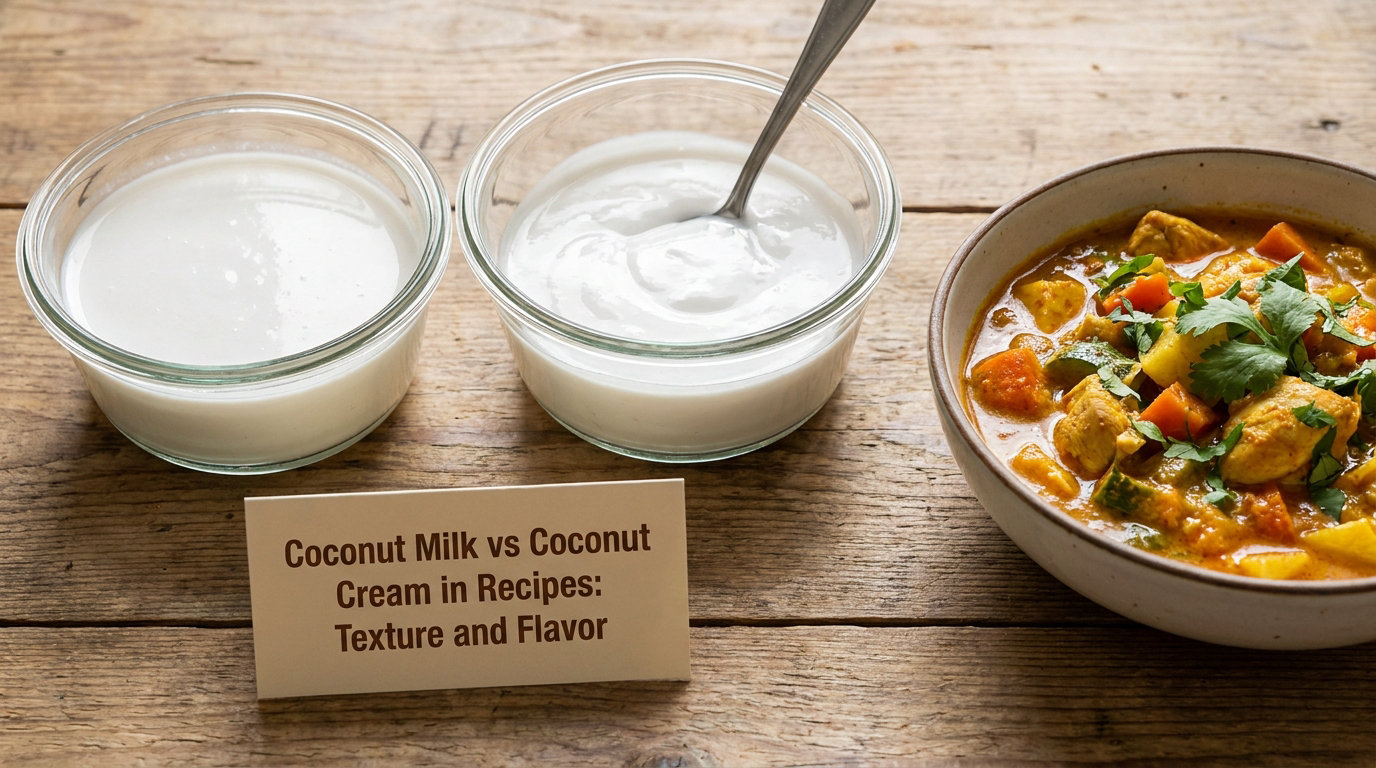
Texture is where the two products separate most clearly. Coconut milk flows across the back of a spoon and settles into a dish without body. Coconut cream coats the spoon, leaves a trail, and holds a soft peak for a second before slumping. That difference is why a cream-based curry sauce clings to chicken and a milk-based one pools underneath it.
Flavour runs the same direction. Coconut milk tastes like a supporting note, which is what you want in a soup with five other vegetables. Coconut cream tastes like coconut, and it is not shy about it. In a dessert that is called for, in a lemon chicken or a butternut soup that is not called for, it can read as a flavour you added rather than a cream you built.
What each one does under heat is worth knowing. Coconut milk is meant to be brought up to a simmer and held there, not boiled hard, because a hard boil can make it break and separate slightly. Coconut cream tolerates a boil far better and only thickens as you reduce it, which makes it the more forgiving option for a pan sauce. Chilled, coconut cream goes from spoonable to almost solid, while coconut milk barely changes at all.
Whipping is the one place the answer is absolute. Straight from a chilled can, coconut cream whips to a soft, stable peak in a couple of minutes. Coconut milk does not hold peaks no matter how long you beat it, and chilled coconut milk whipped hard will eventually give you a loose, watery bowl rather than anything you can spoon onto a pie.
Nutrition and Ingredient Differences
The table below gives typical per-cup values for the three products you will find most often. Read them as ranges, because the fat percentage printed on the can is the only number that really counts and brands vary widely.
| Per 1 cup | Full-fat coconut milk | Lite coconut milk | Coconut cream |
|---|---|---|---|
| Calories | Roughly 450 to 500 | Roughly 200 to 260 | Roughly 700 to 800 |
| Total fat | About 45 to 50 g | About 20 to 26 g | About 75 to 85 g |
| Saturated fat | About 40 to 45 g | About 18 to 24 g | About 65 to 75 g |
| Protein | About 2 g | About 1 to 2 g | About 2 to 3 g |
| Fibre | About 2 g | About 1 g | About 2 g |
Here is the part that trips people up at the shelf: a brand’s coconut cream can list less fat than its coconut milk. That happens because some companies make their cream from coconut milk that has already been thinned or blended with extra water, so the word on the front of the can tells you the consistency and not the nutrition. The fix is to look at the nutrition panel and compare grams of fat per serving, not per cup, and not the serving size printed on a carton that you would never actually pour.
One more label habit pays off. Lite and reduced-fat coconut milk usually lean on guar gum, carageenan, or another thickener to fake the body that was taken out. Those gums are fine in a smoothie and genuinely troublesome in custards, sauces, and baked goods, where they can turn a pudding grainy and a cake dense. For anything you are cooking rather than drinking, pick full-fat and read the ingredient list.
Which One Works Best in Soups, Curries, and Sauces?
Coconut milk is the right default for soups and broths. It flows into the pot, seasons without shouting, and lets the other ingredients stay in charge. Thai green curry, red curry, soups, chowders, and butternut or carrot soups are all coconut milk dishes, and swapping cream for milk in a seafood curry is a standard move when you want a lighter result.
Coconut cream earns its place when a dish needs to cling or needs to taste rich. Massaman curry and khao soi are the classic cases, where a nuttier, thicker sauce is the point. It is also the better answer for a soup that has come out thin, because it thickens as well as flavours. In a butternut squash soup, a few spoonfuls of cream at the end give it a better texture and act as a mild thickener without cooking the whole pot down.
Pasta is the case with the least guidance out there, so here it is plainly. Yes, you can use coconut milk in place of cream in a pasta sauce, and it is one of the easiest dairy-free swaps because the starch in the pasta water does the thickening for you. Use coconut milk for a light, glossy sauce, and add a spoonful of coconut cream at the end if you want it to coat the pasta rather than slide off.
For marinades and braises, thin coconut milk is what you want, because it soaks into the protein during a long cook. Cream in a marinade tends to scorch on a grill. When the coconut note gets too loud in a savoury dish, a squeeze of lime, a splash of vinegar, or an extra spoonful of stock brings it back into balance.
Which One Works Best in Desserts and Drinks?
Desserts are coconut cream territory without much argument. A chocolate mousse, a crème brûlée-style custard, a pudding, or a pie filling all want the body and the fat that holds the structure together. Ice cream bases made with coconut cream freeze with a noticeably smoother texture because less water goes in, and they stay scoopable straight from the freezer rather than turning icy.
The flip side is the flavour problem in reverse. Coconut cream is strong, so putting it into a dessert that is not supposed to taste like coconut changes the dessert. If you are chasing a rich texture in something like lemon bars or a vanilla panna cotta, thin the cream with a little water or use full-fat coconut milk, or the coconut will be the loudest thing on the plate.
Whipped toppings, coffee, and drinks go the other way. Use coconut milk for a piña colada or a smoothie where you want volume and a light body, and coconut cream for a coffee where you want a foam that stays. A spoonful of cream in the bottom of the glass, shaken hard with ice, turns flat carton coconut milk into something close to a cafe drink.
Coconut milk vs coconut cream in baking
In cakes and muffins, both add moisture, and full-fat coconut milk is the more useful of the two. It keeps a cake moist for days, and its sugars give the crumb a light brown colour. Coconut cream is far too thick to pour into a batter without thinning it first, so if a baking recipe calls for it, whisk it with a little warm water until it moves like the milk the recipe expects.
Cookies and cakes also brown differently with coconut. The sugars in coconut milk caramelise at a lower temperature than wheat flour on its own, so watch the colour in the last few minutes rather than trusting the timer. A cake that looks pale in the first thirty minutes can go from golden to dark fast.
How to Substitute One for the Other
Yes, you can substitute coconut cream for coconut milk, and yes, it is okay to go the other way. The direction decides what you do with the jar. Thickening is easy; thinning is not.
Going from milk to cream, start at one part cream to one part water and stir, then taste. You can often go further than that in a soup or a breakfast bowl. For a rich curry or a dessert, one part cream to one part water is closer to right, and two parts cream to one part water gives you close to straight cream.
Going from cream to milk, whisk four tablespoons of coconut cream with three quarters of a cup of warm water and you have about one cup of coconut milk. Warm water blends in faster than cold, and a quick whisk in a small bowl beats trying to shake it inside the can.
Making cream from a can of milk takes a little planning rather than a recipe. Refrigerate the unopened can for 8 to 12 hours, open it carefully, and spoon the thick white layer from the top into a bowl. Do not shake the can, and do not pour the thin liquid back over what you have scooped. One can usually gives you roughly a third of a cup of cream, which is enough for a dessert or a small pan sauce.
If you forgot to chill it, reduce it instead. Simmer coconut milk uncovered over low heat for 15 to 20 minutes, stirring now and then, and it will thicken toward a light cream as the water cooks off. Keep the heat low and do not let it boil hard, or the emulsion can break and the sauce will look curdled.
When a swap goes wrong, there is a fix. A thin curry gets body from a slurry of cornstarch and cold water stirred in at the end, or from a light roux, or from a second pour of cream. A split sauce usually just needs an immersion blender to bring the emulsion back together off the heat. A grainy mousse or pudding means a thickener crept in, so strain it or add an extra egg yolk off the heat. And a whipped topping that will not stiffen was almost certainly made with coconut milk rather than cream.
Which Should You Choose?
For everyday cooking, keep one can of full-fat coconut milk in the pantry and buy coconut cream when a recipe calls for it by name. It is the cheaper and more flexible of the two, and the ratio maths to turn it into cream is trivial.
For meal prep, coconut milk is the better base for soups and curry bases because it freezes and reheats without going grainy, and you can always add cream at the end to bring the richness back. For desserts, puddings, whipped toppings, and anything you want to look like it came from a bakery, go straight to coconut cream.
For drinks and lighter cooking, coconut milk wins on body-per-calorie and mixes smoothly into smoothies, coffee, and cereal. For maximum richness, a dessert, or a sauce that needs to cling, coconut cream is the answer, and the extra saturated fat is the trade you are making. If you are watching saturated fat, the reduced-fat label is worth reading closely, because the difference in grams is usually bigger than the front of the can suggests.
Whichever you choose, check the fat percentage and the ingredient list rather than the product name. Full-fat, no gums, and a two-ingredient list will never let you down.
Frequently Asked Questions
Is it better to cook with coconut milk or coconut cream?
It depends on the dish. Use coconut milk for soups, broths, light curries, marinades, smoothies, and coffee, where you want flavour to stay in the background. Use coconut cream for thick curries, pan sauces, desserts, puddings, and whipped toppings, where body and richness are the goal. Full-fat coconut milk is the safer everyday default because you can add cream later but cannot add body back.
Can I substitute coconut cream for coconut milk in a recipe?
Yes. Start at one part coconut cream to one part water, whisk until smooth, and then taste. For a soup or breakfast bowl you can go thinner than that; for a curry or dessert stay close to 1:1. Do not use coconut milk in a recipe that needs cream to stay spoonable without reducing it first, because extra water is the one thing you cannot take back out of a finished dish.
Can I use coconut milk instead of cream in pasta?
You can, and the pasta water usually does the thickening for you. Simmer coconut milk with garlic, chili, and seasoning, toss in the drained pasta with a splash of its starchy water, and let it reduce for a minute. Add a spoonful of coconut cream at the end if you want the sauce to coat the noodles instead of pooling underneath them.
Does Thai curry use coconut milk or coconut cream?
Most Thai curries, including red and green, are built on coconut milk because the sauce needs to stay pourable around the meat and vegetables. Massaman and khao soi lean richer, and coconut cream is a good choice there. A helpful rule: use milk for the base of the pot, then stir in a few spoonfuls of cream at the end for body without cooking a heavier sauce.
How much coconut cream should I use instead of coconut milk?
Start with one part coconut cream to one part water. That gives you a richer sauce than straight milk without turning it into a paste. For a dessert or a thick curry, go further, around two parts cream to one part water. Taste as you go, because brands differ in fat content and the same ratio will not feel identical in every can.
How long does coconut milk last after opening?
Refrigerate the can or container promptly and use it within about five days, up to a week if you pour it into a sealed container rather than leaving it in the open can. Freeze it in portion sizes for up to a month, and let it sit at room temperature for a few minutes before using. If it smells off, looks darkened, or the texture has gone very thick and gluey, discard it.
Conclusion
Start with coconut milk whenever the dish should stay light and fluid, such as soups, broths, most everyday curries, marinades, and drinks. Move to coconut cream when the recipe is asking for thickness, richness, or a whipped or set texture, which covers desserts, puddings, frostings, and thick curries like Massaman.
When you need to convert, the numbers are simple: one part cream to one part water to imitate milk, four tablespoons of cream whisked with three quarters of a cup of warm water to make a cup of milk, or a can chilled overnight with the top layer scooped off. Keep the heat low, and check the fat percentage on the label rather than trusting the word on the front.